Indonesia Maintains Third Place in Global Halal Economy Rankings
Source: Detik News
JAKARTA — Indonesia has sustained its position as the world’s third-largest halal economy while achieving remarkable progress in key sectors, according to the latest State of the Global Islamic Economy Indicator (SGIE) Report 2024 released by DinarStandard.
Steady Performance with Sectoral Breakthroughs
The archipelago nation demonstrated consistent performance in the global halal economy landscape, with particularly notable achievements in modest fashion, tourism, and pharmaceutical sectors. The SGIE report highlights Indonesia’s strategic positioning as a major player in the international Islamic economy ecosystem.
Ahmad Haikal Hasan, Head of Indonesia’s Halal Product Assurance Agency (BPJPH), emphasized that maintaining third place represents both an achievement and a foundation for future growth. He stressed the importance of this ranking as motivation for all stakeholders to enhance their efforts toward achieving first place in future assessments.
“This SGIE report should capture our attention and serve as motivation for us together with all stakeholders to ignite enthusiasm and performance so that we can achieve first place in the coming year,” Hasan stated in a written release.
He further outlined Indonesia’s ambitious vision: “As a starting point to leap higher and play a leading role in shaping the future of an inclusive, innovative, and civilized global halal economy. Therefore, strengthening all halal industry sectors must continue to be reinforced through collaboration among all parties, with one vision: making Indonesia the world’s halal center.”
Fashion Leadership and Tourism Excellence
Indonesia achieved its most significant advancement by securing the top global position in the modest fashion sector, demonstrating the country’s growing influence in Islamic fashion markets. This achievement reflects years of strategic development and international promotion of Indonesian Muslim fashion products.
The nation also claimed second place in Muslim-friendly tourism, marking a dramatic improvement from 2023 when Indonesia was not included in the global top 10. This remarkable progress showcases the effectiveness of government initiatives to develop halal-certified tourism infrastructure and services.
In the pharmaceutical and cosmetics sector, Indonesia advanced significantly to second place from fifth position in 2023, trailing only Malaysia in the top ranking. The Islamic finance sector also showed improvement, rising from seventh to sixth place year-over-year.
Strategic Government Initiatives
Muhammad Aqil Irham, Secretary General of BPJPH, attributed these achievements to serious government efforts in promoting the national halal industry ecosystem. He highlighted the comprehensive approach taken by Indonesian authorities to strengthen various sectors of the halal economy.
“We are grateful for the progress in several leading sectors of the halal industry in the SGIE Report 2024 release. This represents the government’s performance achievement that continues to strive to strengthen the national halal ecosystem through various strategic efforts,” Irham explained.
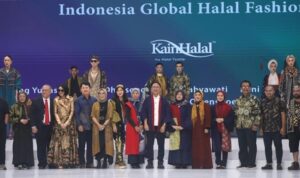
The success in modest fashion particularly reflects the impact of the Indonesia Global Halal Fashion (IGHF) initiative, which expanded Indonesia’s fashion presence to five countries. The program began with Indonesia Fashion Week in March 2024, followed by events in Malaysia in August 2024, and concluded with showcases in London, Milan, and Paris in September 2024.
Indonesia Global Halal Fashion Initiative
The IGHF program represents a collaborative effort between government agencies, textile industry players, designers, and halal fabric producers throughout Indonesia. Launched during Indonesia Fashion Week at JCC Jakarta on March 28, 2024, the initiative aims to promote Indonesian Muslim fashion products while establishing the country as a global Islamic fashion hub.
The program showcases distinctive Indonesian textile characteristics infused with cultural values, including traditional weaving, songket, batik, and other heritage fabrics. This approach demonstrates how traditional Indonesian craftsmanship can be integrated with modern halal fashion requirements.
“IGHF is expected to become a strategic platform to promote and strengthen the fashion industry in making Indonesia the qibla of world Muslim fashion,” Irham stated. “So IGHF is more than just promoting Indonesian halal fashion products to the world market, but also proves that our halal products are capable of competing in terms of quality in the world market.”
Mandatory Halal Certification Preparation
The strengthening of the Muslim fashion industry ecosystem occurs in preparation for mandatory halal certification requirements for consumer goods, including fashion products, which will be implemented starting October 2026. This regulatory framework aims to ensure comprehensive halal compliance across various product categories.
The fashion industry enhancement begins from upstream sectors involving raw material access, production processes, branding, and exhibition and promotion activities. The upstream sector starts with certified halal textile or fabric products, which facilitates Muslim fashion production and is supported by optimal promotional activities.
Tourism and Certification Acceleration
Indonesia’s dramatic improvement in Muslim-friendly tourism rankings results from government efforts to accelerate halal certification for food and beverage products in 3,000 tourist villages through collaboration between BPJPH and the Ministry of Tourism and Creative Economy.
This comprehensive approach ensures that tourism destinations can provide halal-certified dining options and services that meet the requirements of Muslim travelers, enhancing Indonesia’s attractiveness as a destination for Islamic tourism.
Mixed Sectoral Performance
While Indonesia achieved significant progress in several sectors, some areas experienced declining performance. The halal food sector dropped from second place in 2023 to fourth place in the current rankings, indicating increased competition and the need for enhanced strategies in this crucial segment.
Similarly, the media and recreation sector declined from sixth place in 2023 to seventh place, suggesting areas where Indonesia must focus future development efforts to maintain competitiveness in the global halal economy.
Future Outlook and Strategic Direction
The SGIE 2024 results provide a comprehensive assessment of Indonesia’s position in the global halal economy while highlighting areas for continued development. The government’s commitment to achieving first place in future rankings demonstrates the strategic importance placed on halal economy development.
The success in modest fashion and tourism sectors provides a foundation for broader economic development, while challenges in food and media sectors indicate priorities for future policy initiatives and industry collaboration.
Conclusion
Indonesia’s performance in the SGIE 2024 report reflects the nation’s evolving role in the global halal economy. The achievement of top ranking in modest fashion, combined with strong performance in tourism and pharmaceuticals, demonstrates the effectiveness of strategic government initiatives and industry collaboration.
As Indonesia prepares for mandatory halal certification implementation in 2026, the current achievements provide momentum for continued growth and development across all sectors of the halal economy. The nation’s commitment to becoming a global halal center positions it well for future leadership in the international Islamic economy landscape.
Original article:
halaltimes.com. (n.d.).RI Peringkat 3 Ekonomi Halal Dunia, Busana Muslim Jadi yang Populer. Retrieved July 13, 2025, from https://news.detik.com/adv-nhl-detikcom/d-8007249/ri-peringkat-3-ekonomi-halal-dunia-busana-muslim-jadi-yang-populer