Korean Halal Products Face Global Market Gap Despite Open Access
JAKARTA – The scarcity of Korean halal-certified products in global markets continues to frustrate industry leaders, despite Korea’s growing popularity for food and beauty items worldwide.
Mustafa Jin Jae-nam, Managing Director of Korea Halal Authority (KHA), highlighted the stark disparity between market potential and current reality during a recent interview. While approximately 3,000 halal food retailers operate in Korea, including chains like Asia Mart and Halal World Mart, most stock imported goods rather than domestically certified Korean products.
Minimal Korean Presence in Major Muslim Markets
“Major distributors in Islam nations like Mah Sing Group in Malaysia sell tens of thousands of halal items for local Muslim consumers,” Jin explained from KHA’s Cheongju office. “Among them, Korean products account for only a few hundred, mostly food and beauty products.”
KHA maintains mutual recognition agreements or memorandums of understanding with 30 halal-certifying bodies across Southeast Asia, Central Asia, Europe, and the Middle East. This includes partnerships with Indonesia’s Halal Product Assurance Organizing Body, which serves the world’s largest halal market of 245 million Muslims.
Comprehensive Certification Infrastructure in Place
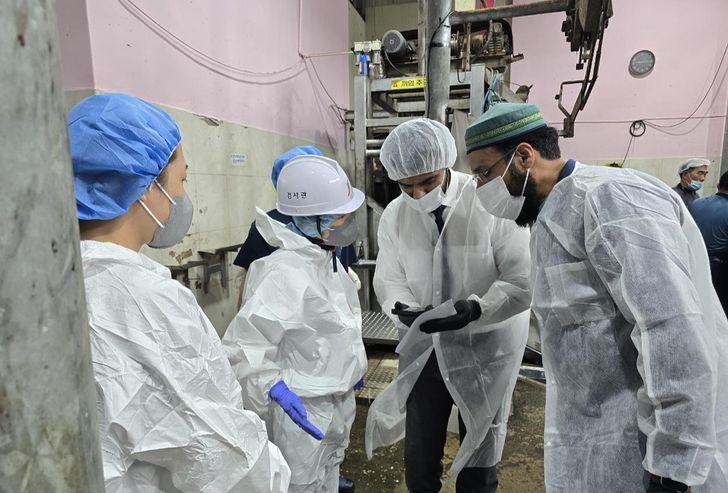
The agency’s office houses extensive documentation for approximately 250 active companies with certified products. KHA’s 18-member team operates through three specialized divisions: halal experts handling product research, on-site inspections, and documentation; a Shariah committee with imams verifying religious compliance; and a fair trade committee monitoring market integrity.
Founded in 2015, KHA stands as one of six halal certifiers in Korea, distinguishing itself as the sole authority providing cross-category certification services.
The organization issues six distinct halal labels covering food, beauty, pharmaceutical, industrial, agricultural, and tourism/restaurant categories. Initial certifications last one year, with two-year renewal cycles thereafter.
Knowledge Gap Hinders Certification Adoption
Jin identified a critical awareness problem among Korean companies regarding domestic certification options. He noted that some private consultants mislead businesses by directing them toward foreign certifiers, profiting from brokerage fees reaching millions of won per transaction.
“Now, with K-food’s global popularity, many companies seem to go for halal but many of them still think the process is redundant and difficult,” Jin observed. “Contrary to Korean foods’ popularity across the Islam nations, their market shares in those countries are pitifully small.”
Strategic Expo Plan for Direct Distribution Access
Jin proposes hosting a halal-focused exposition to bring major Muslim market distributors to Korea, enabling direct introductions to certified Korean products. He views this approach as more effective than conventional government-organized international food exhibitions featuring one-on-one buyer meetings.
“If there are enough halal-labeled Korean products here to show them, we can hit supply deals with those firms,” Jin stated.
Label Priority Over Brand Recognition
He emphasized that for Muslim consumers, halal certification holds paramount importance—surpassing brand recognition or pricing considerations. While many Korean companies claim international sales, their buyers often consist of Korean-focused retailers abroad rather than mainstream distributors.
“The companies need the label to truly expand their global markets, particularly in Southeast Asia and Central Asia where demands are much higher than the Middle East due to closer proximity and more vibrant cultural exchanges,” Jin added.
Government Initiative Meets Industry Skepticism
KHA recently experienced increased inquiries from various government ministries—including industry, agriculture, and food and drug safety—regarding certification procedures.
President Lee Jae Myung recently directed the Ministry of Food and Drug Safety to develop a state-operated halal certification system following his November state visit to Dubai. After recognizing private agencies currently handle certification, he proposed government leadership to enhance system credibility and reliability.
Concerns Over Rushed Government Entry
Jin expressed reservations about the government’s approach, characterizing it as insufficiently prepared. He stressed that successful certification requires years of understanding Muslim markets, deep familiarity with religious principles and halal adherence, and awareness of consequences from faith violations that could trigger market bans.
“I traveled the world studying halal and have designed regulations for KHA. I have even committed myself to the Islam faith in Singapore, and all KHA employees are Muslims,” he explained.
“That was the first mandatory step for starting this certifying business. The government? I don’t think they have prepared any regulations regarding certification or have studied countries to maintain MRA ties with Korean halal labels.”
Original Article:
Korea Times. (2026, January 13). Halal-certified Korean products remain scarce despite wide-open markets. Retrieved from https://www.koreatimes.co.kr/business/companies/20260110/halal-certified-korean-products-remain-scarce-despite-wide-open-markets