The Status of Children in Interfaith Marriages: Perspectives and Legal Consequences Under Islamic Indonesian Law
Introduction
In Indonesian Islamic law, marriage is a sacred covenant (mitsaqan ghalizhan) and serves as the foundation for legal relationships within a family, including those concerning children. Religious unity is viewed as a vital foundation for building a harmonious family aligned with the objectives of religious life.
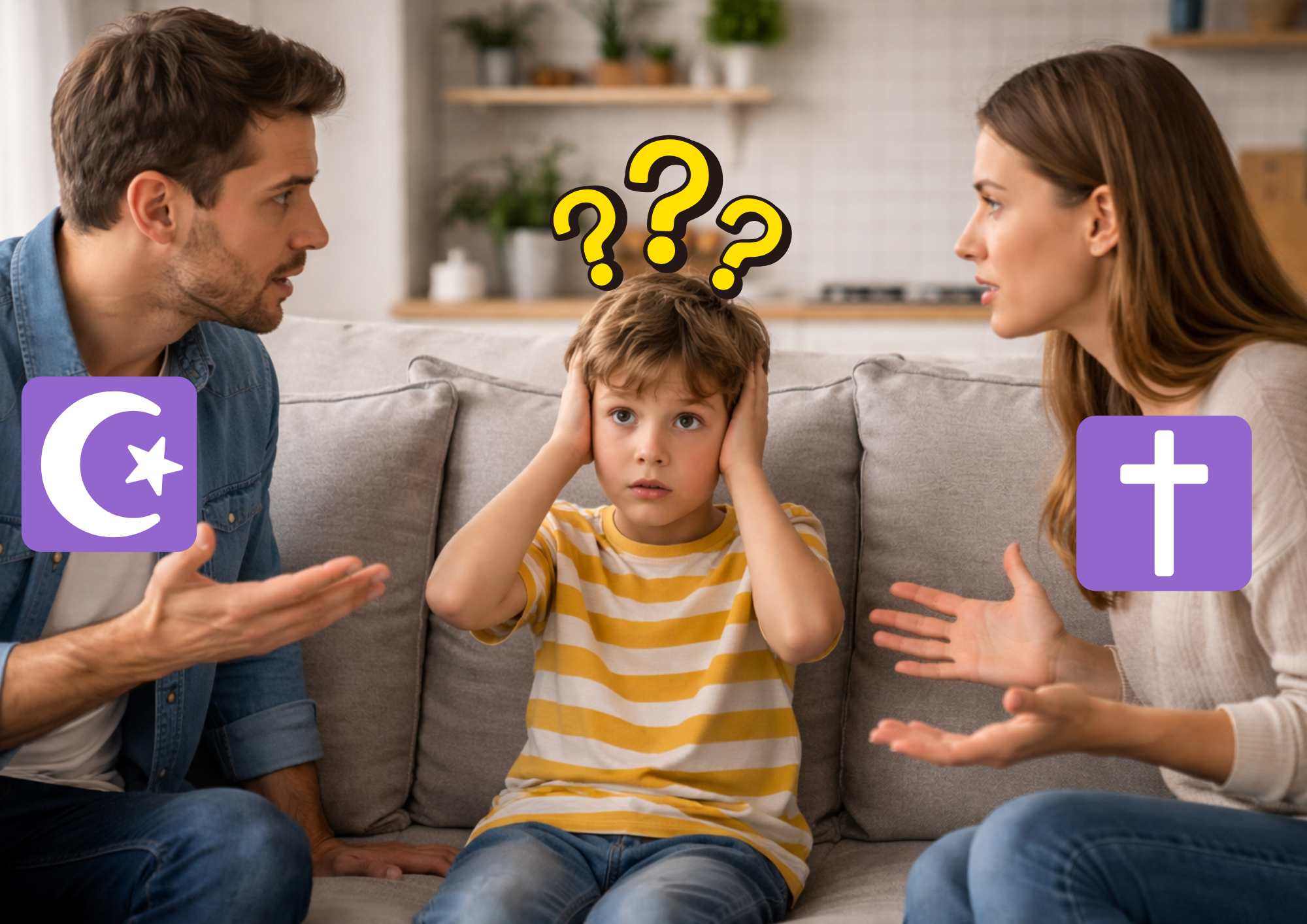
Interfaith marriages whether occurring from the outset or due to conversion after marriage give rise to various legal consequences for children. Islam does not only recognize biological ties but also considers the unity of faith (aqidah) in determining legal rights and obligations.
The Status of Children in Interfaith Marriages
From the perspective of Islamic law, a child born from a valid marriage maintains a lineage (nasab) relationship with both parents. However, when a difference of religion exists between the child and the parents, certain legal rights are restricted.
While the biological connection remains recognized, legal consequences such as inheritance and guardianship are influenced by the factor of religious difference.
Legal Consequences for Children in Interfaith Marriages
1. Consequences for Inheritance Status
A difference in religion is one of the impediments to inheritance (man’i al-irth) in Islamic law. The Prophet Muhammad SAW stated:
“A Muslim does not inherit from a non-believer, and a non-believer does not inherit from a Muslim.”
The majority of scholars (jumhur) agree that cross-religious inheritance is not permitted. This provision is also affirmed in the Compilation of Islamic Law (KHI) Article 171 letter c, which stipulates that an heir must be Muslim.
Legal Implications:
- A child of a different religion than their Muslim parent is not entitled to inherit under Islamic intestate succession laws.
- Inheritance rights are severed due to the difference in faith.
- Blood relations do not automatically generate inheritance rights.
- However, in judicial practice, the concept of Mandatory Testamentary Grant (Wasiat Wajibah) has evolved through court decisions as a form of ijtihad (legal reasoning) to achieve justice.
2. Consequences for Family Relations (Nasab)
Family lineage (Nasab) in Islam is a hereditary relationship with significant legal implications.
Legal Implications:
- Biological relationships remain recognized.
- The child is considered legitimate if the marriage was valid according to Sharia.
- However, specific legal implications (such as the right to inherit assets or the right to act as a guardian/representative in marriage) may be obstructed by religious differences.
3. Consequences for Marriage Guardianship (Wali Nikah)
In Islamic Jurisprudence (Fiqh), a marriage guardian for a Muslim woman must be a Muslim.
Legal Implications:
- A non-Muslim father cannot legally serve as the wali (guardian) for his Muslim daughter’s marriage.
- Guardianship shifts to a Guardian Judge (Wali Hakim).
- Religious unity is a prerequisite for the validity of wilayah (guardianship authority).
4. Consequences for Child Custody (Hadhanah)
Child custody in Islam aims to protect the child’s physical and religious safety.
Legal Implications:
- Children under the age of seven (Mumayyiz) are generally cared for by the mother.
- If the mother is non-Muslim and the child is Muslim, custody rights may be restricted if there is a concern regarding the child’s religious upbringing.
- The protection of religion (hifz al-din) is the primary consideration.
5. Consequences for Maintenance (Nafkah)
The obligation to provide maintenance is based on the nasab (lineage) relationship.
Legal Implications:
- The father remains obligated to provide financial support for his child.
- A difference in religion does not waive this obligation.
- Maintenance remains the parent’s responsibility as long as the lineage is legally recognized.
6. Consequences for Bequests (Wasiat)
Although barred from inheritance, a child of a different religion may receive a bequest.
Legal Implications:
- A bequest (Wasiat) is permitted for up to a maximum of 1/3 of the estate.
- A bequest is based on the testator’s will, not an automatic legal right.
7. Consequences for Gifts (Hibah)
Gifts (Hibah) are the most Sharia-compliant solution for interfaith families.
Legal Implications:
- Hibah can be legally given to anyone, including non-Muslims.
- It is performed while the donor is still alive.
- Since it is not categorized as inheritance, it is not hindered by religious differences. This serves as a preventive measure to avoid future inheritance disputes.
Analysis within the Framework of Maqasid al-Shari’ah
The law regarding children in interfaith marriages must be understood within the objectives of Islamic law:
- Hifz al-Din (Protection of Religion): Prohibiting cross-religious inheritance preserves religious identity and loyalty.
- Hifz al-Nasl (Protection of Progeny): Maintaining family structure and clarity of lineage.
- Hifz al-Mal (Protection of Property): Regulating the orderly and fair distribution of wealth.
The mechanisms of Wasiat and Hibah demonstrate the flexibility of Islamic law in maintaining family welfare (maslahah) without violating fundamental Sharia principles.
Conclusion
In the perspective of Islamic law, children in interfaith marriages have a recognized biological status but face specific legal limitations due to differences in faith.
The legal consequences include:
- Impediment from receiving inheritance under standard Islamic law.
- Continued recognition of lineage (nasab).
- Invalidation of a non-Muslim father as a marriage guardian for a Muslim daughter.
- Potential limitations on custody to protect the child’s faith.
- Ongoing obligation for parental maintenance (nafkah).
- Use of bequests and gifts as Sharia-compliant solutions to ensure family justice.
Source
Suseno, M. A., & Kushidayati, L. (2020). Keluarga beda agama dan implikasi hukum terhadap anak. Yudisia: Jurnal Pemikiran Hukum dan Hukum Islam, 11(2). https://journal.iainkudus.ac.id/index.php/Yudisia/article/view/8321
Ulya, H., Faiz, M., Umala, P., Rian, M., & Lukman, M. (2024). Perlindungan hukum terhadap anak dari perkawinan beda agama dalam memeluk agama dari perspektif hukum Islam. Jaksa: Jurnal Kajian Ilmu Hukum dan Politik, 2(3), 114–126. https://journal.stekom.ac.id/index.php/Jaksa/article/view/1894
Susilo, H., Junaidi, M., Sulistyani, D., & Arifin, Z. (t.t.). (2021) Hak waris anak yang berbeda agama dengan orang tua berdasarkan hukum Islam. https://journals.usm.ac.id/index.php/julr/article/view/3409