Halal Certification by MUI: Ensuring Compliance with Islamic Principles in Indonesia
Kawaguchiko, Japan — In a nation where over 87% of the population identifies as Muslim, the demand for halal-certified products has surged, driving the Majelis Ulama Indonesia (MUI) to play a pivotal role in safeguarding religious compliance. As Indonesia’s highest Islamic authority, MUI’s Halal Certification process has become a cornerstone of trust for consumers and a critical benchmark for businesses aiming to thrive in the world’s largest Muslim-majority market.

The Backbone of Halal Assurance
Established through Fatwa MUI No. 4/2003, the Indonesian Ulema Council’s Halal Certification framework outlines stringent standards covering food, beverages, cosmetics, pharmaceuticals, and even tourism services. The certification process, managed by MUI’s Assessment Institute for Foods, Drugs, and Cosmetics (LPPOM-MUI) and the Halal Product Assurance Agency (BPJPH), ensures that products adhere to Sharia principles—from ingredient sourcing to production methods.
Fatwas and Halal Product Assurance
Fatwa is a product of Islamic legal thought that serves as a response to emerging issues. As societal challenges continue to evolve across all aspects of human life, new complexities arise that demand rulings grounded in Sharia principles—in other words, they require fatwas. The assurance of Halal Products must adhere to foundational principles such as protection, justice, legal certainty, accountability, transparency, effectiveness, efficiency, and professionalism. Therefore, the governance of Halal Products aims to ensure confidence, safety, security, and guaranteed access to Halal Products for the public in their consumption and usage. Additionally, it seeks to enhance added value for businesses engaged in producing and marketing halal products.
Referring to MUI’s Fatwa No. 4 of 2003 on Halal Standardization, the following criteria must be adhered to in halal certification:
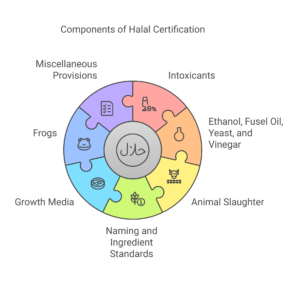
1. Intoxicants (Khamr)
- Definition: Any substance that causes intoxication (e.g., beverages, food) is classified as haram (prohibited).
- Ethanol Content:
- Beverages with ≥1% ethanol are deemed khamr (intoxicants) and najis (impure).
- Beverages with <1% ethanol from engineered fermentation are haram but not najis.
- Traditional fermented products like tape (fermented cassava) are exempt unless they cause intoxication.
2. Ethanol, Fusel Oil, Yeast, and Vinegar
- Ethanol:
- Ethanol derived from non-khamr sources is pure (suci).
- Permissible if undetectable in final products; prohibited if detectable.
- Ethanol from khamr sources is haram.
- Fusel Oil:
- From non-khamr sources: halal.
- From khamr sources: haram unless chemically transformed into a new compound.
- Vinegar: Derived from khamr (natural or engineered) is halal.
- Yeast: Separated from khamr production and purified (no residual taste/odor) is halal.
3. Animal Slaughter
- Slaughterer: Must be a Muslim of legal age (akil baligh).
- Method:
- Recite basmalah (In the name of Allah).
- Use a sharp tool to sever the trachea, esophagus, and jugular veins.
- Animal must be alive during slaughter.
- Stunning: Permitted if non-lethal and the animal remains alive post-stunning. Mechanical, electrical, or chemical stunning that causes pain is prohibited.
4. Naming and Ingredient Standards
- Prohibited Names/Symbols:
- Names evoking disbelief, falsehood, or prohibited animals (e.g., pork, alcohol).
- Exceptions apply to culturally ingrained terms (e.g., bakso, bakmi) if proven free of haram elements.
- Flavor Restrictions: Products mimicking haram flavors (e.g., “bacon-flavored”) are prohibited.
5. Growth Media
- Microbial Products:
- Microbes grown in halal media are halal; those in haram/najis media are haram.
- Microbial products for consumption must trace their halal status back to the initial growth stage.
6. Frogs
- Killing or consuming frogs is haram due to environmental and prophetic prohibitions.
7. Miscellaneous Provisions
- Expired Certificates:
- Imported meat: Valid per shipment if undamaged.
- Local meat: 6 months.
- Flavors: 1 year.
- Other ingredients: 6 months.
- Foreign Halal Certificates: Require accredited SOPs and verification.
- Cleaning Contaminated Utensils:
- Sertu ritual: Wash 7 times, one wash with soil/detergent.
- Separate equipment for halal and non-halal products, even after cleaning.
Indonesian Law about Halal Product Assurance
Existing laws and regulations related to Halal Product governance have not provided sufficient legal certainty and protection for Muslim communities. Therefore, regulations on Halal Product Assurance must be established through a unified law that comprehensively covers products, including goods and/or services related to food, beverages, medicine, cosmetics, chemical products, biological products, genetically engineered products, and consumer goods used or utilized by the public.
The determination of the halal status of food products is outlined in Undang-Undang Nomor 33 Tahun 2014 Tentang Jaminan Produk Halal. The following is the determination:
- The determination of a product’s halal status is conducted by the Indonesian Ulema Council (MUI).
- The determination of a product’s halal status as referred to in paragraph (1) is carried out through a Halal Fatwa Session.
- The MUI Halal Fatwa Session as referred to in paragraph (2) involves experts, representatives from ministries/institutions, and/or related agencies.
- The Halal Fatwa Session as referred to in paragraph (3) must decide on the product’s halal status within a maximum of 30 (thirty) working days from the date MUI receives the product inspection and/or test results from BPJPH.
- The decision regarding the product’s halal certification as referred to in paragraph (4) is signed by MUI.
- The decision on the product’s halal certification as referred to in paragraph (5) is submitted to BPJPH to serve as the basis for issuing the Halal Certificate.
A Catalyst for Economic Growth
Since the enactment of Law No. 33/2014 on Halal Product Assurance, MUI has certified over 4 million products, spanning local SMEs to multinational corporations. The certification not only caters to domestic demand but also boosts Indonesia’s halal exports, which reached $6.2 billion in 2023. Industries such as halal tourism—featuring Sharia-compliant hotels and culinary tours—have seen a 40% growth, attracting Muslim travelers globally.
“MUI’s certification is more than a label; it’s a moral obligation to protect Muslim consumers,” said Dr. H. Hasanuddin, MUI’s Fatwa Commission Secretary. “We collaborate with scientists and auditors to ensure every product meets both religious and safety standards.”
Challenges and Innovations
Despite its success, the system faces hurdles. Small businesses often struggle with certification costs, while global manufacturers must navigate complex supply chain audits. Additionally, counterfeit halal labels—a rising concern—have prompted MUI to launch blockchain-based traceability tools in partnership with tech firms.
The 2023 update to MUI’s guidelines further addresses modern challenges, such as lab-grown meat and synthetic additives, emphasizing the need for continuous adaptation.
Muhammad Raihan Adhika
SouqTimes
Reference:
Muchamad, F. (2018). Fatwa dan Problematika Pentapan Hukum Halal Di Indonesia. Jurnal Ilmiah Ekonomi Islam, 4(01).
Niam, A. (2022). Menjawab Pertanyaan Seputar Fatwa MUI tentang Produk Halal. Youtube.
Indonesia, M. U. (2003). Standardisasi fatwa halal. Majelis Ulama Indonesia. Jakarta.
Supardin, M. I. (2024). Standar dan Prosedur Fatwa Halal Di Indonesia dan Thailand. el_hisbah, 4(1).