Islamic Finance Experiences Unprecedented Growth as Ethical Investment Gains Momentum
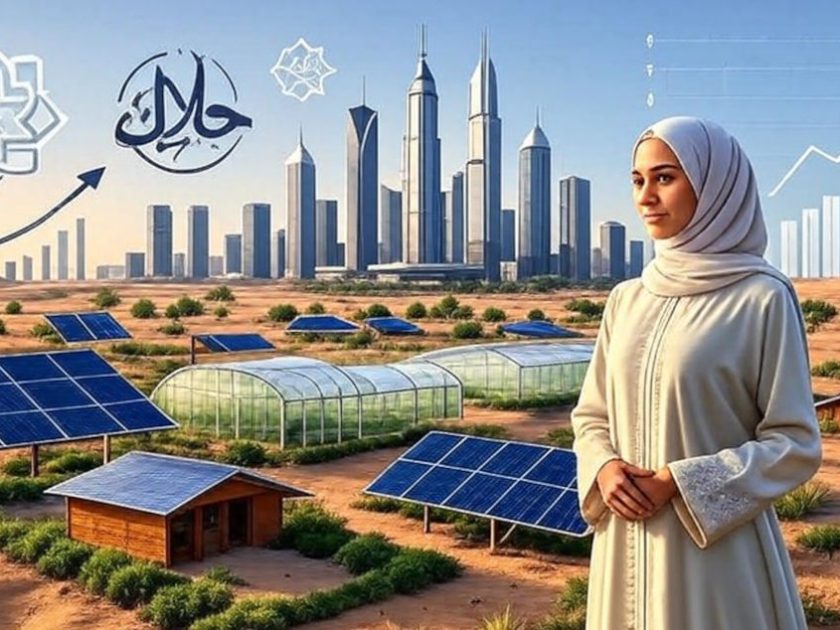
JAKARTA — In the scorching landscape of Tabuk province, where vast sand dunes once represented insurmountable challenges, 42-year-old Fatima Al-Mansoori stands proudly atop a state-of-the-art solar installation, her hijab moving gracefully in the desert wind. Three years ago, her village of Al-Jarrah—home to 2,000 residents subsisting on date palm cultivation and occasional remittances—struggled with frequent power outages and limited opportunities. Today, these solar panels generate clean energy powering 80% of the community, irrigate new greenhouses producing organic figs, and charge electric vehicles transporting visitors to eco-friendly lodges.
The remarkable $45 million transformation wasn’t financed by conventional hedge funds or fossil fuel interests, but through a green Sukuk—a Sharia-compliant bond that aligns investor profits with tangible environmental and social outcomes rather than interest-based returns.
Fatima, formerly a schoolteacher who became a community advocate, played a crucial role in presenting the proposal to Dubai’s Islamic financial institutions. “This represented more than mere capital,” she reflects, her voice clear against the sound of solar inverters. “It embodied a partnership: profits distributed only when our community prospers.” Launched in 2023 by Saudi Arabia’s Public Investment Fund, the sukuk attracted $12 billion in investment interest—three times the initial target—from ethical investors across cities from Kuala Lumpur to London. By 2025, it has delivered 5.2% annual returns, surpassing many conventional green bonds, while reducing Al-Jarrah’s carbon emissions by 40%.
Stories like Fatima’s aren’t isolated incidents in the Islamic finance expansion; they represent its fundamental purpose, demonstrating that faith-aligned capital can address challenges conventional markets have historically overlooked.
Remarkable Growth in a Volatile Market
As global assets in this $6 trillion sector increased 21% last year, surpassing conventional alternatives, Islamic finance has evolved from a parallel system into a mainstream force, merging Sharia’s prohibition of usury with worldwide demand for sustainable, equitable economic growth. However, beneath this optimistic outlook lie challenges: liquidity constraints, regulatory complexities, and a talent shortage that could potentially slow the sector’s projected growth toward $9.7 trillion by 2029.
Drawing from the Islamic Financial Services Board’s recent Stability Report, S&P Global’s forward analysis, and LSEG’s 2025 Development Indicator, this examination explores the data, driving forces, and obstacles facing the industry. For investors seeking profitable yet ethical opportunities, policymakers designing resilient economies, and visionaries like Fatima pursuing their next goals, the conclusion is clear: Islamic finance isn’t merely expanding—it’s fundamentally redefining how we measure prosperity.
Exceptional Asset Growth Despite Global Uncertainty
During a challenging year characterized by trade tensions and interest rate fluctuations, the global Islamic financial services industry (IFSI) demonstrated remarkable resilience, expanding core assets to $3.88 trillion—a 14.9% increase that significantly outperformed the broader financial sector’s 8% growth. Comprehensive calculations, including sukuk, takaful, and real estate, reach $6 trillion according to LSEG’s detailed analysis, highlighting resilience built on asset-backed prudence rather than excessive leverage.
Banking forms the foundation of this growth, with $2.7 trillion in assets increasing 17%, while takaful premiums expanded 11.8% to $36.5 billion, driven by demand for ethical protection against unforeseen events.
Sukuk, the sector’s infrastructural cornerstone, achieved impressive results: $180 billion issued in 2024, with the third quarter of 2025 alone generating $80 billion—positioning totals toward a record-breaking $200 billion this year, according to Fitch Ratings forecasts. Sustainable versions, like Fatima’s solar project, surged 27% in the first half of 2025 to $9.3 billion, their attractiveness enhanced by ESG requirements that naturally align with Sharia’s stewardship principles. S&P offers slightly more conservative projections, estimating $190-200 billion for full-year 2025 amid market volatility, but acknowledges: “The market’s maturation is unmistakable.”
Key Performance Indicators
| Islamic Finance Metrics | 2024 Results | 2025 Projections | Annual Growth to 2029 |
|---|---|---|---|
| Core IFSI Assets | $3.88T | $4.4T | 11.2% |
| Total Global Assets | $6.0T | $6.6T+ | 10.5% |
| Sukuk Issuance | $180B | $190-200B | Varies |
| Islamic Banking Assets | $2.7T | $3.1T | 12% |
| Takaful Premiums | $36.5B | $40B | 11.8% |
Sources: IFSB Stability Report 2025, LSEG ICD Report, S&P Global
These figures represent more than statistical data—they’re transformative forces. Consider the 1.8 billion Muslims (projected to reach 2.2 billion by 2030) who view financial transactions as spiritual acts, requiring interest-free models that distribute risks and rewards equitably. Notably, 20-30% of new investment comes from non-Muslim participants, attracted by transparency that weathered the 2008 financial crisis without major losses.
Driving Forces: Faith, Technology, and Impact Investment
What fuels this extraordinary growth? Demographics provide the foundation—a growing Muslim population creating inherent demand—but innovation accelerates momentum. Artificial intelligence now verifies Sharia compliance in seconds, reducing costs by 30%; blockchain technology tokenizes sukuk, democratizing access to assets previously available only to large investors. In Indonesia, peer-to-peer platforms like Amartha have distributed $1 billion in micro-sukuk to women-led agricultural enterprises, generating 7% returns while improving 4 million lives.
Supportive regulatory environments contribute significantly: Malaysia’s incentive programs have attracted $50 billion in foreign direct investment since 2020; the UK’s “faith-neutral” hybrid instruments drew €6 billion in 2024 alone. “We’re observing convergence,” notes Dr. Obiyathulla Bacha, INCEIF University dean, in LSEG’s report. “Sharia’s principles are ESG’s foundation.” Non-Muslims, seeking post-crisis protections, now purchase 25% of U.S. halal ETFs, according to Wahed Invest’s $1.5 billion growth.
Personal narratives amplify the appeal: On professional networks, Egyptian entrepreneurs credit sukuk-funded startups with “lifting families from poverty”; Canadian Muslims celebrate Sharia-compliant mortgages as protection against 7% interest rates. This represents tangible evidence: Islamic finance has moved beyond niche markets—it’s becoming essential.
Regional Powerhouses and Emerging Markets
The Gulf region controls 60% of the market, with Saudi Vision 2030 alone directing $100 billion into sukuk for futuristic development—Aramco’s $5 billion green issuance being a prime example. Asia, however, demonstrates populist energy: Indonesia’s assets doubled to $80 billion through millennial-focused applications; Pakistan’s 20% sukuk debt requirement created a $30 billion ecosystem.
The exciting development? Peripheral markets are flourishing. America’s 43 Sharia-compliant institutions completed 10,000 home financings last decade, with fintech companies bridging murabaha service gaps. Europe’s €1.5 trillion sustainable investment movement combines with Islamic hybrid instruments, creating “impact sukuk” that transcend religious boundaries. As one London ESG specialist observes: “This isn’t about conversion—it’s about conviction.”
Significant Challenges Ahead
Growth brings obstacles. Liquidity presents the primary challenge: Sharia’s prohibition of interest-bearing reserves creates a $200 billion gap, increasing interbank lending spreads by 50 basis points under Basel III requirements. Fitch identifies it as “the paramount challenge,” fragmenting funding during turbulent periods.
Regulatory frameworks? A complex array of governing bodies—Malaysia’s progressive approach conflicts with GCC conservatism, impeding capital flows; U.S. FDIC misalignments and Asian legacy concerns add friction. Talent shortages? A deficit of 50,000 professionals combining Sharia and fintech expertise is projected by 2030, according to CIBAFI surveys, as training programs lag behind digital transformation. Moody’s warns of a potential 20% sovereign sukuk decline to $92 billion if austerity measures intensify.
These aren’t insurmountable problems but challenges requiring solutions—unified regulatory frameworks and enhanced educational programs could accelerate progress.
Vision for 2029 and Beyond
Envision 2029: $9.7 trillion in assets, a 62% expansion, funding renewable energy projects and empowering startups. Green sukuk, already at $150 billion cumulative issuance, will exceed $50 billion outstanding next year, according to Lexology. Tokenization and AI-driven personalization will eliminate barriers, customizing prosperity solutions.
The requirements? Harmonize regulations, develop talent, invest strategically. As LSEG states, “New frontiers await”—but success demands inclusivity. Islamic finance doesn’t simply endure challenges; it builds connections between communities and ideologies.
Consider Fatima’s illuminated village: In a world often divided, this demonstrates how we can light the path forward—for everyone, regardless of faith or background. Islamic finance proves that ethical principles and profitable returns aren’t mutually exclusive—they’re complementary forces reshaping global finance for the better.
Original Article:
Halal Times. (2025, October 31). Demand for Islamic Financial Products Surges Amid Ethical Investing Boom. Retrieved from https://www.halaltimes.com/demand-for-islamic-financial-products-grows/