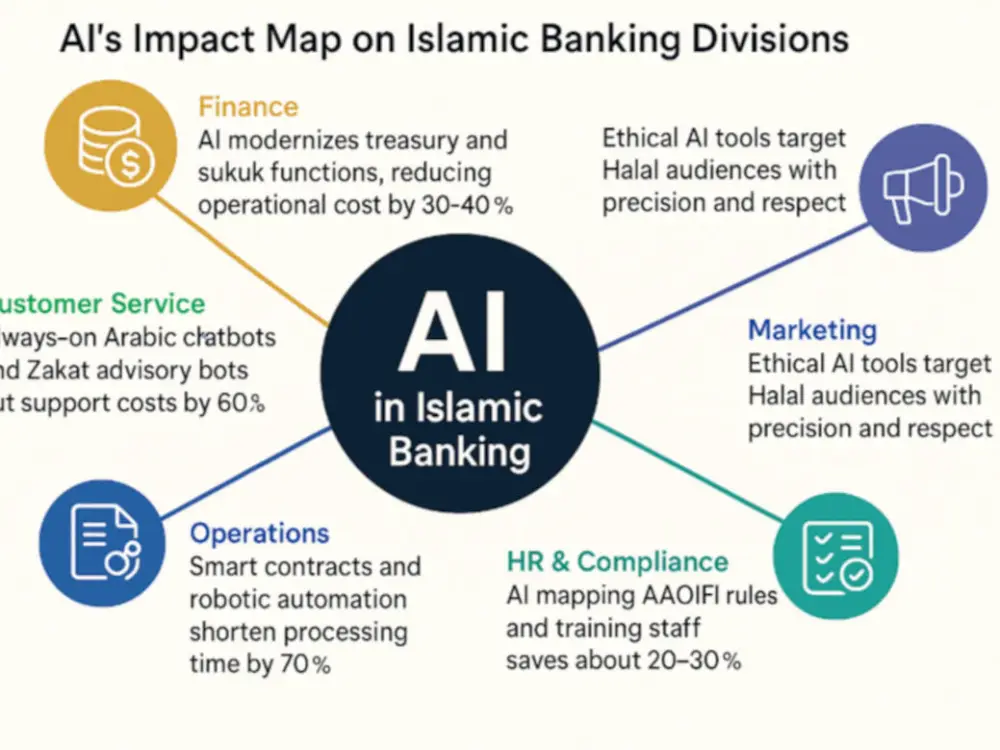
How Artificial Intelligence Will Transform Islamic Banking: A Comprehensive Timeline
JAKARTA – Artificial Intelligence stands ready to revolutionize Islamic banking across all operational areas—similar to conventional financial institutions—but with distinctive considerations for Shariah compliance, ethical standards, and transparency requirements.
This analysis examines three timeframes: short-term (1-3 years), mid-term (3-7 years), and long-term (7-15 years), drawing from the Islamic Finance Development Report 2025 (LSEG), IFSB Insight Papers, and State of the Global Islamic Economy 2024 (DinarStandard).
Departmental Transformation Roadmap
Treasury & Liquidity Management
Short-Term Impact (1-3 years)
- AI-powered cashflow predictions and live liquidity monitoring systems
- Automated hedging strategies for currency exposure using Shariah-compliant swap arrangements
Medium & Long-Term Evolution (3-15 years)
- AI optimization of investment allocations across sukuk, murabaha, and Wakala products
- Predictive analytics eliminate manual asset-liability management processes
Financial Impact: Operating costs decrease 30-40% through improved funding coordination; margins increase 2-3 basis points via real-time pricing optimization.
Customer Service & Digital Banking
Short-Term Impact (1-3 years)
- Conversational AI trained in Arabic and Shariah vocabulary
- Round-the-clock fatwa-compliant inquiry support
Medium & Long-Term Evolution (3-15 years)
- Fully independent AI assistants customize Islamic savings plans and zakah calculations for individual customer profiles
Financial Impact: Contact center expenses reduced by approximately 60%, with enhanced service velocity and customer loyalty.
Personal Loans / Consumer Finance
Short-Term Impact (1-3 years)
- AI-powered credit evaluation incorporating ethical consumption behaviors and non-traditional data sources
- Automated documentation verification for murabaha agreements
Medium & Long-Term Evolution (3-15 years)
- Dynamic pricing mechanisms for personal Ijara and murabaha financing based on risk profiles and maqasid-aligned ethics scoring
Financial Impact: Underwriting processes accelerate by over 50%, reducing non-performing financing through enhanced risk detection.
Corporate Finance & Sukuk Issuance
Short-Term Impact (1-3 years)
- Natural language AI generates term sheets conforming to AAOIFI standards
- Predictive analytics evaluate issuer creditworthiness
Medium & Long-Term Evolution (3-15 years)
- AI systems simulate cash flows and Shariah structures for project-based sukuk and sustainable issuance
Financial Impact: Underwriting duration decreases 40%, transaction expenses drop 15%, accelerated secondary market activity.
Underwriting / Risk & Credit Analysis
Short-Term Impact (1-3 years)
- Machine learning identifies early default indicators
- AI evaluation of environmental and Shariah compliance risks
Medium & Long-Term Evolution (3-15 years)
- Self-improving risk frameworks integrate financial and social metrics aligned with maqasid al-shariah principles
Financial Impact: Reduced credit assessment personnel costs, superior portfolio quality, enhanced ethical risk transparency.
Marketing & Customer Insights
Short-Term Impact (1-3 years)
- Sentiment tracking on faith-focused social media audiences
- AI customization for Ramadan and Hajj promotional campaigns
Medium & Long-Term Evolution (3-15 years)
- Context-intelligent AI develops financial wellness guidance consistent with Islamic principles
Financial Impact: Marketing expenditure efficiency improves 30-50% through precision targeting.
Operations & Payments
Short-Term Impact (1-3 years)
- Robotic Process Automation for trade finance and murabaha documentation
Medium & Long-Term Evolution (3-15 years)
- AI-enabled smart contracts on authorized blockchains execute mudarabah profit distribution instantaneously
Financial Impact: Processing time decreases 70%, operational expenses decline 25%.
Human Resources
Short-Term Impact (1-3 years)
- AI workforce analytics identify Shariah-finance competency gaps
Medium & Long-Term Evolution (3-15 years)
- Customized learning AI delivers fiqh muamalat education
Financial Impact: Recruitment and training costs decrease 20%, skilled Islamic finance workforce expands.
Compliance / Regulatory & Shariah Governance
Short-Term Impact (1-3 years)
- AI regulatory technology maps AAOIFI requirements and validates documentation
Medium & Long-Term Evolution (3-15 years)
- Integrated Shariah-audit systems monitor transactions continuously against prohibited activities
Financial Impact: Compliance precision exceeds 95%, costs decrease 30%. Shariah boards expand oversight capabilities without significant staff increases.
Understanding the Transformation
In straightforward terms, AI becomes an invisible collaborator within Islamic banks. Initially, it streamlines repetitive, expensive tasks—projecting treasury cash requirements, evaluating loans, verifying documentation—allowing employees to concentrate on relationship building and ethical considerations.
Over five to fifteen years, these systems mature into comprehensive tools: automatically generating sukuk documentation, examining social and environmental consequences, and delivering customized Islamic finance education aligned with staff responsibilities. Departmental costs decline substantially, while customers experience accelerated, more accessible 24-hour service that comprehends both linguistic nuances (Arabic to Bahasa and beyond) and ethical foundations.
AI won’t displace professionals in Islamic banks; instead, it will amplify their purpose and contribution—enabling them to provide honesty, fairness, and accuracy at unprecedented scale while maintaining faith as the foundation.
Aggregate Performance Projections
Operating Cost Reduction
- Short-Term: 15-25%
- Long-Term: 30-50%
- Shariah-Ethical Consideration: Cost efficiency maintained without compromising ethics, measured through transparency mechanisms
Productivity Gain
- Short-Term: +20%
- Long-Term: +45%
- Shariah-Ethical Consideration: AI manages routine functions, humans concentrate on relationship finance and maqasid impact
Net Margin Change
- Short-Term: +2-3 basis points
- Long-Term: +5-8 basis points
- Shariah-Ethical Consideration: Generated by reduced inefficiencies and innovative Islamic products (ESG sukuk, digital microfinance)
Risk Management Precision
- Short-Term: ↑30%
- Long-Term: ↑70%
- Shariah-Ethical Consideration: AI-enhanced screening minimizes Shariah violation risk
Customer Satisfaction
- Short-Term: +25%
- Long-Term: +60%
- Shariah-Ethical Consideration: Accelerated responses, customized faith-aligned solutions
Interpreting the Broader Picture
From a comprehensive perspective, these metrics narrate a transformation story rather than disruption. Short-term results show Islamic banks achieving moderate cost reductions and enhanced operational flow; processes previously requiring ten employees now need perhaps five. Over time, these efficiencies deepen as AI capabilities advance and integrate seamlessly across functions. Operating expenses could be reduced by half, enabling stronger profit margins while maintaining ethical and fair financing rates.
The genuine advancement emerges in productivity and confidence. Machines process data-intensive tasks—compliance verification, payment execution, reporting—while people emphasize compassion, attentive listening, and community engagement. Risk evaluation becomes more precise, identifying early ethical or credit concerns before they escalate.
Within the coming decade, customers will likely encounter an Islamic bank that feels simultaneously highly digital and profoundly human: efficient applications answering zakat inquiries instantly, sukuk transactions completed within hours, and consistent demonstration that technology can harmonize with honesty and Shariah values.
Navigating Challenges & Implementing Safeguards
As Islamic banks adopt artificial intelligence, they confront new challenges extending beyond technical implementation. The paramount concern is maintaining ethics at the forefront. AI systems must develop under Shariah Supervisory Board oversight, ensuring automation never ventures into riba-linked or inequitable territory. Every automated determination must embody Islamic values of honesty and justice. Data privacy holds equal importance—in Islam, information isn’t a commodity but an amānah, a sacred trust. Banks must handle every customer’s data with the same care and integrity applied to any entrusted responsibility.
A human dimension accompanies this transition. Islamic banks require professionals fluent in both Shariah principles and algorithmic language—AI-literate scholars and ethically conscious engineers capable of collaborative work. Transparency must guide every action, ensuring every AI determination is explainable with clear intention (niyyah). While efficiency provides benefits, equity remains essential. AI should expand Islamic microfinance access and integrate the unbanked into secure, responsible finance—not marginalize them. Ultimately, AI will strengthen Islamic banking only if it prioritizes people and remains guided by faith, fairness, and inclusion.
Original Article:
Halal Times. (2026, January 12). AI’s Impact Map on Islamic Banking Divisions. Retrieved from https://www.halaltimes.com/ais-impact-map-on-islamic-banking-divisions/