Two Southeast Asian Halal Authorities: Analyzing BPJPH Indonesia and MUIS Singapore’s Strategies in the Global Halal Market
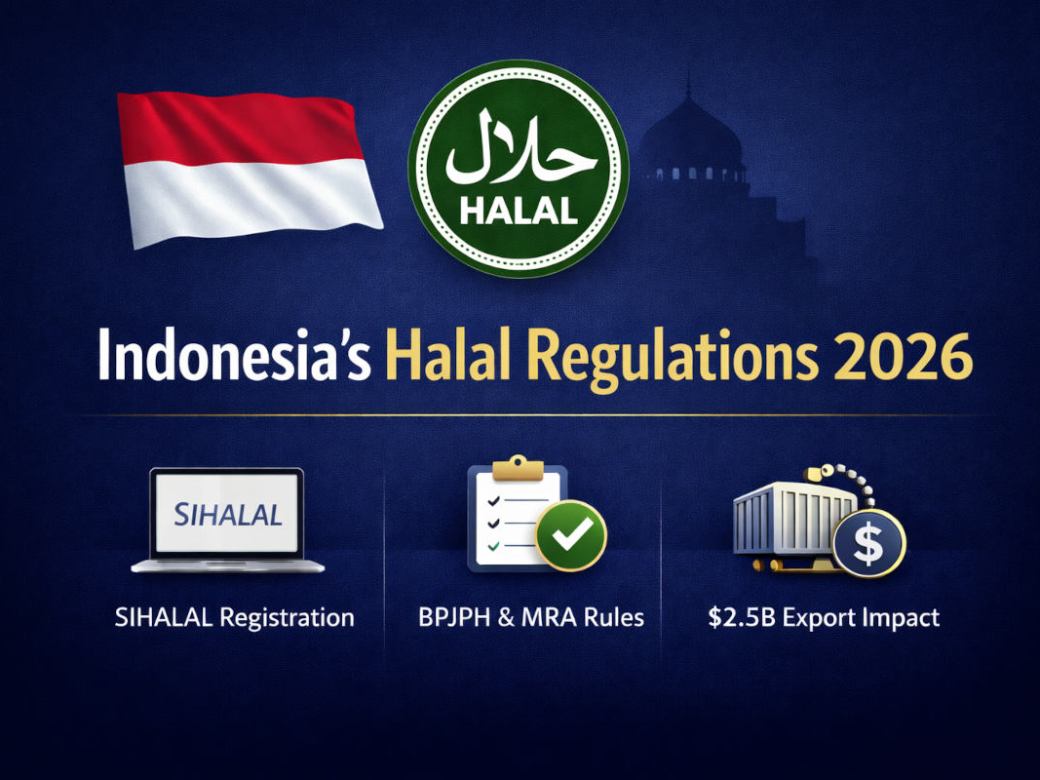
JAKARTA – The global halal industry is experiencing exponential growth. The market, projected to grow from USD 2.99 trillion in 2025 to USD 6.49 trillion by 2034 with an annual growth rate of 9%, has become a strategic competitive arena among nations. In Southeast Asia, two halal certification bodies stand out with markedly different approaches: Indonesia’s BPJPH and Singapore’s MUIS.
What’s intriguing is not merely which is larger or better, but why these two neighboring countries have developed such contrasting systems. More importantly, how will each face future challenges in the global halal industry?
Fundamental Differences: Authority Structure and Integration
BPJPH Indonesia: Integrated Multi-Agency System
The Halal Product Assurance Organizing Agency (BPJPH) is a cabinet-level government agency under Indonesia’s Ministry of Religious Affairs. Established in October 2017 based on Law Number 33 of 2014 on Halal Product Assurance, BPJPH operates within a system involving three parties:
- BPJPH – The government agency that organizes and regulates halal product assurance
- Halal Inspection Agency (LPH) such as LPPOM MUI – Conducts inspections, audits, and technical verification
- Indonesian Ulema Council (MUI) – Through its Fatwa Commission determines product halalness and issues fatwas
In this system, BPJPH organizes the entire halal product assurance process, LPPOM MUI conducts document verification and field audits, then MUI through its Fatwa Commission issues halal decisions based on audit results. The halal certificate is ultimately issued by BPJPH based on MUI’s fatwa (Ali & Shafie, 2022).
MUIS Singapore: Fully Integrated One-Stop System
The Islamic Religious Council of Singapore (MUIS) is a statutory board under Singapore’s Ministry of Culture, Community and Youth. Established in 1968 when the Administration of Muslim Law Act (AMLA) came into effect, MUIS is the sole authority managing halal certification and regulating Singapore’s halal industry.
Unlike Indonesia’s model, MUIS performs all functions within one institution:
- Religious authority
- Technical inspection and audit
- Halal certificate issuance
- Ongoing monitoring and oversight
MUIS provides halal certification services comprehensively as an integrated solution, without needing to involve separate institutions for fatwas or audits (Riaz & Chaudry, 2019).
Structural Comparison
| Aspect | BPJPH Indonesia | MUIS Singapore |
|---|---|---|
| Integration Model | Multi-agency integrated | Single-body integrated |
| Number of Parties | 3 institutions (BPJPH, LPH, MUI) | 1 institution (MUIS) |
| Inspection & Audit | LPH (separate agency) | MUIS internal |
| Fatwa Authority | MUI (independent organization) | MUIS itself |
| Certificate Issuance | BPJPH (based on MUI fatwa) | MUIS (all-in-one) |
| Characteristics | Checks and balances | Centralized efficiency |
Historical Roots: Why Different Systems?
The fundamental difference between these two systems is not coincidental, but rather the result of very different historical and political contexts.
Indonesia: Political Compromise between Government and Religious Authority
Since the late 1980s, MUI has been the sole authority issuing halal certification for food and cosmetic producers in the Indonesian market. For decades, MUI through LPPOM MUI held a complete monopoly on halal certification (Bergeaud-Blackler, 2007).
This monopoly was repeatedly criticized by media and civil society as a source of corruption. The Indonesian government, starting from President Megawati’s era, attempted to take over halal authority from MUI. However, these efforts faced a political dilemma:
- On one hand: The government wanted control to improve accountability and prevent corruption
- On the other: MUI held strong religious authority and was trusted by Indonesian Muslims
The 2014 Halal Product Assurance Law became a compromise solution. This law introduced a division of labor in the halal certification scheme while still establishing MUI as the final decision-maker in all certification processes (Fischer, 2016).
Political tension was evident during BPJPH’s leadership selection in August 2017. President Jokowi’s administration made a strategic maneuver by removing Lukmanul Hakim, then director of LPPOM MUI and one of the main candidates, from the shortlist three days before the official announcement. This demonstrated a power struggle between government and MUI over control of the halal industry.
The final result: Indonesia’s multi-agency system is a product of political compromise – the government gained regulatory control through BPJPH, while MUI retained religious authority through halal fatwas (Prabowo et al., 2015).
Singapore: Centralized Design from the Start
Singapore’s context was very different. MUIS was established in 1968 as a government statutory board when the Administration of Muslim Law Act (AMLA) came into effect. From the beginning, MUIS was designed as the sole authority for Muslim affairs in Singapore.
Several factors enabled this centralized system to succeed in Singapore:
- No strong independent religious organization: Unlike Indonesia with MUI as an independent organization with a long history, MUIS was from the start a direct product of government.
- Small nation context with centralized governance: Singapore is a small country with a highly centralized and efficient government system. The government has had full control over all aspects of society from the beginning.
- Focus on efficiency and international trust: In 2008, a Free Trade Agreement (FTA) was signed between Singapore and Gulf Cooperation Council (GCC) countries officially recognizing MUIS halal certification. The centralized system facilitated international recognition and built Singapore’s reputation as a trusted halal hub (Abdul et al., 2009).
- No power conflict: Because MUIS was a government product from the start, there was no conflict of interest or power struggle as in Indonesia.
Philosophy Behind the Systems
| Factor | Indonesia | Singapore |
|---|---|---|
| Formation History | MUI existed and was strong before government involvement | MUIS formed directly by government |
| Political Dynamics | Compromise between government and independent religious organization | Full government control from inception |
| Problem Faced | MUI monopoly criticized for corruption | No prior monopoly issues |
| Solution Chosen | Divide power among 3 agencies (BPJPH, LPH, MUI) | Maintain one centralized agency (MUIS) |
| System Philosophy | Checks and balances between government and religious scholars | Efficiency and centralized control |
Future Projections: Two Different Strategies Facing the Global Market
With the global halal market projected to reach USD 6.49 trillion by 2034, yet facing the primary challenge of lack of standardization in certification processes, how are these two institutions positioning themselves?
BPJPH Indonesia: Ambition to Become a Global Leader
BPJPH demonstrates significant ambition to lead not only the regional halal market but the global one.
Global Standard Harmonization Strategy
BPJPH positions itself to lead and guide global halal standard harmonization, creating opportunities for broader halal trade chains, and ensuring halal product integrity worldwide. The agency continues pushing for strengthening and harmonizing halal standards to make Indonesian halal products increasingly competitive in international markets (Widyaningrum, 2020).
International Cooperation Expansion
BPJPH actively forms regional forums such as the ASEAN-Australia-New Zealand Halal Forum and establishes Memoranda of Understanding (MoU) with various countries including Russia, Saudi Arabia, and the United States. Through the Organization of Islamic Cooperation (OIC), BPJPH participates in developing unified global halal standards.
Ambitious Targets
Indonesia targets highly ambitious figures:
- 10 million halal certified products in the market by 2025
- Halal economic value reaching USD 330 billion by 2025
Technology Innovation
Technology plays an important role in ensuring transparency and trust in halal products. Indonesia is investing in blockchain-based traceability systems and developing the SiHalal 2.0 digital platform to improve certification process efficiency (Kurniawati & Savitri, 2020).
Halal Infrastructure Development
Special Halal Industrial Zones (HIZ) have been built in Batam, Bintan, and Sidoarjo. These zones are designed to simplify logistics, certification processes, and Indonesian halal product export operations.
Major Challenges Facing BPJPH
However, behind this grand ambition, BPJPH faces several serious challenges:
- Multi-Agency System Complexity: Coordination among BPJPH, LPH, and MUI can become a bottleneck slowing processes. Potential conflicts of interest between government and religious authority remain a risk (Elasrag, 2016).
- Gap Between Target and Reality: The government targets 10 million halal certifications by 2025, but according to BPJPH data as of February 2024, only about 3.9 million products have been halal certified. This significant gap indicates substantial implementation challenges.
- Still Low Public Literacy: Public literacy about sharia economics and halal products generally remains relatively low, only around 23 percent. The target to increase literacy to 50 percent by 2025 appears highly optimistic.
- Import Dependency: A serious structural challenge is that raw materials and auxiliary materials for Indonesia’s processing industry are still dominated by imports. This makes Indonesia’s halal supply chain vulnerable and reduces domestic added value.
- Competition from Muslim-Minority Countries: A surprising fact is that Vietnam and Thailand export their halal products to the Middle East in substantial quantities, showing Indonesia lagging in halal export competition despite having the world’s largest Muslim population.
MUIS Singapore: Focus on Quality and Technology
MUIS takes a completely different approach – not becoming the largest, but becoming the most trusted and technologically advanced.
Enhanced FHCB Recognition Framework
An enhanced Foreign Halal Certification Bodies (FHCB) recognition framework will be implemented on October 1, 2025. The goal is to address the increasing complexity of global halal supply chains. The enhanced recognition scheme introduces several key improvements including greater transparency in qualification criteria and procedures for recognition (Rahman et al., 2021).
Full Digitalization
MUIS will introduce digital halal certificates for halal-certified establishments starting October 1, 2025. The updated halal certificate design will incorporate QR codes for instant verification. An integrated e-competency assessment platform and Comprehensive Halal Risk Management (CHARM) framework form part of MUIS’s digital transformation.
Position as Regional Gateway
Singapore’s geography makes it an ideal hub for halal food production, trade, and re-export. Close to Muslim-majority Malaysia and Indonesia, supported by highly advanced logistics infrastructure, Singapore positions itself as a global halal hub for sharing resources in halal product development, production, and distribution (Talib et al., 2016).
Strong International Recognition
MUIS certification is recognized and accepted in Malaysia, Indonesia, Brunei, and GCC countries. Currently, 101 Foreign Halal Certification Bodies are recognized by MUIS, demonstrating a very strong international network.
MUIS’s Competitive Strengths
- Efficient Centralized System: The one-stop solution model reduces bureaucracy and accelerates processes. Standard consistency is better ensured because all processes occur within one organization.
- High Reputation and Trust: MUIS halal certification is internationally trusted. Singapore as a country with excellent governance provides additional credibility.
- Infrastructure and Technology: As a developed nation, Singapore has sophisticated digital systems and the region’s best logistics and supply chain management.
- Strategic Positioning: MUIS doesn’t compete as a mass producer but as a quality assurance hub. Focus on value-added services such as certification, quality control, and technology platforms.
MUIS’s Limitations
- Small Domestic Market Size: Singapore’s domestic halal dining market is valued at only S$1 billion – very small compared to Indonesia. With a Muslim population of only 15.6%, the domestic market is highly limited.
- Import Dependency: Singapore has no large production base or agricultural land. The country can only serve as an intermediary and quality assurance hub, not a producer.
Strategic Comparison: Volume vs Quality
| Strategic Dimension | BPJPH Indonesia | MUIS Singapore |
|---|---|---|
| Primary Vision | Largest global halal market leader | Premium halal hub & quality gateway |
| Approach | Volume & massive expansion | Quality & trust |
| Target Market | Large domestic + mass export | Re-export & regional certification |
| Primary Advantage | Largest Muslim population, natural resources, economies of scale | Technology, governance, international trust |
| Biggest Risk | Complex bureaucracy, multi-agency coordination, target-reality gap | Production limitations, small domestic market |
| Biggest Opportunity | Becoming world’s #1 producer & exporter | Becoming global “halal certification authority” |
| Business Model | Production powerhouse | Service & quality hub |
Conclusion: Not About Who Wins
In the context of the continuously evolving global halal market, the question “who will win” may not be the right question. These two institutions operate in different niches and both have opportunities to “win” in their respective segments.
BPJPH Indonesia has the potential to become the largest player in terms of halal production volume, number of certifications, political influence in the Muslim world, and global halal product market share. With the world’s largest Muslim population, abundant natural resources, and strong political ambition, Indonesia has all the elements to become the world’s number one halal producer.
However, major challenges remain: the complex multi-agency system could hinder efficiency, halal literacy remains low, a very large gap exists between targets and implementation reality, and competition from more efficient and pragmatic non-Muslim countries persists.
MUIS Singapore will become the quality standard in the most trusted halal certification, halal technology hub (blockchain, AI, digital certification), quality control and assurance, and gateway for halal products to enter premium global markets.
MUIS’s limitations are clear: small domestic market size and total dependence on other countries for production. However, in a global economy increasingly emphasizing trust, transparency, and technology, MUIS’s positioning as a quality hub could prove highly valuable.
Ideal Scenario: Strategic Collaboration
What would most benefit the global halal industry – and Muslim consumers worldwide – is if these two systems didn’t compete head-to-head but collaborated strategically:
- Indonesia becomes the production powerhouse & volume leader leveraging its large population, natural resources, and economies of scale
- Singapore becomes the quality hub & certification authority leveraging technology, governance, and international trust
- Both work together on regional and global standard harmonization
With this collaboration model, Indonesian halal products could gain legitimacy and quality assurance from internationally trusted MUIS standards, while MUIS gains access to Indonesia’s massive production market to expand its certification reach (Muhamad et al., 2017).
This is a win-win solution to address the biggest challenge facing the global halal industry today: lack of standardization. If the two largest players in Southeast Asia can collaborate on standard harmonization, it will be a game-changer for the entire global halal industry.
References
Ali, M. H., & Shafie, F. A. (2022). Halal certification system in Indonesia: Challenges and prospects. Journal of Islamic Marketing, 13(5), 1156-1172.
Rahman, M. M., Khatun, M., & Rahman, M. S. (2021). Halal certification and its impact on consumer purchase intention: A review. Journal of Islamic Marketing, 12(10), 2089-2107. https://doi.org/10.1108/JIMA-03-2020-0083