Halal Certification Dispute Leaves Bangladeshi Exporters in Uncertainty
Bangladesh’s efforts to capitalize on the rapidly expanding global halal market are being hindered by an unresolved jurisdictional dispute between two government bodies over halal certification authority, creating regulatory confusion and increasing costs for exporters.
The ongoing rivalry between the Islamic Foundation (IF) and the Bangladesh Standards and Testing Institution (BSTI) has resulted in parallel certification systems, forcing businesses to obtain dual approvals in order to access international markets. Industry stakeholders warn that the situation is undermining competitiveness at a time when global demand for halal products continues to rise among both Muslim and non-Muslim consumers.
The lack of a unified certification framework has prompted renewed calls for government intervention to streamline the process, secure international recognition, and unlock export growth.
Global Market Opportunity, Limited National Gains
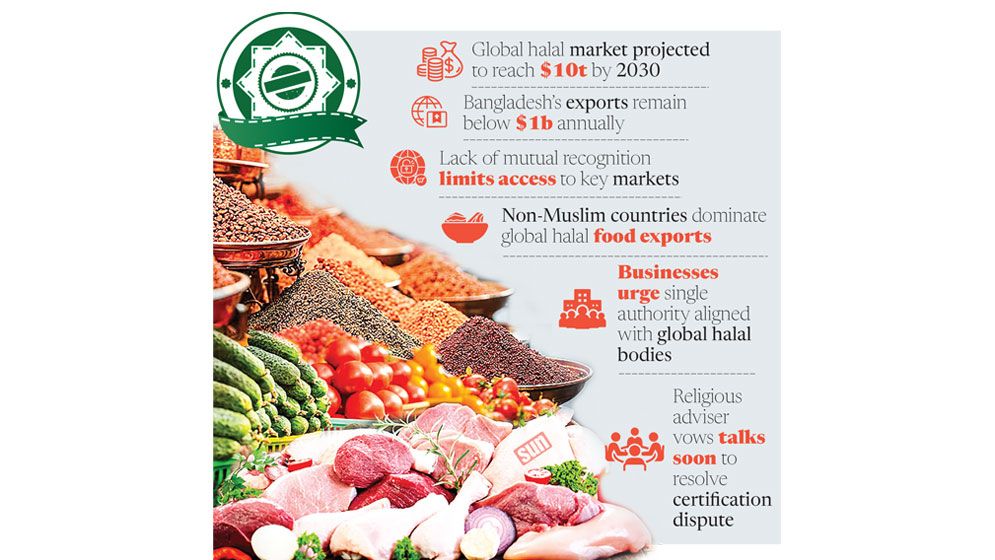
The global halal market is estimated to be worth more than $7 trillion and is projected to reach $10 trillion by 2030, expanding at an annual rate of 5.5 per cent, according to the American Halal Foundation. Saudi Arabia alone accounts for approximately $207 billion in Muslim consumer spending.
Despite this potential, Bangladesh’s halal export earnings remain modest. Data from the Export Promotion Bureau (EPB) show that halal-related exports stood at $988.6 million in the 2024–25 fiscal year, largely driven by agro-based products.
While factors such as high production costs, limited product diversification and weak market positioning have constrained growth, exporters consistently identify dual certification requirements as the most persistent obstacle, citing inflated compliance costs and reduced credibility in global markets.
Government Signals Intervention
Religious Affairs Adviser Dr AFM Khalid Hossain told The Daily Sun that the government is working to resolve the deadlock and will soon convene discussions involving senior officials and advisers.
“Businesses may obtain certification from any government body, but since halal certification is a religious matter, the responsibility lies with the Islamic Foundation,” he said.
Dr Khalid emphasised that BSTI’s mandate is confined to technical standards testing, not religious compliance. “Halal is a Shariah issue. A product may meet BSTI standards but still be deemed non-compliant under Shariah. Therefore, religious oversight should fall under the Ministry of Religious Affairs or the Islamic Foundation,” he said.
He added that global demand for Bangladeshi halal products is strong and expanding, including among non-Muslim consumers who associate halal products with quality and safety.
Exporters Caught Between Two Systems
Md Maidul Islam, chief marketing officer of Akij Food and Beverage Ltd, said Bangladesh has strong potential in halal agro-products but remains constrained by bureaucratic complexity.
“Businesses are required to obtain certification from both IF and BSTI, which creates unnecessary hurdles,” he said. Akij has exported halal products such as spices and biscuits for over 15 years under IF certification.
According to Maidul, IF certification enjoys wider international recognition than BSTI’s, partly due to IF’s collaboration with accredited laboratories such as BCSIR and its alignment with Malaysia’s halal authority, JAKIM. “This gives us better acceptance in Middle Eastern and European markets,” he said.
He urged the government to establish a single national halal authority aligned with global standards to improve market access.
Compliance Challenges for Meat Exporters
Ahmad Asif, chief executive officer of Bengal Meat Processing Industries Ltd, said his company maintains halal certification from both IF and BSTI to satisfy varying regulatory demands.
Bengal Meat began exporting halal meat in 2006, initially relying on certification from Malaysia’s JAKIM before expanding shipments to markets such as the Maldives.
“While price competitiveness is a challenge, demand for premium Bangladeshi beef exists. “The main barrier is compliance. To enter advanced markets like the EU, we need internationally recognized disease-free zones,” Asif said.
Need for Mutual Recognition
PRAN Group Managing Director Eleash Mridha said the conglomerate obtained IF certification in 2015 and BSTI certification in 2023, having earlier secured JAKIM certification in 2010 to enter Malaysia.
PRAN currently exports approximately $40 million worth of halal-certified products annually, including beverages, snacks, confectionery, culinary items and frozen foods. Malaysia remains its largest halal market.
Mridha warned that the absence of mutual recognition agreements with major halal authorities remains a critical bottleneck. “There are no agreements with bodies such as JAKIM, Indonesia’s MUI or China’s halal authorities, making certification costly and time-consuming due to repeated audits,” he said.
Institutional Pushback
Islamic Foundation Deputy Director for Halal Certification Dr Md Abu Saleh Patoari said IF has issued halal certificates since 2007 and had certified 276 companies as of January 2026, including 66 exporters shipping 600 products to 45 countries.
He said IF has recognition from JAKIM and has completed most requirements for inclusion in Saudi Arabia’s approved halal certification list. “Once we are listed, exports will increase significantly,” he said.
Patoari accused BSTI of compelling businesses to obtain its halal certification when they approach the agency for standard testing, arguing that halal certification falls outside BSTI’s legal mandate.
BSTI, however, maintains that it is strengthening national halal infrastructure. Industries Adviser Adilur Rahman Khan inaugurated BSTI’s National Halal Laboratory in July 2025, calling it a strategic step to enhance export readiness.
BSTI Deputy Director for Halal Certification SM Abu Sayed said the agency has issued 202 halal certificates to 25 companies and is now equipped with advanced PCR technology for porcine derivative testing. BSTI became a member of OIC/SMIIC in 2022, he added.
Falling Behind Global Competitors
Despite being a Muslim-majority nation, Bangladesh trails non-Muslim exporters in the halal trade. Major exporters include Brazil, India, the United States, China, Thailand and Australia, with Brazil alone exporting halal meat worth more than $5 billion annually.
Experts estimate that capturing even 2–3 per cent of the global halal market could significantly boost Bangladesh’s economy, particularly as the country prepares for its post-LDC transition.
A Call for Unified Policy
Prof Dr Mohd Ma’Sum Billah of King Abdul Aziz University said Bangladesh’s demographic advantage positions it well to become a halal trade hub.
He recommended a unified national halal policy under government oversight, led by the Ministry of Religious Affairs, with the Islamic Foundation ensuring Shariah compliance through qualified scholars and audit mechanisms.
“Every product must undergo both scientific testing and Shariah scrutiny. Only through internationally aligned quality assurance can Bangladesh achieve global acceptance,” he said.
Source:
Daily Sun. (2025). Halal certification dispute between IF, BSTI leaves exporters in limbo. https://www.daily-sun.com/bangladesh/850206