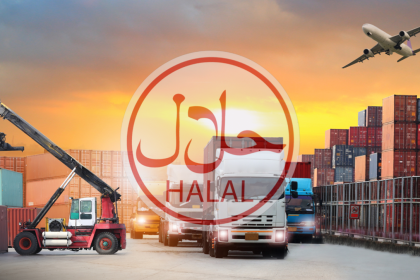
Not Just Products, Logistics Must Also Be Halal: Indonesia Pioneers New Standards for Halal Export
(Source: DetikLogistik)
Depok, Indonesia – While public attention has primarily focused on halal labels for food, beverages, and cosmetics, a new chapter marks a major transformation: logistics services are now required to obtain halal certification. This revolutionary policy by the Indonesian government expands the scope of halal assurance to encompass the entire supply chain—from storage, packaging, transportation, to final distribution to consumers.
This policy is part of the implementation of Law Number 33 of 2014 concerning Halal Product Assurance (UU JPH), with its scope gradually expanded in 2024–2025. This progressive step aligns with the global trend of increasing demand for halal products and services, including in the logistics sector, which has long been considered a “gray zone” in halal standardization.
Indonesia, as the country with the world’s largest Muslim population (87% of 273 million inhabitants), not only affirms its commitment to the Islamic economy but also positions itself at the forefront of global halal standardization. Companies like SELOG (Serasi Logistics Indonesia) have become pioneers by obtaining halal certification for their logistics services in several major cities, demonstrating that this policy implementation is no longer discourse but reality.
However, behind this grand ambition lies a fundamental question:
How to ensure comprehensive halal compliance without creating excessive burden for business actors, especially MSMEs (Micro, Small, and Medium Enterprises) that form the backbone of Indonesia’s economy?
Will this pioneering policy become a model adopted by other countries as a global halal standard?
Background and Legal Foundation
Evolution of Halal Regulations in Indonesia
The journey toward halal logistics certification began with the awareness that product halal compliance doesn’t end at the production process. According to Islamic principles, contamination can occur at any point in the supply chain, including during transportation and storage processes. This prompted the Indonesian government to expand the interpretation of UU JPH, which originally focused only on products to encompass the entire distribution ecosystem.
MUI Fatwa and Islamic Legal Foundation
The Indonesian Council of Ulama (MUI) has issued a fatwa stating that maintaining product halal status is a shared responsibility throughout the supply chain. This fatwa emphasizes the importance of the precautionary principle (ihtiyat) in avoiding all forms of contamination that could cast doubt on a product’s halal status. Additionally, the separation principle (fasl) requires physical separation between halal and non-halal products in logistics facilities, while the cleanliness principle (taharah) mandates maintaining facility cleanliness and purity from impurities and dirt.
Phased Implementation 2024-2025
The government implements this policy gradually to provide adaptation time for the industry. The first phase in 2024 targets large logistics companies and multinational corporations, followed by the second phase in 2025 covering medium-sized logistics companies and regional expeditions. The third phase planned for 2026 will reach MSMEs and small-scale logistics operators, providing sufficient time for them to prepare the necessary infrastructure and resources.
Policy Development and Implementation in Indonesia
Industry Pioneer: SELOG and Best Practices
Serasi Logistics Indonesia (SELOG), a subsidiary of Astra Group with a network of 50 cities and revenue of Rp 2.8 trillion, has become a successful example of halal logistics certification implementation. The company implements separate infrastructure including dedicated warehouses for halal products with independent ventilation systems, specially labeled transport fleets for halal products, and handling equipment that never comes into contact with non-halal products. Through infrastructure investment of Rp 150 billion and training of over 2,000 employees, SELOG successfully increased revenue by 23% from the halal segment and raised market share from 8% to 18%. In terms of digital technology, SELOG uses blockchain-based tracking systems to ensure traceability, IoT sensors for real-time temperature and humidity monitoring, and QR codes for halal status verification of every shipment.
Meanwhile, DHL Indonesia adapts its global halal logistics framework by implementing halal-certified warehouses in 10 major cities and a dedicated halal delivery fleet. As a result, the company achieved a 95% customer satisfaction rate for halal logistics services with 30% growth in halal cargo volume and zero contamination incidents since implementation began.
New Operational Standards
DHL Indonesia has noted several operational standards that have now become industry references. In terms of physical separation, companies must provide separate storage zones for halal and non-halal products, use different loading/unloading equipment, and implement clear labeling and coding systems. Employee training aspects include halal awareness certification for all operational staff, facility cleaning procedures according to Islamic standards, and cross-contamination handling protocols. Meanwhile, audit and monitoring systems include periodic inspections by halal certification bodies, digital documentation of all operational processes, and contamination incident reporting systems.
Strategic Advantages of Halal Logistics Certification Policy
1. Halal Product Integrity Assurance
Halal logistics certification provides comprehensive assurance that halal products maintain their status from factory to consumer hands. This addresses the concerns of Muslim consumers who have been skeptical about the possibility of contamination during the distribution process. Concrete impacts of this implementation include elimination of cross-contamination risks with non-halal products, cleanliness assurance of facilities according to Islamic standards, and full transparency in the halal supply chain.
2. Increased Consumer Trust and Loyalty
Recent surveys show that 78% of Muslim consumers in Indonesia are willing to pay a 10-15% premium for products with halal logistics assurance. This trust not only impacts domestic sales but also opens export opportunities to countries with significant Muslim populations. Observable trust indicators include increased brand awareness of fully halal-certified products, reduced complaints and contamination claims, and significant increase in repeat purchase rates.
3. Acceleration of Halal Export Market Penetration
Indonesia, as the largest halal product exporter in ASEAN, can leverage halal logistics certification as a competitive advantage. Importing countries like Saudi Arabia, UAE, and Malaysia are increasingly strict in their halal product import standards. The global market opportunities are very promising considering the global halal market is valued at USD 2.4 trillion in 2024 with annual growth of 6.2% until 2030. Indonesia has the potential to control 15% of the world’s halal logistics market share with this policy implementation.
4. Technological Innovation and Digitalization
The need for transparency and traceability in halal logistics drives the adoption of cutting-edge technology. Blockchain technology enables the creation of immutable records for every distribution stage, implementation of smart contracts for automated compliance checking, and real-time verification for end consumers. Meanwhile, the Internet of Things (IoT) provides 24/7 storage condition monitoring sensors, alert systems for anomaly detection, and predictive maintenance to prevent contamination. Artificial Intelligence technology also contributes through pattern recognition for contamination risk detection, optimization algorithms for halal-specific routing, and automated reporting for compliance audits.
Implementation Challenges and Obstacles
1. Certification and Operational Cost Burden
The certification cost structure shows significant financial challenges for industry players. Initial audit costs range from Rp 50-200 million depending on operational scale, accompanied by annual certification costs of Rp 25-100 million, and infrastructure upgrade costs reaching Rp 500 million to 2 billion rupiah. The impact on MSMEs is strongly felt where 65% of logistics MSMEs experience difficulties financing certification, profit margins decrease by 8-12% in the first year of implementation, and there is an urgent need for access to special financing schemes.
2. Knowledge Gap and Human Resource Capacity
A Ministry of Industry survey shows that 70% of logistics operators still have limited understanding of halal standards for logistics services. Main knowledge deficit areas include facility cleaning procedures according to Islamic law, halal documentation and audit systems, and supporting technology for compliance. To address this, comprehensive capacity building is needed in the form of intensive training for more than 50,000 logistics workers, halal logistics specialist professional certification, and internship programs at already certified companies.
3. Operational and Infrastructure Complexity
Facility separation challenges include the need for significant dual infrastructure investment, scheduling complexity for mixed cargo, and 15-20% decrease in operational efficiency during the initial implementation phase. Additionally, multi-stakeholder coordination becomes a separate challenge as it requires synchronization with suppliers and customers, standard harmonization between certification bodies, and IT system integration with diverse business partners.
4. International Standard Harmonization
Indonesia faces challenges in aligning domestic standards with diverse international standards. Each country has different interpretations of halal logistics standards, such as Malaysia with JAKIM Halal Logistics Standard, UAE with Emirates Authority for Standardization and Metrology, and Saudi Arabia with Saudi Food and Drug Authority (SFDA). This global standard variation requires complex harmonization efforts to ensure Indonesian products can be accepted in various international markets.
Global Projections and Trends
Adoption of Similar Policies in Other Countries
Malaysia through JAKIM Halal Logistics Initiative targets mandatory implementation by 2026 focusing on halal food and pharmaceutical logistics with USD 200 million investment for infrastructure upgrade. UAE with Dubai Halal Logistics Hub positions itself as a halal logistics hub for Africa and Asia through free zone incentives for halal-certified logistics companies and targets 40% halal cargo volume by 2030. Meanwhile, Vietnam as an emerging halal logistics market began implementing voluntary certification since 2024 focusing on exports to Malaysia and Indonesia, supported by government support programs for SME logistics companies.
Global Market Growth Predictions
According to recent reports from several research institutions, the halal logistics market is projected to grow from USD 180 billion in 2024 to USD 350 billion in 2027 and reach USD 500 billion in 2030 with a compound annual growth rate (CAGR) of 15.8%. Regionally, Asia-Pacific is expected to control 45% market share with Indonesia, Malaysia, and Pakistan as leaders, followed by the Middle East with 30% market share where UAE and Saudi Arabia serve as regional hubs. Africa contributes 15% as emerging markets, while other regions contribute 10% of the total global market share.
Future Technology and Innovation
Emerging technologies that will shape the future of halal logistics include Digital Twin Technology that provides virtual representation of the entire halal supply chain with real-time simulation and predictive analysis as well as automatic risk assessment and mitigation. Quantum Cryptography will provide ultra-secure data transmission for halal certification with tamper-proof documentation systems and enhanced consumer trust through verifiable authenticity. Autonomous Halal Logistics will bring self-driving trucks with halal-specific routing, automated warehouses with halal segregation, and drone delivery for last-mile halal products.
Sustainability integration becomes an important aspect in future development with implementation of green halal logistics for reduced carbon footprint, circular economy principles in packaging, and use of renewable energy for halal logistics facilities. The combination of technology and sustainability is expected to create a halal logistics ecosystem that is not only Sharia-compliant but also environmentally friendly.
Economic and Social Impact
Contribution to GDP and Employment
Economic contribution projections show that the halal logistics sector will directly contribute 0.8% to GDP in 2025 and increase to 1.5% by 2030, with creation of 250,000 new jobs and tax revenue reaching Rp 15 trillion per year by 2030. The resulting multiplier effect includes stimulus for the halal packaging industry, growth in halal certification services, and development of increasingly emerging halal logistics technology startups.
MSME Empowerment and People’s Economy
The government has prepared various support programs for MSMEs through special financing schemes in the form of soft loans with 3% interest for halal certification, Rp 500 million grants for 1,000 logistics MSMEs, and tax incentives for the first 3 years. Capacity building programs include free training for 10,000 MSME operators, mentoring programs with big players, and digital platforms for knowledge sharing. Success stories show that 40% of certified logistics MSMEs experienced a 35% increase in turnover, MSME halal product export value increased by 60% after using certified logistics, and brand recognition improvement averaged 45%.
Strategic Recommendations
For Government
Regulatory harmonization becomes the top priority through standard synchronization with other Muslim countries, mutual recognition agreements (MRA) for halal certification, and simplified procedures for MSMEs. Incentives and support systems are needed in the form of extended tax holidays for halal logistics investors, infrastructure development in regions, and R&D funding for halal logistics technology. International promotion can be done through trade missions to target market countries, participation in international halal exhibitions, and diplomatic initiatives for market access.
For Industry Players
Strategic investment should be prioritized on technology adoption, partnerships with fintech for payment solutions, and collaboration with academic institutions for R&D. Human capital development includes continuous learning programs for employees, professional certification for halal logistics specialists, and leadership development in halal business management. Market expansion strategy can be done through diversification to halal pharmaceutical and cosmetics logistics, regional expansion to ASEAN markets, and e-commerce platform integration.
For Consumers and Society
Education and awareness become key through socialization of halal logistics certification benefits, understanding consumer rights in halal supply chain, and support for local halal businesses. Active participation can be realized through feedback mechanisms for service improvement, advocacy for halal logistics standards, and community-based monitoring systems that involve active community participation in overseeing halal standard implementation.
Conclusion
The halal certification policy for logistics services is a revolutionary breakthrough that positions Indonesia as a pioneer in global halal standardization. This initiative not only answers the spiritual needs of Muslim society but also opens great economic opportunities in the rapidly growing global halal market.
Key Takeaways:
Indonesia successfully positioned itself as a leader in halal logistics standardization, providing competitive advantage in global trade. The potential halal logistics market worth USD 500 billion by 2030 opens great opportunities for Indonesian industry players to develop their businesses. Compliance needs drive the adoption of advanced technologies such as blockchain, IoT, and AI in the logistics industry, creating a more modern and efficient ecosystem. Despite facing cost and complexity challenges, this policy has the potential to empower MSMEs through appropriate and sustainable support programs. Indonesia’s success story can become a model for other countries in developing a comprehensive and integrated halal logistics ecosystem.
Future Outlook:
The successful implementation of this policy will greatly depend on solid collaboration between government, industry, and society. With technology support, adaptive regulations, and sustained commitment from all stakeholders, Indonesia has the potential to become a global hub for halal logistics and strengthen its position as a leader in the global halal economy.
This policy is not just about certification, but about building a comprehensive, sustainable, and inclusive halal ecosystem. If successful, Indonesia will not only become the largest halal product exporter but also an exporter of halal logistics standards and best practices to the entire world.
References
Agnes, V., Rahmatullah, A., & Fitriani, R. (2025). Development of halal logistics implementation in courier companies in Indonesia. Journal of Samawa Industry and Technology, 6(1), 68–72.
Alourani, A., & Khan, S. (2024). Digital transformation in halal supply chains: blockchain and IoT applications. International Journal of Islamic Economics, 15(2), 123-140.
DHL Indonesia. (2025). Halal supply chain management in Indonesia: A comprehensive guide. DHL Express Indonesia. Retrieved from https://www.dhl.com/discover/en-id/e-commerce-advice/shipping-guides-by-country/halal-logistics-supply-chain-management-indonesia
Global Islamic Economy Report. (2024). State of the Global Islamic Economy. Dubai International Financial Centre.
JAKIM Malaysia. (2024). JAKIM halal logistics certification manual. Department of Islamic Development Malaysia.
Ministry of Industry of the Republic of Indonesia. (2024). Roadmap for Indonesian halal industry development 2024-2030. Jakarta: Ministry of Industry RI.
Mordor Intelligence. (2024). Halal logistics market report 2024–2030: Industry analysis and growth projections. Mordor Intelligence Research. Retrieved from https://www.mordorintelligence.com/industry-reports/halal-logistics-market
PWC Indonesia. (2024). The future of halal logistics in Southeast Asia: Opportunities and challenges. Jakarta: PricewaterhouseCoopers Indonesia.
Serasi Logistics Indonesia. (2025, April). Why logistics companies must have halal certification? SERA News. Retrieved from https://www.sera.astra.co.id/id/news/2025/04/kenapa-perusahaan-logistik-wajib-sertifikasi-halal-ini-jawabannya
Talib, M. S. A., Zailani, S., & Abdul Hamid, A. B. (2022). Halal logistics: Critical success factors and stakeholder perspectives. Journal of Islamic Marketing, 13(3), 567–582.