Religious Concerns Over Halal Compliance Fuel Vaccine Reluctance During Indonesia’s Measles Crisis
JAKARTA – Three healthcare workers traveled by motorbike into Sumenep city in Indonesia, transporting measles vaccine doses and a registry of children requiring immunization. Equipped with blue medical kits, they conducted door-to-door visits to administer these critical injections.
Mobile Health Teams Combat Nine-Month Outbreak
These mobile healthcare providers represent the regional government’s most recent initiative to contain a fatal measles outbreak on Madura Island that has continued for nine months. Over 2,600 children have contracted the disease this year, resulting in 20 fatalities.
Pork-Derived Ingredients Create Religious Dilemma
However, attempts to prevent the outbreak’s spread throughout the predominantly Muslim community are being complicated partly by apprehensions that certain measles vaccines may not satisfy Islam’s halal requirements because they contain a stabilizer derived from porcine sources.
Pork-based gelatin is extensively utilized as a stabilizer to maintain vaccines’ safety and effectiveness during storage and transportation, creating a challenge for religious communities that consider pigs ritually impure. Numerous Islamic scholars maintain that vaccines containing gelatin stabilizers are permissible under religious law, as are other medical products with pig-derived components, under specific circumstances.
Religious Authorities Permit Use Until Alternatives Available
Indonesian religious authorities determined in 2018 that vaccines containing pig gelatin are haram, or prohibited, but recommended that Muslims should utilize them until alternative vaccines become available “for society’s welfare,” explained Ahmad Syamsuri, head of Disease Control and Prevention at the Sumenep Health Office.
Community Members Hesitant to Discuss Religious Concerns
In Sumenep, many residents are unwilling to openly address their religious apprehensions.
Pujiati Wahyuni, a 31-year-old Muslim mother and nurse, is aware of parents who decline vaccines for their children based on religious principles, though she recently had her daughter vaccinated at an Islamic kindergarten in Pamolokan village.
“Yes, some exist. Islam is a major religion. Perhaps some Muslim individuals simply prefer not to receive vaccinations, and this isn’t recent, but has been ongoing since birth,” Wahyuni stated.
Extensive Vaccination Campaign Reaches Multiple Venues
The regional government’s current initiative commenced in August and encompasses making over 78,000 vaccines accessible to children in the area, distributed through local clinics, delivered directly to residents’ homes, and even transported to educational institutions.
The objective is that the campaign will help avert future outbreaks, infections, and fatalities. However, they cannot force hesitant parents, noted Musthafa, general secretary of the Indonesian Ulema Council in Sumenep.
“We hold great expectations for Muslims in Indonesia, who are the consumers. Let us request the government, specifically the Health Office and the Ministry of Health, to locate a halal vaccine,” Musthafa said.
Nation Faces Recurring Measles Outbreaks
Indonesia, the world’s most populous Muslim-majority country, has documented previous measles outbreaks, primarily caused by vaccination coverage deficiencies.
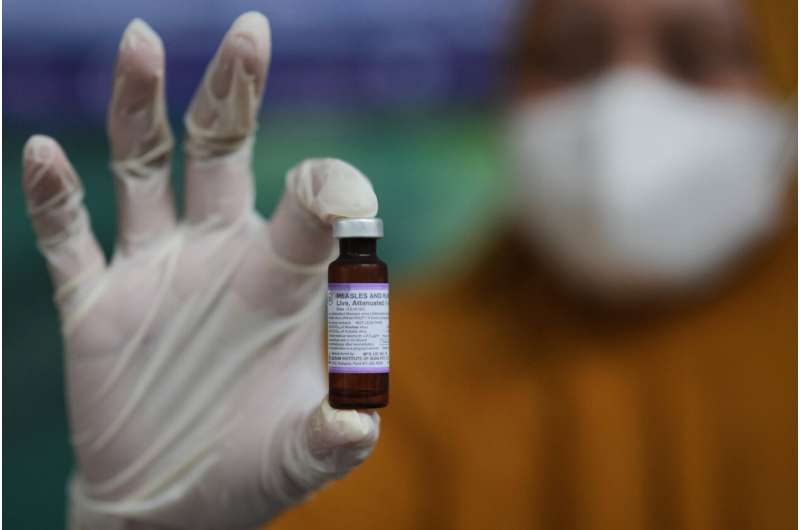
In 2018, a significant outbreak of the extremely contagious disease emerged in Papua, the easternmost province, resulting in numerous deaths. Because of some vaccine hesitancy at that time, the Indonesian Ulema Council stated the measles-rubella vaccine, manufactured by the Serum Institute of India, contained a pig-derived ingredient but authorized its use until a halal alternative became accessible.
The Serum Institute declined The Associated Press’ request for comment.
Immunization Rates Drop Below Safety Threshold
Globally, the World Health Organization reports 84% of children received the first measles vaccine dose last year, with 76% receiving two doses. However, specialists indicate measles vaccination rates must reach 95% to prevent outbreaks. WHO observed that 60 countries reported significant measles outbreaks last year.
Measles vaccination rates in Indonesia dropped below national objectives in 2023, based on Ministry of Health data. In 2023, measles-rubella vaccinations achieved 86.6% of the target, and in 2024, the figure declined to 82.3%.
Hospital Facilities Overwhelmed During Peak Period
From May to July—the outbreak’s peak in Sumenep—isolation rooms at regional hospitals reached capacity as staff managed over a hundred measles cases daily.
At an Islamic kindergarten in Pamolokan village, the community health center director addressed students’ mothers before vaccines were administered and encouraged them to safeguard their children by decreasing measles transmission in Indonesia.
Parents Balance Religious Beliefs with Child Safety
Despite her reservations about the vaccine’s ingredients, Ayu Resa Etika, 28, from Kebunan village, ultimately permitted her 2-year-old son to receive his delayed second dose after witnessing numerous local children hospitalized with measles.
“There is slight uncertainty because it isn’t halal. But regardless, this is for the child’s health,” Etika said. “The consequences are quite severe; it can result in death. I fear that if my son isn’t vaccinated against measles, that’s the danger. So it’s acceptable, provided the outcomes are beneficial.”
Original Article:
Medical Xpress. (2025, October 21). Halal concerns drive vaccine hesitancy as Indonesia fights measles outbreak. Retrieved from https://medicalxpress.com/news/2025-09-halal-vaccine-hesitancy-indonesia-measles.html