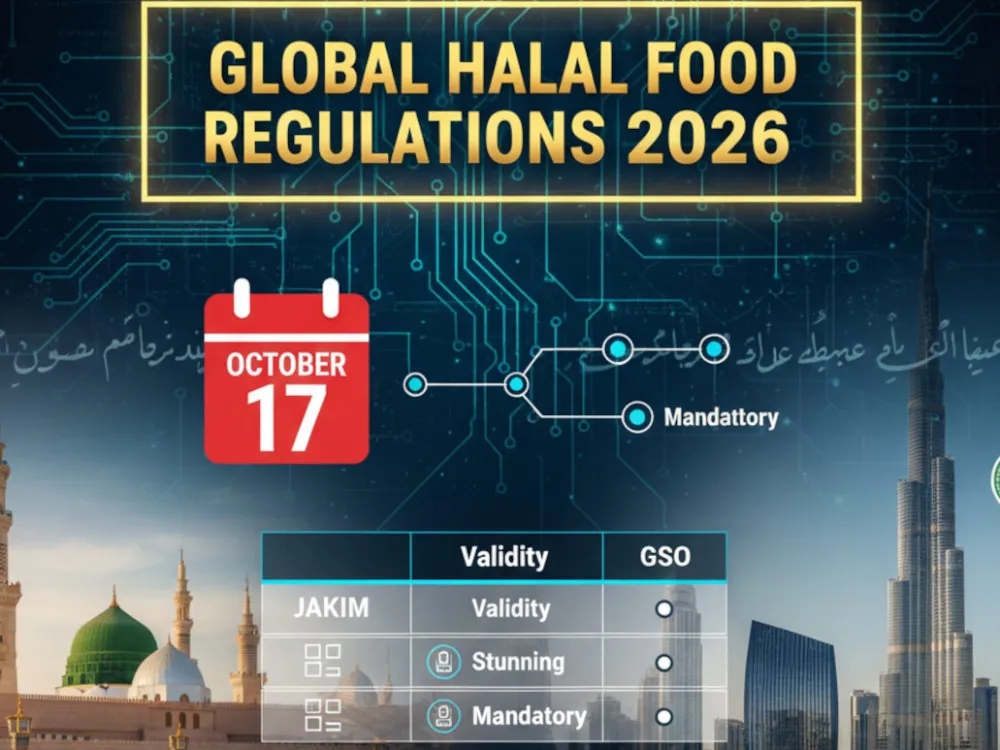
Compliance Guide for JAKIM, BPJPH–MUI, and GSO Standards for 2026
As of early 2026, the global halal industry has moved decisively away from a largely voluntary and niche framework toward a regulated compliance environment that is increasingly mandatory across key markets. For manufacturers, exporters, and supply-chain operators, understanding how regional halal standards intersect is no longer optional—it is a prerequisite for market access.
Participation in the estimated US$2.3 trillion global halal market in 2026 requires more than possession of a halal certificate. It demands strategic regulatory alignment, particularly as Indonesia enforces mandatory halal certification by October 17, 2026, Malaysia accelerates digital audit integration, and Gulf countries reinforce unified halal standards under the Gulf Standardization Organization (GSO).
While the foundational principles of Shariah compliance remain unchanged, administrative procedures, audit mechanisms, and technical requirements have evolved significantly. Three regulatory pillars now shape global halal trade flows: Malaysia (JAKIM), Indonesia (BPJPH–MUI), and the Gulf Cooperation Council (GSO).
Key Regulatory Developments in 2026
A defining regulatory trend in 2026 is the adoption of phased implementation strategies. Governments are expanding halal certification requirements beyond food and beverages to include logistics, packaging, pharmaceuticals, cosmetics, chemical inputs, and consumer goods, reflecting a broader interpretation of halal integrity across the value chain.
Indonesia: A Critical Compliance Deadline
Under Government Regulation No. 42 of 2024, Indonesia has designated October 17, 2026, as the mandatory halal certification deadline for cosmetics, pharmaceuticals, chemical products, and consumer goods marketed domestically. Products that do not meet halal requirements must be clearly labeled as “Non-Halal” and segregated from halal-certified items.
A major policy shift accompanying this mandate is Indonesia’s move toward permanent certificate validity, provided that ingredients, suppliers, and production processes remain unchanged. This approach contrasts sharply with renewal-based systems applied in other jurisdictions.
Malaysia: Unified Governance Structure
Malaysia has consolidated its halal governance framework through the establishment of the Malaysian Halal Commission, which now oversees policy coordination and governance. JAKIM remains the authoritative body responsible for halal standards, certification, and auditing.
This institutional reform is intended to reduce certification bottlenecks, improve inter-agency coordination, and shorten processing timelines through enhanced digital integration, particularly via the MYeHALAL system.
GCC: Harmonization and Traceability
Across the Gulf region, halal compliance continues to be governed by the unified GSO 2055-1 standard. In 2026, regulatory emphasis has shifted toward traceability, digital compliance systems, and harmonized enforcement, particularly for exporters seeking access to Saudi Arabia and the United Arab Emirates.
Mutual recognition mechanisms and data-driven oversight are increasingly central to market entry strategies in the GCC.
Comparative Overview of Major Halal Standards (2026)
| Feature | JAKIM (Malaysia) | BPJPH–MUI (Indonesia) | GSO (GCC States) |
| Primary Standard | MS 1500:2019 | Law No. 33/2014 & GR 42/2024 | GSO 2055-1:2015 |
| Certificate Validity | 2 years (renewable) | Permanent (subject to unchanged processes) | 3 years (renewable) |
| Stunning Policy | Allowed (strictly regulated, reversible) | Highly restricted, subject to fatwa | Allowed (reversible only; poultry gas stunning restricted) |
| Mandatory Status | Market-essential | Mandatory by Oct 17, 2026 | Unified GCC enforcement |
| Laboratory Testing | Mandatory for high-risk products | Mandatory PCR and laboratory verification | Mandatory residue and compliance testing |
| Digital Platform | MYeHALAL | SIHALAL | SABER / GSO portals |
Compliance Considerations for Exporters
Exporters targeting Malaysia, Indonesia, or the GCC in 2026 must align entity registration, ingredient sourcing, audit readiness, and labeling requirements with local regulations.
Key compliance considerations include:
- Verification of local representatives or recognised certification bodies
- Comprehensive screening of raw materials, including additives, carriers, and processing aids
- Selection of appropriate certification pathways, including mutual recognition mechanisms where applicable
- Preparation for hybrid audit models combining on-site inspections and digital verification
- Strict adherence to country-specific halal labeling and logo requirements
Mandatory Deadlines to Monitor
| Product Category | Indonesia | Malaysia / GCC |
| Food & Beverages | Oct 17, 2026 | Market-essential / unified |
| Cosmetics & Skincare | Oct 17, 2026 | Voluntary but commercially critical |
| Pharmaceuticals | Oct 17, 2026 | Strict regulatory oversight |
| Consumer Goods | Oct 17, 2026 | Developing standards |
| Medical Devices (Class B/C) | Oct 17, 2029 | Selective mandates |
Compliance Risks and Bottlenecks
One of the most significant compliance challenges in early 2026 has been the apostille requirement for foreign halal certificates submitted under Indonesia’s overseas certification registration mechanism. Inadequate document authentication has resulted in delays and rejections, underscoring the importance of early legal and administrative preparation.
Outlook
The transition toward mandatory halal compliance in Indonesia and strengthened harmonisation across the GCC marks a new phase in global halal trade governance. Differences in audit models, certificate validity, and regulatory oversight between JAKIM, BPJPH–MUI, and GSO necessitate region-specific compliance strategies, rather than a single global approach.
As the October 2026 deadline approaches, companies that initiate documentation, certification, and audit preparation well in advance are expected to be better positioned to maintain uninterrupted market access and long-term competitiveness in the global halal economy.
Source:
Halal Times. (2026). Global halal food regulations. https://www.halaltimes.com/global-halal-food-regulations/