Behind the Darkened Sky: The Meaning of Eclipses in Fiqh, Astronomy, and Empirical Perspectives
Introduction
The phenomenon of eclipses is a natural event that occurs due to the relative positions of the sun, earth, and moon aligning in a straight line or near alignment. In modern science, eclipses are understood as astronomical events that can be calculated precisely. However, in Islam, eclipses are not merely cosmic phenomena but also signs of Allah’s power (ayat kauniyah) that carry spiritual value, acts of worship, and lessons for reflection.
Various studies show that eclipses have broad dimensions: in Islamic jurisprudence (fiqh), they are related to the ruling of eclipse prayers; in astronomy, they are predictable phenomena explained mathematically; and in empirical studies, they have observable effects and social meanings within society.
Definition of Eclipses
Linguistically, eclipses are referred to as kusuf (solar eclipse) and khusuf (lunar eclipse).
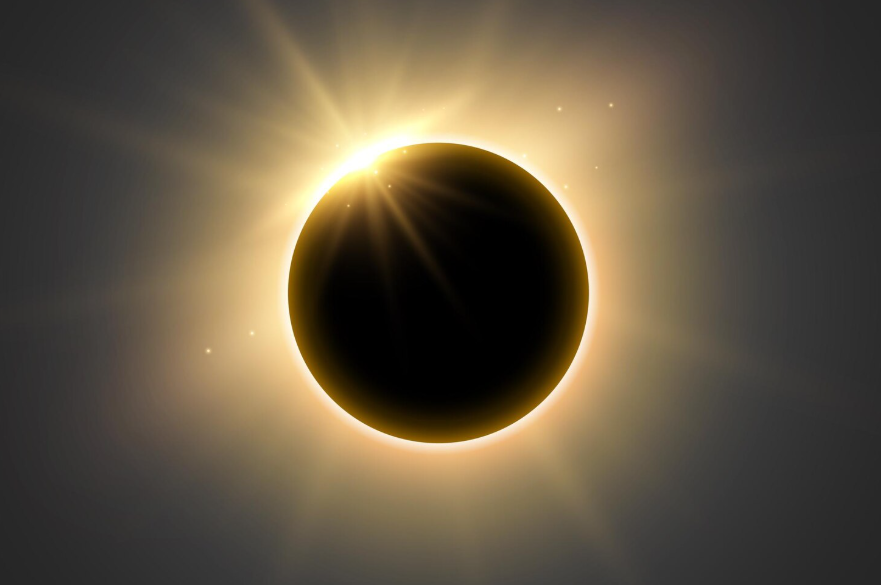
- Solar Eclipse (Kusuf): occurs when the moon is positioned between the earth and the sun, blocking sunlight partially or completely.
- Lunar Eclipse (Khusuf): occurs when the earth is positioned between the sun and the moon, causing the moon to be covered by the earth’s shadow.
In astronomy, eclipses only occur when these three celestial bodies align closely near the lunar orbital nodes. Due to the tilt of the moon’s orbit, eclipses do not occur every month even though new and full moon phases happen regularly.
In the Islamic perspective, the sun and moon are regarded as signs of Allah’s power, not objects of myth or omens of fate.
History of Eclipses During the Prophet’s Time
During the time of the Prophet Muhammad ﷺ, an eclipse occurred coinciding with the وفاة of his son, Ibrahim.
Some people associated the eclipse with this event, but the Prophet ﷺ corrected this misunderstanding, emphasizing that eclipses do not occur due to the birth or death of anyone, but are signs of Allah’s greatness.
This event became a significant foundation in Islamic understanding of eclipses, rejecting pre-Islamic superstitions that linked natural phenomena with mystical causes.
Eclipses in the Perspective of the Qur’an and Hadith
Qur’an
One of the verses related to this topic states:
“Among His signs are the day and the night, the sun and the moon.” (QS. Fussilat: 37)
This verse highlights that the sun and moon are signs of Allah’s greatness that should be reflected upon, not worshipped or associated with superstition.
Hadith
The Prophet ﷺ explained that the sun and moon are signs of Allah and do not eclipse due to anyone’s birth or death. When an eclipse occurs, Muslims are instructed to pray and supplicate.
From this hadith, it can be understood that:
- Eclipses are not mystical or omens of fate.
- They are signs of Allah’s power.
- They serve as moments for worship and self-reflection.
Implications of Eclipses in Islam
- Worship Implications
Eclipses are the basis for the prescribed eclipse prayer (shalat kusuf and khusuf), along with increased supplication, remembrance, charity, and sermons. - Theological (Aqidah) Implications
Islam rejects myths linking eclipses to misfortune or supernatural forces, reinforcing the concept of tawhid (the oneness of Allah). - Educational Implications
Eclipses serve as both spiritual and intellectual learning moments, reminding humans of divine power and cosmic order.
Empirical Dimensions of Eclipse Observation
Empirically, eclipses also involve observable scientific aspects, such as:
- Changes in light intensity and temperature
- Behavioral changes in certain animals
- Optical phenomena in the Earth’s atmosphere
- The need for safe observation methods for solar eclipses
Observing a solar eclipse directly without protection can damage the eyes, while lunar eclipses are safe to view with the naked eye.
These observations show that eclipses are not only spiritual events but also important scientific subjects.
Integration of Fiqh and Astronomy
Fiqh and astronomy complement each other in the study of eclipses:
- Fiqh provides guidelines for worship, such as eclipse prayers.
- Astronomy explains the scientific mechanisms behind eclipses.
Both disciplines intersect in determining timing and understanding the phenomenon comprehensively. Islam does not reject science but encourages its use to understand the signs of Allah.
Wisdom Behind Eclipses in Islam
Eclipses carry several lessons, including:
- Demonstrating Allah’s power over the universe
- Reminding humans of the Day of Judgment
- Encouraging humility and awe toward Allah
- Eliminating superstition and myths
- Promoting scientific inquiry
- Teaching balance and order in nature
- Serving as moments to increase acts of worship
Conclusion
In Islam, eclipses are phenomena with broad dimensions encompassing fiqh, astronomy, and empirical studies. In fiqh, they give rise to the obligation of eclipse prayer as an act of worship. In astronomy, they are natural events that can be calculated scientifically. From an empirical perspective, they are observable phenomena with physical and social impacts.
Islam views eclipses not as bad omens or mystical events, but as signs of Allah’s greatness containing spiritual, scientific, and moral lessons. Thus, eclipses become a means to strengthen faith, deepen knowledge, and increase human awareness of the greatness of the Creator of the universe.
Source
Kasim, D. (2018). Fikih gerhana: Menyorot fenomena gerhana perspektif hukum Islam. Al-Mizan: Jurnal Pemikiran Hukum Islam, 14(1), 41–62. https://www.neliti.com/publications/289999/fikih-gerhana-menyorot-fenomena-gerhana-perspektif-hukum-islam
Qamaruzzaman. (2016). Gerhana dalam perspektif hukum Islam dan astronomi. Empirisma, 25(2), 157–170. https://repository.iainkediri.ac.id/931/
Alim, M. I. N., Rahman, A. G., Handayani, P., Hanifah, L., & Nahdiah. (2023). Pandangan Islam terhadap fenomena gerhana matahari dan bulan. Journal Islamic Education, 1(3). https://maryamsejahtera.com/index.php/Education/article/view/589