Islamic Development Bank Institute Launches Comprehensive Microfinance Toolkits to Combat Poverty
JAKARTA – With more than 700 million individuals worldwide trapped in extreme poverty, the demand for innovative financial solutions has never been more pressing. The Islamic Development Bank Institute (IsDBI) has responded to this challenge by introducing a groundbreaking five-volume series of Islamic Microfinance Toolkits, developed in partnership with the IsDB Global Practice & Partnership (GPP) Directorate’s Cooperation and Capacity Development Department (CCD).
This ambitious initiative aims to transform financial accessibility across the 57 nations that comprise the Islamic Development Bank’s membership, offering ethical, Shari’ah-compliant financing options to help millions escape the cycle of poverty.
Bridging the Financial Inclusion Gap
Traditional banking systems often fail to serve those who need financial services most—smallholder farmers in rural areas, aspiring business owners without collateral, and individuals unable to meet conventional lending requirements. Islamic microfinance presents an alternative approach, emphasizing equitable risk-sharing and fairness over interest-based transactions, providing a respectful pathway to economic engagement.
The newly released toolkits serve as comprehensive guides for implementing this vision, incorporating principles that unite financial development with social equity and environmental sustainability.
Addressing Urgent Economic Disparities
The necessity for these resources is evident in the statistics. Data from the Organisation for Economic Co-operation and Development (OECD) reveals that 21% of residents in Organisation of Islamic Cooperation (OIC) member states live beneath the international poverty threshold—twice the worldwide rate.
Academic research demonstrates Islamic microfinance’s effectiveness as a sustainable poverty reduction strategy. Studies indicate these programs strengthen economic foundations in disadvantaged areas, encourage entrepreneurial activity, and advance the United Nations Sustainable Development Goals (SDGs). Nations including Pakistan, Bangladesh, Malaysia, and Turkey have recorded significant poverty reduction and entrepreneurship growth through Islamic microfinance initiatives, with quantitative research confirming their contribution to SDG targets.
Unlike conventional interest-based lending, these models provide more than capital—they build economic resilience by avoiding exploitative practices and promoting shared economic prosperity.
Expert Perspectives on the Initiative
Dr. Sami Al-Suwailem, IsDBI’s Director General, articulated the initiative’s purpose: “Islamic microfinance, rooted in fairness and risk-sharing principles, serves as an essential instrument enabling economically disadvantaged individuals to engage in economic activities with dignity. These toolkits deliver practical guidance for stakeholders building inclusive financial frameworks that embody Islamic finance’s core values.”
Dr. Issa Faye, GPP’s Director General, highlighted the collaborative nature of the project: “This partnership demonstrates our shared dedication to assisting member nations in enhancing their financial inclusion approaches. Through technical expertise and practical frameworks, we seek to enable institutions to create scalable, culturally appropriate Islamic microfinance programs. I wish to acknowledge both the current development team and former colleagues from multiple departments who contributed to these resources.”
Comprehensive Coverage Across Five Volumes
The toolkit series provides interconnected yet independent resources designed for various stages of Islamic microfinance institution (IMFI) development:
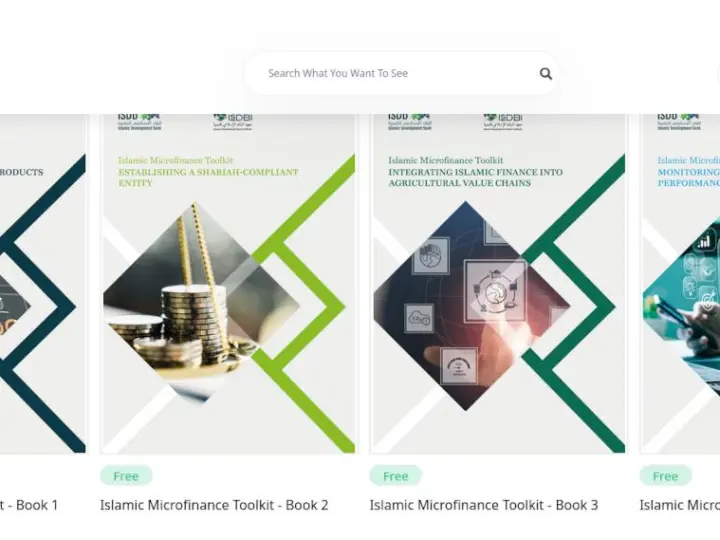
Volume 1 – Concepts, Business Models & Products: Establishes foundational understanding of Islamic microfinance principles, presenting innovative operational models and product designs spanning micro-lending to savings programs.
Volume 2 – Establishing a Shari’ah-Compliant Entity: Delivers detailed guidance on strategic planning, governance framework development, financial sustainability assessment, and maintaining complete Shari’ah compliance—critical for organizations entering this sector.
Volume 3 – Integrating Islamic Finance into Agricultural Value Chains: Focuses on agriculture—a vital sector for many developing nations—featuring Islamic financial instruments such as Murabaha and Musharaka. Real-world examples from member countries illustrate how these mechanisms enhance agricultural productivity and food security.
Volume 4 – Monitoring and Evaluation Performance and Outcomes: Provides performance assessment frameworks and essential indicators for tracking financial sustainability, social impact, and Shari’ah compliance, facilitating evidence-based program enhancement.
Volume 5 – Regulations and Supervisory Guidelines: Presents a regulatory model for authorities, covering licensing procedures, risk mitigation approaches, and Shari’ah governance to support a stable, ethical financial environment.
These volumes extend beyond theoretical concepts, offering adaptable practical models suitable for diverse local circumstances, making them invaluable for expanding operations.
The IsDB’s Legacy and Islamic Finance Principles
Established in 1973 with headquarters in Jeddah, the IsDB has consistently promoted sustainable development throughout its member nations across Africa, Asia, Europe, and the Middle East. Islamic microfinance distinguishes itself through its ethical foundation—prohibiting riba (interest), emphasizing genuine economic activity, and prioritizing community wellbeing.
Academic research from institutions including the University of Connecticut validates its sustainability in addressing global poverty, noting that microfinance principles have elevated millions by providing capital access without creating debt dependency. In Nigeria, Islamic microfinance is regarded as a solution to financial exclusion, with empirical research advocating for expanded initiatives to decrease poverty rates. Internationally, microfinance organizations are viewed as key poverty-reduction mechanisms, with Islamic variants offering additional cultural and religious compatibility for Muslim-majority communities.
Accessing the Resources
The complete toolkit series is now available at no cost for download from the IsDB Institute’s website at https://isdbinstitute.org/product/islamic-microfinance-toolkit/. Policymakers, financial professionals, and development specialists are encouraged to utilize these resources to catalyze positive change within their communities.
This release represents more than a publication—it constitutes a rallying cry for action. As global inequality persists, the IsDB’s toolkits provide a promising solution, combining religious values, financial expertise, and innovative thinking to construct a more just future. These instruments are poised to transform lives throughout the Islamic world and beyond.
Original Article:
Halal Times. (2025, September 29). IsDBI Unveils Innovative Islamic Microfinance Toolkits to Enhance Financial Inclusion. Retrieved from https://www.halaltimes.com/isdbi-unveils-innovative-islamic-microfinance-toolkits-to-enhance-financial-inclusion/