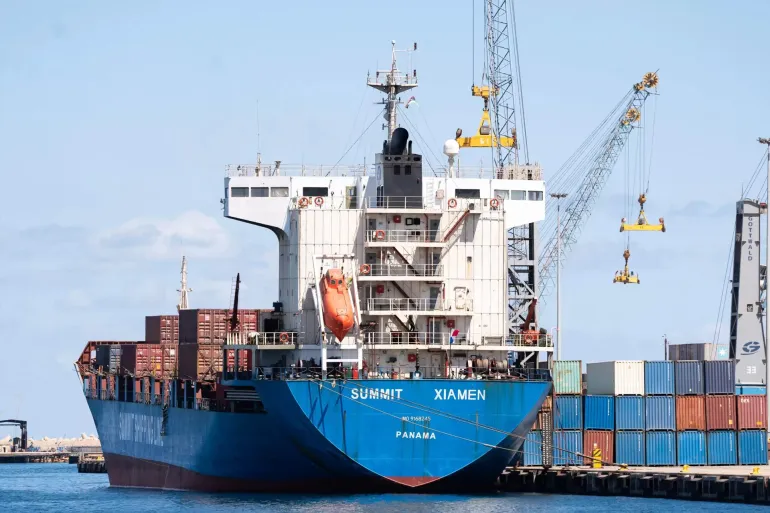
Libya Announces $2.7 Billion International Partnership to Expand Misrata Free Zone
JAKARTA – Libya’s Government of National Unity has unveiled a major strategic partnership aimed at transforming the Misrata Free Zone port terminal into a leading Mediterranean logistics hub through $2.7 billion in foreign investment.
Prime Minister Abdulhamid Dbeibah announced the signing of the international collaboration, which brings together Qatari, Italian, and Swiss companies to develop and expand the port facility located approximately 200 kilometers east of the capital, Tripoli.
Project Scope and Capacity Targets
The ambitious expansion initiative seeks to dramatically increase the port’s container handling capacity to 4 million containers annually, positioning Misrata as a competitive force in western Mediterranean logistics infrastructure.
According to the Prime Minister’s public statements, the development represents a comprehensive approach to port modernization designed to elevate Libya’s position among the region’s largest maritime facilities in terms of both scale and operational capacity.
The Misrata port currently occupies approximately 470 acres, providing substantial room for the planned expansion activities that will transform its operational capabilities.
Economic Impact Projections
Financial analysts associated with the project estimate significant economic returns across multiple dimensions.
Operational revenue generation is projected at approximately $500 million annually once the expanded facility reaches full operational capacity. This revenue stream would represent a substantial addition to Libya’s economy, which currently depends overwhelmingly on petroleum exports accounting for over 95% of economic output.
Employment creation constitutes another major benefit, with forecasts indicating 8,400 direct employment opportunities and approximately 60,000 indirect positions generated through supporting industries and services connected to port operations.
These employment figures would provide meaningful economic opportunity in a nation seeking to diversify beyond its petroleum-dependent economic structure.
Strategic Positioning and Trade Access
Beyond immediate economic metrics, the project aims to strategically reposition Libya within regional and continental trade networks.
The enhanced port capacity targets improved access to African markets, supporting regional trade development and positioning Misrata as a critical logistics node connecting Mediterranean Europe with sub-Saharan Africa.
This geographic advantage places the expanded facility at the intersection of multiple trade corridors, potentially capturing container traffic currently flowing through competing regional ports.
The strategic location offers shipping companies efficient access to both northern and southern markets, creating logistics efficiency that could attract major international shipping lines seeking optimized routing.
Financing Structure and Implementation
The partnership employs direct foreign investment financing rather than government budget allocation, according to official statements emphasizing fiscal responsibility.
This financing approach ensures project implementation proceeds without imposing additional burdens on state finances, allowing Libya to develop critical infrastructure while preserving budgetary resources for other priorities.
The international partnership structure incorporates clear operational arrangements governing development phases, operational responsibilities, and revenue distribution mechanisms designed to align partner incentives with project success.
Foreign partners will assume responsibility for both construction development and subsequent operational management under defined contractual frameworks, bringing international expertise and capital while Libyan authorities maintain sovereign oversight.
Regional Competitive Landscape
The Misrata expansion enters a competitive Mediterranean port market where established facilities in North Africa, Southern Europe, and the Middle East vie for container traffic and logistics business.
Success depends on the project’s ability to offer competitive pricing, efficient operations, and reliable service that attracts shipping companies currently using alternative routes and facilities.
Libya’s geographic position offers inherent advantages for certain trade routes, particularly those connecting European markets with African destinations where Misrata could provide routing efficiency compared to more circuitous alternatives.
However, operational excellence and infrastructure quality will ultimately determine whether the expanded facility captures projected market share in this competitive regional landscape.
Implementation Timeline and Challenges
While announcement details emphasize partnership formalization, specific construction timelines and phased implementation schedules remain to be detailed publicly.
Major infrastructure projects of this scale typically require multi-year development periods encompassing planning, construction, equipment installation, and operational testing before reaching full capacity.
Libya’s complex political environment and ongoing governance challenges could influence project execution, requiring sustained commitment from both government authorities and international partners throughout the extended development period.
Successful implementation will depend on maintaining political stability, ensuring security for international contractors and investors, and preserving the institutional continuity necessary for multi-year infrastructure development.
Broader Economic Diversification Context
The Misrata port expansion aligns with broader economic diversification objectives pursued by Libyan authorities seeking to reduce extreme petroleum dependence.
Developing competitive logistics infrastructure could generate sustainable revenue streams less vulnerable to global petroleum price volatility while creating employment in non-extractive sectors.
Enhanced port capacity also supports general economic development by reducing import costs and improving export efficiency for Libyan businesses across various sectors, potentially catalyzing broader economic activity beyond direct port operations.
The project represents a concrete step toward economic modernization, leveraging Libya’s geographic advantages and natural deep-water port facilities to create value through international trade facilitation rather than solely natural resource extraction.
Original Article:
Aljazeera Net. (2026, January 21). ليبيا: شراكة عالمية لتوسيع المنطقة الحرة في مصراتة بـ2.7 مليار دولار. Retrieved from https://www.aljazeera.net/ebusiness/2026/1/18/libya-misrata-free-zone