How Muslims Wash the Deceased: A Clear and Compassionate Guide
In Islam, caring for someone who has passed away is considered a final act of dignity, mercy, and communal responsibility. One of the most important parts of Islamic funeral rites is washing the deceased, known in Arabic as ghusl al-mayyit.
This guide explains the religious basis, meaning, and step-by-step method of washing a Muslim’s body in a way that is clear and accessible.
- The Religious Status of Washing the Deceased
In Islamic law, washing the deceased is classified as fard kifayah (a communal obligation). If some members of the community perform it properly, the rest are absolved. If no one does it, the entire community shares responsibility.
Islam outlines four essential duties toward a deceased Muslim:
- Washing the body
- Shrouding the body
- Performing the funeral prayer
- Burial
Washing is the first step in this process.
The obligation is based on the teachings of Prophet Muhammad ﷺ. In a narration recorded in Sahih al-Bukhari and Sahih Muslim, the Prophet said regarding a man who died:
Arabic:
اغْسِلُوهُ بِمَاءٍ وَسِدْرٍ, وَكَفِّنُوهُ فِي ثَوْبَيْنِ
Translation:
“Wash him with water and Sidr (jujube leaves) and shroud him in his two garments (that he was wearing for Ihram).”
This hadith forms the primary textual evidence that washing the deceased is required.
Classical scholar Imam al-Nawawi stated that there is scholarly consensus (ijmaʿ) that washing the deceased is a communal obligation.
2. The Spiritual Meaning of the Ritual
🔹 Spiritual Purification
Just as Muslims purify themselves before prayer, the deceased is washed before burial. It symbolizes preparation to return to God.
🔹 Preservation of Human Dignity
The Prophet ﷺ said:
Arabic:
كَسْرُ عَظْمِ الْمَيِّتِ كَكَسْرِهِ حَيًّا
Translation:
“Breaking the bone of a dead person is like breaking it while he is alive.”
(Reported in Sunan Abu Dawud and Sunan Ibn Majah)
This shows that the body must be handled with the same respect as when the person was alive.
🔹 Following the Prophetic Way (Sunnah)
The washing follows detailed instructions taught by the Prophet ﷺ, making it both a religious duty and an act of devotion.
3. Who May Wash the Deceased?
Islam emphasizes modesty and respect:
- The washer must be a trustworthy adult Muslim.
- The washer must be the same gender as the deceased.
- For children, either gender may perform the washing.
- The washer should know the proper Islamic method.
- It is recommended (not obligatory) for the washer to be in a state of wudhu (ablution).
When the Prophet’s daughter passed away, he instructed women to wash her, demonstrating gender guidelines in practice. The narration states:
Arabic:
اغْسِلْنَهَا ثَلَاثًا أَوْ خَمْسًا أَوْ أَكْثَرَ مِنْ ذَلِكَ إِنْ رَأَيْتُنَّ ذَلِكَ، بِمَاءٍ وَسِدْرٍ، وَاجْعَلْنَ فِي الْآخِرَةِ كَافُورًا
Translation:
“Wash her three times, or five times, or more if you see fit, with water and sidr (jujube leaves), and in the last wash add camphor.”
(Recorded in Sahih al-Bukhari, no. 1253; also in Sahih Muslim)
This hadith also establishes several procedural steps discussed below.
4. Preparation and Required Materials
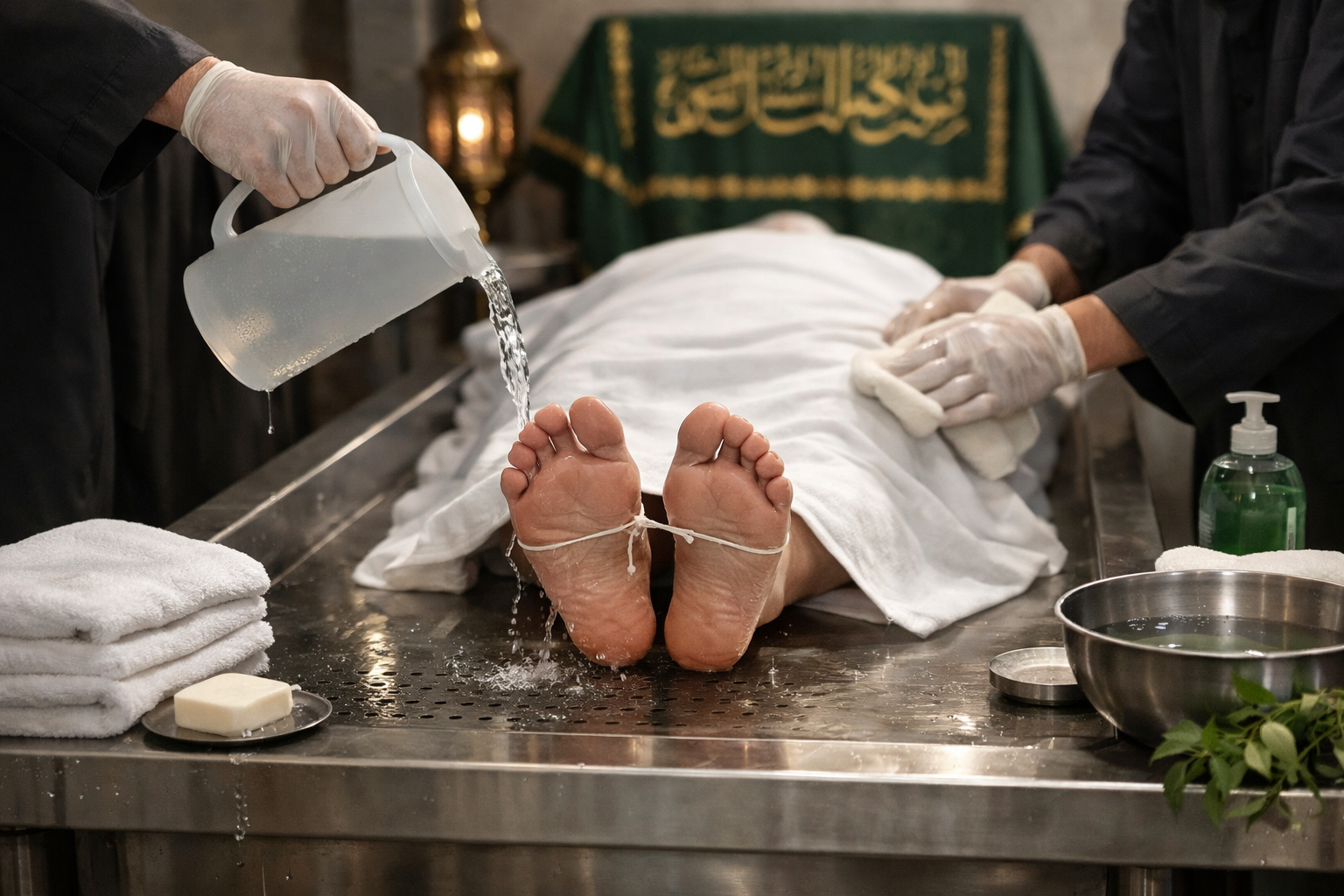
The washing is done privately to protect dignity. Materials typically include:
- Clean water
- Sidr (jujube leaves) or mild soap
- Camphor (for the final wash)
- Gloves or cloth
- Towels
- Cloth to cover the private area
Scholars mention that normal-temperature water is preferred unless warm water is necessary.
5. Intention (Niyyah)
Before washing, the washer makes the intention in the heart.
For a Male Deceased
Arabic:
نَوَيْتُ الْغُسْلَ لِهَذَا الْمَيِّتِ لِلَّهِ تَعَالَى
Translation:
“I intend to wash this deceased man for the sake of Allah.”
For a Female Deceased
Arabic:
نَوَيْتُ الْغُسْلَ لِهَذِهِ الْمَيِّتَةِ لِلَّهِ تَعَالَى
Translation:
“I intend to wash this deceased woman for the sake of Allah.”
The intention does not have to be spoken aloud; it is primarily an internal resolve.
6. Two Levels of Washing
Islamic jurists describe two valid methods:
A. The Minimum Requirement
At the very least, the entire body must be washed so that water reaches every part and impurities are removed. Once this is done properly, the obligation is fulfilled.
B. The Complete (Sunnah) Method
The preferred method follows detailed prophetic guidance.
7. Step-by-Step: The Sunnah Method
-
Begin with Bismillah
Arabic:
بِسْمِ اللَّهِ
Translation:
“In the name of Allah.”
It is recommended to begin acts of worship with God’s name.
-
Cover the Private Area
The ‘awrah (private parts) must remain covered at all times during washing.
-
Remove Impurities First
The abdomen is gently pressed to remove any remaining waste. The private areas are cleaned using gloves or cloth.
-
Perform Wudhu for the Deceased
The deceased is given ablution similar to the living person before prayer.
The Prophet ﷺ said:
Arabic:
ابْدَأْنَ بِمَيَامِنِهَا وَمَوَاضِعِ الْوُضُوءِ مِنْهَا
Translation:
“Begin with her right side and the parts of wudhu.”
(Reported in Sahih al-Bukhari and Sahih Muslim)
Water is not poured deeply into the mouth or nose—these areas are gently cleaned instead.
-
Wash the Entire Body (Odd Number of Times)
The body is washed at least three times. It may be washed five or more times if needed.
The Prophet ﷺ said:
Arabic:
اغْسِلْنَهَا ثَلَاثًا أَوْ خَمْسًا أَوْ سَبْعًا أَوْ أَكْثَرَ مِنْ ذَلِكَ إِنْ رَأَيْتُنَّ
Translation:
“Wash her three times, or five times, or seven, or more than that if you see fit.”
(Recorded in Sahih al-Bukhari)
Order of Washing:
- Head and hair
- Right side of the body
- Left side of the body
Islamic tradition prefers beginning with the right side in honorable matters.
-
Braiding a Woman’s Hair
For a deceased woman:
Arabic:
فَضَفَّرْنَا شَعْرَهَا ثَلَاثَةَ قُرُونٍ
Translation:
“We braided her hair into three braids.”
(Reported in Sahih al-Bukhari no. 1254)
-
Use Camphor in the Final Wash
As instructed by the Prophet ﷺ:
Arabic:
وَاجْعَلْنَ فِي الْآخِرَةِ كَافُورًا
Translation:
“And in the final wash, add camphor.”
Camphor provides fragrance and mild preservation.
-
Drying and Preparing for Shrouding
After washing is complete, the body is gently dried while maintaining modesty. The next stage is shrouding (kafan).
8. Special Case: Martyrs
Those who die in battle defending the Muslim community are not washed.
It is reported in Sahih al-Bukhari (1343–1344) that the Prophet ﷺ ordered the martyrs of Uhud to be buried in their blood without washing.
9. Supplication After Washing
Some scholars recommend reciting a general remembrance such as:
Arabic:
لَا إِلَهَ إِلَّا اللَّهُ وَحْدَهُ لَا شَرِيكَ لَهُ، لَهُ الْمُلْكُ وَلَهُ الْحَمْدُ يُحْيِي وَيُمِيتُ وَهُوَ عَلَى كُلِّ شَيْءٍ قَدِيرٌ
Translation:
“There is no god except Allah alone, without partner. To Him belongs all dominion and praise. He gives life and causes death, and He has power over all things.”
This reflects remembrance of God and hope for mercy.
Conclusion
The washing of a Muslim’s body after death is:
- A communal religious duty
- A final act of dignity and compassion
- A symbolic purification
- A practice directly taught by Prophet Muhammad ﷺ
Through this ritual, Muslims express that human dignity continues even after death, and that caring for the deceased is an act of faith, respect, and love.
Sources
Al-Bukhari, M. I. (n.d.). Sahih al-Bukhari.
Abu Dawud, S. A. (n.d.). Sunan Abi Dawud.
CNN Indonesia. (2024, June 10). Niat, tata cara, dan bacaan doa memandikan jenazah. https://www.cnnindonesia.com/edukasi/20240610101503-569-1107883/niat-tata-cara-dan-bacaan-doa-memandikan-jenazah
Detik Hikmah. (2024). Tata cara memandikan jenazah dan perlengkapannya. https://www.detik.com/hikmah/khazanah/d-7306569/tata-cara-memandikan-jenazah-dan-perlengkapannya
INELDA. (n.d.). Important ritual of ghusl: Islamic washing. https://inelda.org/important-ritual-of-ghusl-islamic-washing/
Ibn Majah, M. Y. (n.d.). Sunan Ibn Majah.
Muslim ibn al-Hajjaj. (n.d.). Sahih Muslim.
Hakim, M. S. (2023, August 25). Penjelasan hadis tentang tata cara memandikan jenazah. Muslim.or.id. https://muslim.or.id/86623-penjelasan-hadis-tentang-tata-cara-memandikan-jenazah.html
Nahdlatul Ulama Online. (2018, January 18). Tata cara memandikan jenazah. https://www.nu.or.id/syariah/tata-cara-memandikan-jenazah-JaMGW
NBC UK. (n.d.). Shrouding and washing. https://nbc.org.uk/shrouding-and-washing/