Bangladesh Squanders $3 Trillion Halal Market Opportunity Through Systemic Failures
Exports stagnate below $1 billion despite massive global demand
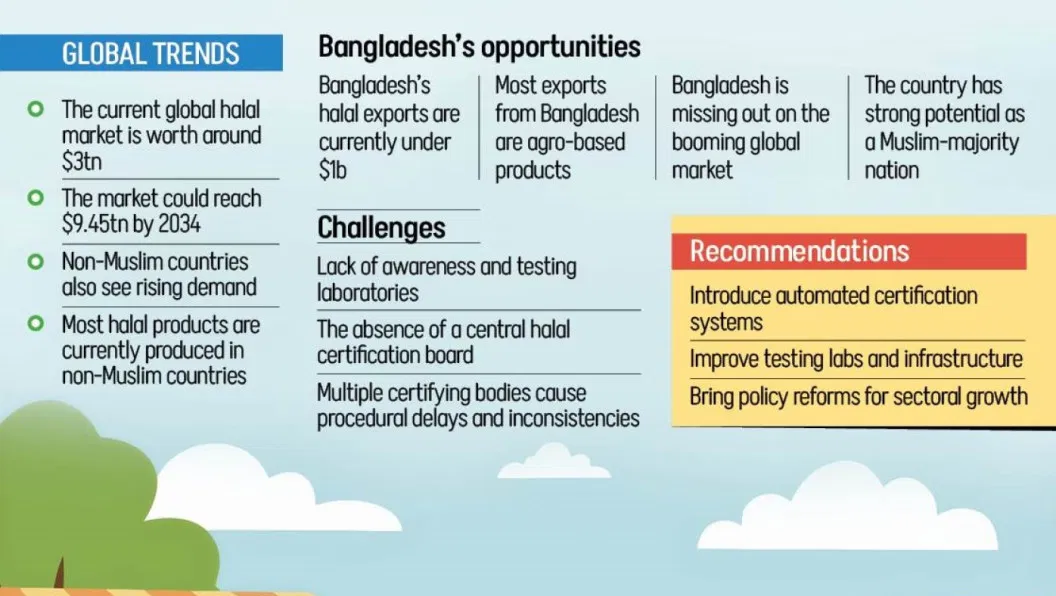
Bangladesh is failing to tap into the $3 trillion global market for halal products as exports remain below $1 billion, mainly due to absence of a proper ecosystem plus an independent authority to issue accredited certifications, businesspeople stated.
The rapidly growing industry projects reaching $9.45 trillion by 2034. However, Bangladesh’s exports of mostly agro-based products are limited to around $850 million, they added.
The comments came at an event organized by the Dhaka Chamber of Commerce and Industry (DCCI) in the capital.
Quality standards attract non-Muslim markets
Razeev H Chowdhury, senior vice-president of the DCCI, said that in addition to Muslim consumers, many non-Muslim countries now show growing interest in halal products due to their quality plus hygienic production processes. Given the current pace of expansion in the global halal market, Bangladesh has a significant opportunity to tap into the sector, he added. Chowdhury stated that as the fourth-largest Muslim-majority country globally, with abundant agricultural, livestock, fisheries resources, Bangladesh holds strong potential.
However, Chowdhury expressed disappointment that currently, non-Muslim countries produce most halal products available worldwide. He added that Bangladesh’s readymade garment sector has already demonstrated its capabilities on the global stage. Now, it’s time to develop the halal industry as a new economic driver.
Multiple structural barriers identified
Despite vast potential, Bangladesh faces several structural plus institutional challenges in developing the halal industry, including low awareness of halal standards, lack of modern laboratories plus technology, shortage of skilled manpower, Chowdhury said. He suggested implementing an automated certification system, establishing advanced laboratory facilities, strengthening traceability plus logistics support to overcome these barriers.
Chowdhury also emphasized the need to form a “Halal Certification Board” comprising representatives of the state-run Bangladesh Standards and Testing Institution (BSTI) plus the Bangladesh Islamic Foundation (BIF) to ensure global recognition of local certificates.
Additionally, he said, Bangladesh must strictly follow the guidelines of the Standards and Metrology Institute for Islamic Countries while taking strong diplomatic plus commercial initiatives to promote its halal products internationally.
Certification fragmentation creates inefficiencies
In a presentation, Mominul Islam, assistant professor at the International University of Business Agriculture and Technology, pointed out that both the BIF plus BSTI issue halal certificates, often resulting in procedural complexities.
He added that key barriers to the sector’s development include lack of modern equipment, skilled human resources, supply chain systems; weak country branding; limited small plus medium enterprise participation; absence of a unified halal policy.
Technology solutions proposed
Md Abul Kalam Azad, assistant manager for export at Paragon Group, emphasized the need for a digital, technology-based halal certification system plus compliance audits to ensure product quality.
AGM Sayadul Haq Bhuiyan, head of supply chain plus export at Bengal Meat, underscored the importance of value addition plus blockchain technology use to trace animal life-cycle data. He also stressed that halal certification authorities in Bangladesh must achieve international accreditation standards.
Government coordination essential
Abu Saleh Patwary, deputy director at the BIF, mentioned that currently no government entity is capable enough to independently issue halal certificates, requiring several institutions to coordinate the process. He also emphasized enhanced government monitoring for quality assurance of halal products.
Baby Rani Karmakar, director general-1 at the Export Promotion Bureau, highlighted that the global halal market grows by approximately 12 percent annually, but Bangladesh still lags behind. She called for concerted efforts to increase Bangladesh’s market share in the global halal industry.
Specialized economic zone under consideration
Ariful Hoque, director general of international investment promotion at the Bangladesh Investment Development Authority, stated that Bangladesh’s halal sector could play vital roles in export diversification following its graduation from least developed country status. He said the government seriously considers establishing a dedicated economic zone for the halal industry.
Aminul Islam, director general of the Bangladesh Accreditation Board, said Bangladesh lags behind in global halal market participation, noting that coordinated efforts could help unlock the sector’s full potential.
Strategic imperative for economic transformation
The stark disconnect between Bangladesh’s natural advantages—the world’s fourth-largest Muslim population, abundant agricultural resources, established manufacturing capabilities—plus its minimal halal market share represents a massive opportunity cost. As the global market accelerates toward $9.45 trillion by 2034, Bangladesh risks permanent marginalization unless it addresses the certification fragmentation, infrastructure deficits, skills gaps that currently cripple its export competitiveness.
The proposed solutions—unified certification boards, blockchain traceability, specialized economic zones, international accreditation alignment—offer pathways toward capturing meaningful market share. However, implementation requires political will to overcome institutional inertia plus inter-agency rivalries that have historically paralyzed Bangladesh’s efforts to diversify beyond garments. The halal industry presents Bangladesh with a rare second chance to replicate its RMG success story, but the window narrows as regional competitors like Indonesia, Malaysia, Pakistan consolidate their positions within the lucrative sector.
Original Article:
Staff Correspondent. (2025, October 11). Bangladesh ships $850m worth of halal products annually: DCCI. The Daily Star. Retrieved from https://www.thedailystar.net/business/news/bangladesh-ships-850m-worth-halal-products-annually-dcci-4007281