Saudi Arabia Dramatically Reduces Scope of Ambitious 100-Mile Desert Megacity Project
JAKARTA – Saudi Arabia has significantly curtailed plans for The Line, its extraordinarily ambitious 100-mile-long megacity project in the desert, marking a substantial shift in the Kingdom’s economic development strategy.
The futuristic linear city, originally unveiled as a cornerstone of Crown Prince Mohammed bin Salman’s Vision 2030 initiative in 2016, represented a central component of the nation’s $2 trillion redevelopment program designed to diversify the economy beyond petroleum dependence through massive real estate ventures.
However, the Riyadh government has now pivoted its priorities, acknowledging financial constraints and the need for strategic recalibration.
Financial Realities Force Strategic Reassessment
At a prominent investment forum held in the capital last week, a Saudi official candidly addressed the situation, acknowledging excessive spending and an unsustainable pace of development. The official noted that the Kingdom rushed forward at maximum velocity and is currently running budget deficits, necessitating a comprehensive reprioritization of projects.
The Line was conceptualized as a revolutionary linear metropolis situated in the desert near the Red Sea, forming part of Saudi Arabia’s Neom urban development initiative. Originally designed to accommodate 9 million inhabitants—representing over one-quarter of Saudi Arabia’s entire population—the project aimed to fundamentally reimagine urban planning for the future.
Original Vision of Revolutionary Urban Design
The city’s initial design featured groundbreaking concepts: no roads, automobiles, or emissions, operating entirely on renewable energy sources with 95 percent of surrounding land preserved for natural environments. The structure would have risen 500 meters above sea level, spanning 200 meters in width and extending 170 kilometers in length.
However, the project has encountered substantial delays throughout its development timeline. According to recent reports, the downsized plan will accommodate merely a fraction of the originally projected population, with approximately 300,000 residents in a city spanning only several miles rather than the planned 100-mile expanse.
Broader Neom Development Context
The Line constituted one of several Neom initiatives encompassing futuristic urban developments and industrial complexes across Tabuk province, all intended to operate using renewable energy sources. The Kingdom has faced international criticism for forcibly relocating thousands of residents from the area to accommodate these developments.
Jerry Inzerillo, an American-born executive serving as a key advisor to the crown prince, characterized the changes as a necessary course correction as Saudi Arabia confronts the economic challenges of depressed oil prices. When Vision 2030 launched in 2016, petroleum prices averaged $100 per barrel; they have not returned to triple digits since 2022, while oil continues constituting half of the national economy.
Inzerillo, who leads the $63 billion Diriyah city-within-a-city project in Riyadh scheduled for 2030 completion, explained that financial pressures compel more conservative planning approaches.
Strategic Refocusing Toward New Priorities
Sources indicate the country has chosen to redirect funding following delays across multiple gigaprojects, instead emphasizing investment in artificial intelligence infrastructure and data centers powered by hydrocarbon resources.
Yasir Al-Rumayyan, governor of the Public Investment Fund, announced at last week’s summit that the next strategic framework would be revealed imminently. The repositioning reportedly comes as mounting pressure affects PIF and its portfolio companies to generate improved near-term returns.
Additionally, the Kingdom has committed to numerous new projects with firm deadlines, including hosting the 2034 men’s football World Cup, which requires constructing 11 stadiums.
Status of Related Neom Projects
The Line: Development plans have been suspended again. Saudi Arabia initially stated in 2021 that the complete 100-mile city would finish by 2045.
Oxagon: This floating industrial complex, envisioned in an octagonal shape approximately 16 miles north of Duba, remains unbuilt though progress has occurred. The first phase is scheduled for 2027.
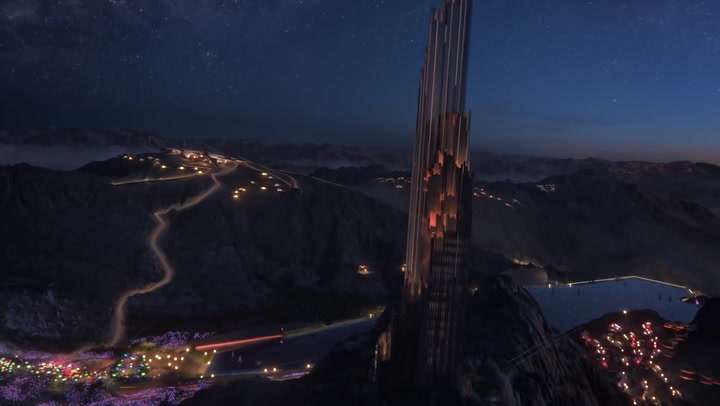
Trojena: The mountain tourism destination, located on Jebal al-Lawz at elevations reaching 2,600 meters above sea level, was intended as the Arabian Peninsula’s first major outdoor skiing venue. Initially scheduled to host the 2029 Asian Winter Games, completion is now projected for 2032.
Sindalah: This luxury island destination represents the only officially completed Neom component, holding its grand opening celebration in October of last year—three years behind schedule and at triple the original budget. As of mid-year, the resort still had not opened to public visitors.
The Kingdom announced 12 additional Neom projects in 2023, none yet constructed. These include Leyja, a natural valley development between 400-meter mountains featuring boutique hotels; Epicon, a resort with two angular skyscrapers; Siranna, an ultra-luxury destination with a 65-room hotel and 35 exclusive residences formed from hexagonal structures; and Utamo, a futuristic performance and immersive arts venue.
Original Article:
Tech Africa News. (2025, November 30). End of The Line? Saudi Arabia scales back plan for wildly ambitious 100-mile-long megacity in the desert. Retrieved from https://www.independent.co.uk/news/world/middle-east/the-line-saudi-arabia-megacity-neom-b2858056.html