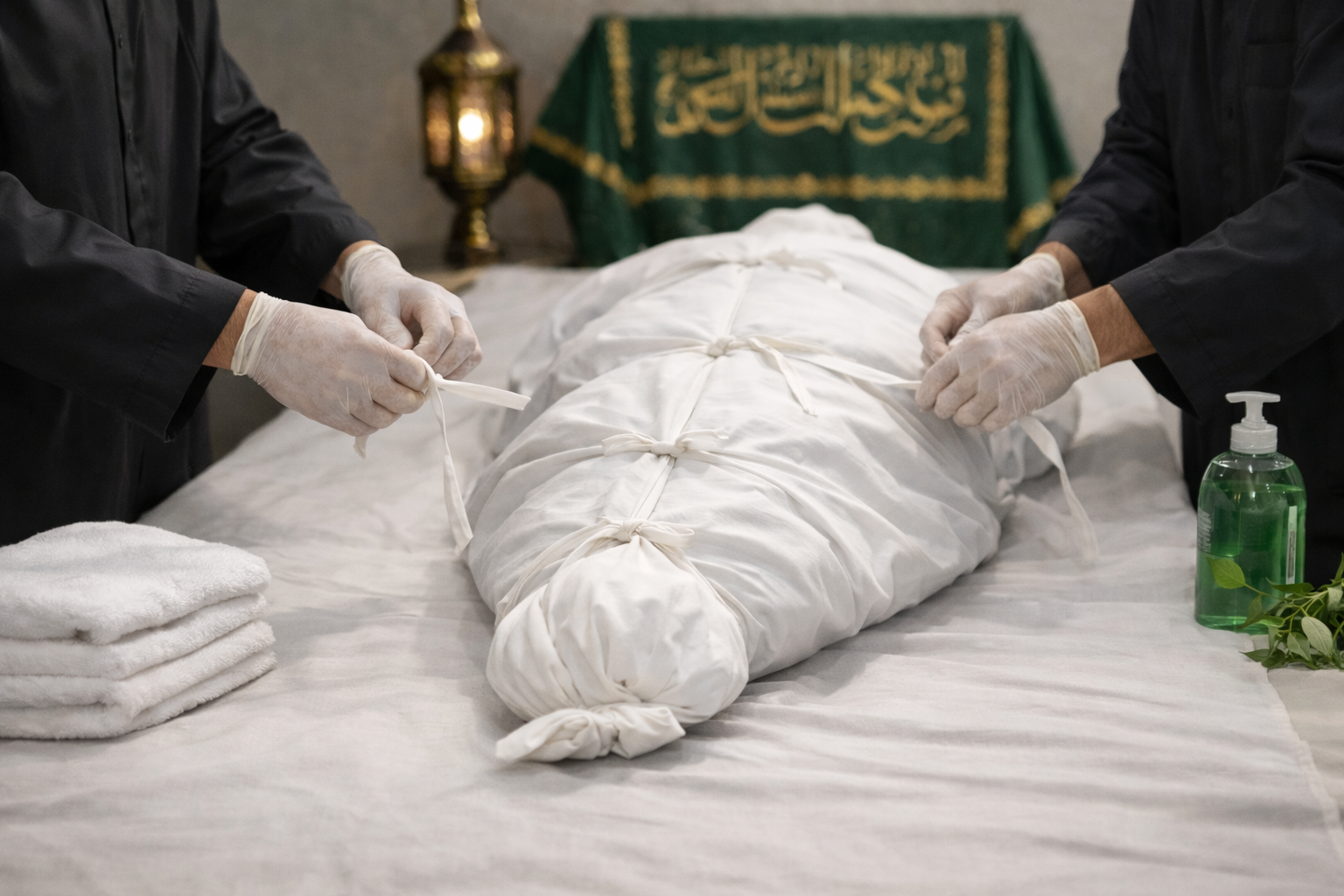
How Muslims Shroud the Deceased: A Simple and Respectful Guide
In Islam, caring for a person after death is considered a sacred responsibility. One important part of this process is shrouding the body, known in Arabic as kafan. This act is not only practical but also deeply spiritual, reflecting dignity, equality, and humility before God.
This article explains how and why Muslims shroud the deceased, in a way that is clear and accessible for readers of all backgrounds, including non-Muslims.
The Religious Basis of Shrouding
In Islamic teaching, preparing a deceased person for burial is a communal obligation (fard kifayah). This means that if some members of the community fulfill the duty, the rest are absolved of responsibility.
The requirement to shroud the deceased comes from the teachings of the Prophet Muhammad ﷺ. In an authentic narration recorded in Sahih al-Bukhari and Sahih Muslim, the Prophet instructed his companions regarding a man who passed away:
“Wash him with water and sidr (jujube leaves), and shroud him in his two garments.”
This narration clearly establishes that washing and shrouding the deceased are religious obligations.
Another narration describes the death of Mus‘ab ibn ‘Umair during the Battle of Uhud. The companions had only a small piece of cloth to cover him. When they covered his head, his feet were exposed, and when they covered his feet, his head became uncovered. The Prophet instructed them to cover his head and place fragrant plants over his feet. This incident demonstrates an important principle: the entire body should be covered if possible, but if resources are limited, one should do the best they can.
Recommended Practices in Shrouding
While shrouding is obligatory, Islamic tradition also provides recommended guidelines:
1. Using White Cloth
The Prophet encouraged wearing white garments and using white cloth for burial. White symbolizes purity and simplicity. It reflects the idea that all people return to God without worldly status or decoration.
2. Using Three Layers for Men
It is recommended that a male be shrouded in three white sheets. When the Prophet himself passed away, he was wrapped in three plain white Yemeni cloths, without a shirt or turban. This narration is also recorded in Sahih al-Bukhari and Sahih Muslim.
3. Using Striped Cloth (If Available)
Another narration mentions that if possible, the deceased may be shrouded in a striped Yemeni cloth (hibarah). This is recommended but not required.
Intention and Supplication
Before beginning the shrouding process, the person performing it makes an intention in their heart, seeking to fulfill this communal obligation for the sake of God.
A common supplication asks God to make the shroud a source of mercy, light, and protection for the deceased. These prayers reflect the belief that even after death, God’s compassion continues.
How a Male Is Shrouded
For a man, the shroud typically consists of three main white sheets and several ties to secure them.
Main Components:
- Lifafah – the outermost sheet
- Izaar – the second sheet
- Qamees – an inner shirt-like sheet
- 3–4 tie ropes
- Two smaller cloths to cover private areas before and after washing
Basic Steps:
- The sheets are spread out in layers.
- The body, already washed, is placed gently on the top sheet.
- The inner sheet (Qamees) is folded over the body.
- Light perfume may be applied to areas that touch the ground during prayer (forehead, nose, hands, knees, feet).
- The remaining sheets are folded right side first, then left.
- The shroud is secured with ties above the head, below the feet, and around the body.
If there is not enough cloth to cover the entire body, priority is given to covering the head and upper body, following the example set by the Prophet.
How a Female Is Shrouded
For women, the shroud typically consists of five white pieces and ties.
Main Components:
- Lifafah – outermost sheet
- Sinaband – a chest-to-thigh wrap
- Izaar – body wrap
- Qamees – inner garment
- Orni – head covering
- 3–4 tie ropes
- Two smaller cloths for covering private areas
Basic Steps:
- All cloth layers are arranged in order.
- The body is placed gently on the sheets after washing.
- The inner garment is folded over the body.
- Perfume may be lightly applied.
- The sinaband is wrapped around the torso.
- The head is covered with the orni.
- The remaining sheets are folded around the body.
- The shroud is secured with ties.
As with men, modesty and dignity are central throughout the process.
The Spiritual Meaning Behind the Shroud
Beyond its physical function, the shroud carries deep symbolic meaning.
In Islamic belief, the shroud represents equality and humility. In death, every person—regardless of wealth, race, or social status—is wrapped in simple white cloth. Expensive clothing, titles, and possessions are left behind. What remains, according to Islamic teaching, are one’s actions and character.
This simplicity reminds the living that life is temporary and that moral conduct matters more than material success.
Shrouding the deceased in Islam is a practice rooted in prophetic tradition and guided by principles of dignity, modesty, and equality. While there are detailed procedures, the core message is simple: treat the deceased with respect, fulfill communal responsibility, and remember the spiritual reality of human life.
Even for those outside the Muslim faith, the practice reflects universal values—honor for the dead, compassion for families, and recognition of human equality in the face of mortality.
Sources
CNN Indonesia. (2024). Doa mengkafani jenazah lengkap bacaan niat dan tata cara. https://www.cnnindonesia.com/edukasi/20240325133009-569-1078669/doa-mengkafani-jenazah-lengkap-bacaan-niat-dan-tata-cara
NBC UK. (n.d.). Shrouding and washing. https://nbc.org.uk/shrouding-and-washing/
Yayasan Bunga Kamboja. (n.d.). Cara mengkafani jenazah dengan baik dan benar. https://yayasanbungakemboja.com/cara-mengkafani-jenazah-dengan-baik-dan-benar/
Al-Bukhari, M. I. (n.d.). Sahih al-Bukhari.
Muslim ibn al-Hajjaj. (n.d.). Sahih Muslim.