Muslim Tech Workers Face Crisis of Faith Over Gaza Contracts
When Ibtihal Aboussad stood up at Microsoft’s 50th anniversary celebration and confronted the company’s AI chief about working with Israel’s military, she wasn’t just making a political statement. She was asking a deeply personal question that’s keeping Muslim tech workers awake at night: Is my paycheck coming from blood money?
The Moment That Changed Everything
Picture this! A young woman in hijab, surrounded by corporate executives in suits, calling out Microsoft’s CEO as a “war profiteer” while security guards move in. That’s exactly what happened when Aboussad decided she couldn’t stay silent anymore about her company’s contracts with the Israeli Defense Forces.
But before that dramatic confrontation, she sent two emails that would ripple through the tech world. The first went to all her colleagues, appealing to their humanity. The second, sent to Microsoft’s Muslim employees, had a subject line that cut straight to the heart: “Muslims of Microsoft, Our Code Kills Palestinians.”
A Crisis Spreading Through Silicon Valley
Aboussad isn’t alone. Across major tech companies like Microsoft, Google, and Amazon, Muslim employees are grappling with an impossible question: Can they religiously justify working for companies that they believe are helping to fuel a war?
The numbers are staggering. The Guardian spoke with nearly a dozen Muslim tech workers, many afraid to use their names for fear of losing their jobs. Some have already quit. Others are planning to leave. Many more are caught in what they describe as a “constant spiritual crisis.”
“Honestly, I’ve been praying about what Allah wants me to do,” one Microsoft employee confided. “It doesn’t seem right for a Muslim to continue working for such companies. But if we leave, then there could be a pro-Israeli person who takes our spot.”
The Family Dinner Debates
The crisis isn’t just personal—it’s tearing families apart. One Google worker decided their job no longer feels “halal” (religiously permissible) but faces fierce opposition from their father, who argues it’s their “Islamic duty” to stay because the job was a blessing from God.
“My parents are like, ‘If you quit, how does that help the cause?'” the worker explained. “I don’t think they understand that by quitting I am not trying to help the cause. I’m at a spiritual and moral negative right now. I’m just trying to go back to neutral.”
Following the Money Trail
So what exactly are these tech giants doing that’s causing such anguish? The details have been murky for years, but recent investigations have pulled back the curtain:
- Microsoft has what leaked documents describe as a “footprint in all major military infrastructures” in Israel. The company deepened its military ties after the October 7, 2023 attacks, despite conducting an internal investigation that found “no evidence” their technology was used to harm people.
- Google and Amazon share a $1.2 billion contract called “Project Nimbus,” providing cloud services and advanced AI tools to the Israeli military. This includes image recognition and analysis capabilities that directly support military operations.
These revelations felt like a “mask-off moment” for many workers, destroying any remaining doubt about their employers’ roles in the conflict.
The Religious Reckoning
Enter Imam Omar Suleiman, a popular Islamic scholar with over 3 million Instagram followers who has become the unofficial counselor for Muslim tech workers in crisis. For 20 years, he’s helped people figure out whether their jobs align with their faith, but tech companies present a unique challenge.
“It’s very hard to compare something that’s just purely generating weapons of mass destruction and a tech company that has a wide array of businesses, but also happens to be manufacturing for a genocide,” Suleiman explained.
Unlike working at a liquor store (clearly forbidden in Islam), tech work exists in a gray area.
Is coding productivity tools the same as building bombs?
What if you work for LinkedIn, which is owned by Microsoft but seems removed from military contracts?
The Two-Choice Ultimatum
Some Muslim activists aren’t waiting for scholarly guidance. Hasan Ibraheem, a Google worker fired for occupying the company’s New York office, wrote a powerful essay that’s circulating among Muslim tech workers. His message is stark and simple: you have two choices.
“If you do not organize, you must leave,” Ibraheem wrote. “And even if you organize, your goal should be to eventually leave. Organizing does not absolve you of complicity indefinitely.”
He quotes the Prophet Muhammad:
“Whosoever of you sees an evil, let him change it with his hand; and if he is not able to do so, then with his tongue; and if he is not able to do so, then with his heart – and that is the weakest of faith.”
Protests and Pushback
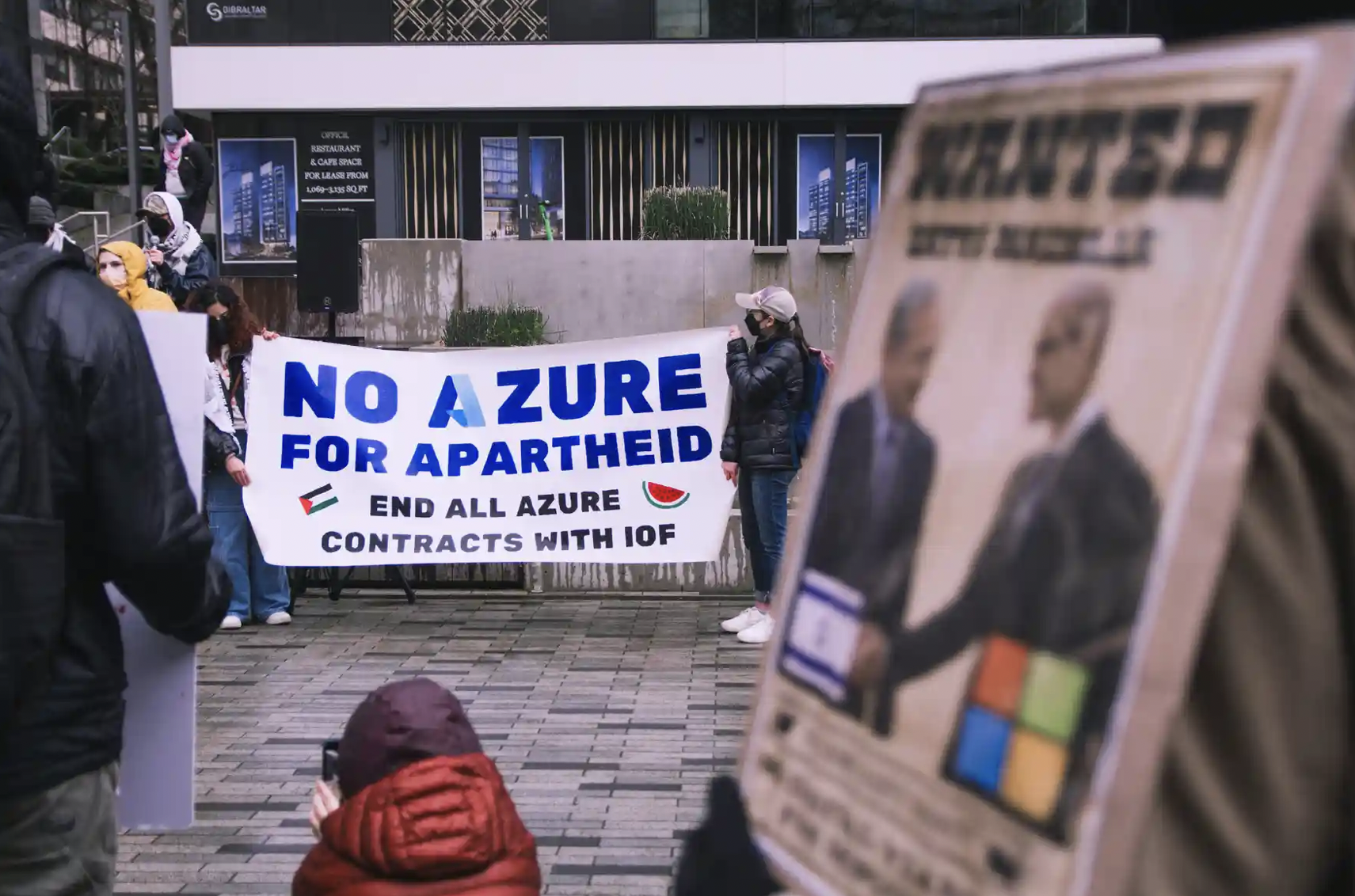
The internal resistance is growing. At Microsoft, a group called “No Azure for Apartheid” (referring to Microsoft’s cloud platform) has disrupted multiple company events. Workers have been fired for organizing vigils. Some, like senior UX designer Jasmina Mathieu, have resigned publicly.
The companies have pushed back hard. Microsoft now blocks emails containing words like “genocide,” “Gaza,” “Palestine,” or even the name “Vaniya Agrawal” (Aboussad’s co-protester). When one worker found a way around the block to send a company-wide email, she called on colleagues to either organize or quit: “If you choose to leave Microsoft to no longer be complicit in genocide, do not go quietly.”
The Global Impact
The crisis extends far beyond Silicon Valley. At Microsoft’s Cairo office, about 100 employees took a coordinated day off in protest—just shy of an illegal strike in Egypt. For many workers in the Middle East and North Africa, Aboussad’s confrontation was the first time they fully understood their company’s military contracts.
One Cairo-based worker described the turning point: “The response of [the executives] was very dismissive. And I think [the CEO] laughed, and that sort of made me feel like, no, I don’t think I belong here, and me staying here is just supporting what they’re doing.”
The Impossible Choice
What makes this crisis so wrenching is that there’s no easy answer. Islamic law provides guidance, but tech companies don’t fit neatly into traditional categories. Some workers are the primary breadwinners for their families. Others are on employer-sponsored visas. Some genuinely believe they can do more good by staying and fighting from within.
Imam Suleiman and his research institute are working on a framework to help Muslims navigate these decisions, but for now, workers are largely on their own. They’re weighing their faith against their financial security, their principles against their families’ needs, their desire to help Palestine against the fear that leaving might just make room for someone who cares less.
A Mirror for America
This story is about more than just Muslim tech workers. It’s a reflection of how deeply American companies have become entangled in global conflicts, often without their employees’ knowledge or consent. It’s about the price of principle in a world where technology and warfare are increasingly intertwined.
As one long-time Microsoft employee put it: “I know during South African apartheid, the company did flip to the right side. I hope that history repeats itself and they become the company where the culture is that you make everyone feel great.”
For now, though, that hope feels distant. And Muslim tech workers continue to wrestle with a question that has no easy answer: How do you live with integrity when your livelihood depends on what you believe is injustice?
The protests continue. The resignations mount. And in conference rooms and cubicles across Silicon Valley, the crisis of conscience deepens—one prayer, one email, one difficult conversation at a time.
Original Article:
The Guardian. (2025, June 25). Big Tech’s Muslim workers speak out over Gaza and Israel. https://www.theguardian.com/technology/2025/jun/11/big-tech-muslim-workers-gaza-israel