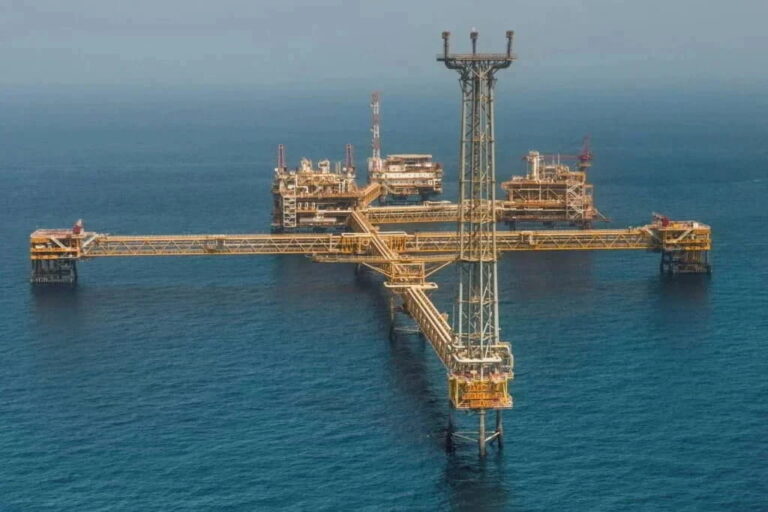
Qatar Positioned to Dominate Middle East Gas Production by 2030s

Source: Offshore Energy
JAKARTA – Energy consultancy Rystad Energy forecasts that the Middle East will surpass Asia as the world’s second-largest natural gas producing region this year, trailing only North America in global output rankings.
Regional Gas Production Surge
Natural gas production across the Middle East has witnessed remarkable expansion, growing approximately 15% since 2020, according to Rystad Energy analysts. This growth reflects regional producers’ strategic focus on capitalizing on their gas reserves and expanding export capabilities to meet rising global demand.
The region currently generates around 70 billion cubic feet per day (Bcf/d) of natural gas. Rystad projects this output will increase by 30% by 2030 and 34% by 2035, driven primarily by major developments in Saudi Arabia, Iran, Qatar, Oman, and the United Arab Emirates.
By the decade’s end, the Middle East is expected to add an additional 20 Bcf/d of production capacity—equivalent to approximately half of Europe’s current natural gas requirements. However, these projections assume Brent crude oil prices remain stable around $70 per barrel and oil-indexed gas prices maintain levels between $7-9 per million British thermal units (MMBtu).
Should gas prices drop below $6 per MMBtu, new project timelines could face delays, potentially limiting volume growth to 20% or less, depending on the duration of the price decline.
Export Expansion Plans
Regional producers are actively working to make an additional 10 Bcf/d available for export by 2030, targeting European markets and growing Asian demand centers. Total Middle Eastern output could reach 90 Bcf/d by the end of this decade, according to Rystad’s analysis.
The majority of this growth will stem from new projects capable of cost-effective production below $5 per thousand cubic feet, particularly in Qatar, the UAE, and Saudi Arabia.
Qatar’s Offshore Development Leadership
Qatar’s ambitious North Field expansion program is set to increase the country’s liquefied natural gas (LNG) capacity by 80% by the end of the 2020s, rising from 77 to 142 million metric tons annually, while maintaining breakeven costs under $6/MMBtu.
Rahul Choudhary, vice president of Upstream Research at Rystad, noted that Middle Eastern projects demonstrate resilience even below these price levels due to their low breakeven costs, typically under $5 per thousand cubic feet.
By 2028, the region should introduce 60 million metric tons per year of new LNG capacity, with Qatar contributing 48 million metric tons annually through its North Field East and North Field South offshore developments.
Current Production Landscape and Future Projections
Iran currently leads Middle East gas production at approximately 25 Bcf/d, followed by Qatar at 16 Bcf/d and Saudi Arabia at 8 Bcf/d. Iran’s production is expected to increase by 6% to about 26 Bcf/d toward the decade’s end, primarily from the South Pars Field in the Persian Gulf, despite recent production disruptions during regional conflicts.
Qatar’s gas output is projected to surge by nearly 50% to 24 Bcf/d, driven by ongoing North Field development activities. By the early 2030s, Qatar will likely surpass Iran as the Middle East’s largest gas producer, according to Rystad’s forecasts.
Regional Contributions and Growth Drivers
The UAE and Saudi Arabia are each expected to contribute an additional 3 Bcf/d of gas production, while Israel’s output should increase by 1.5 Bcf/d following planned expansion phases at the offshore Leviathan and Tamar fields.
This production growth aligns with broader regional strategies to diversify energy portfolios and capitalize on global energy transition dynamics, where natural gas serves as a bridge fuel between traditional hydrocarbons and renewable energy sources.
Market Implications and Strategic Outlook
The Middle East’s emergence as a dominant gas producer reflects the region’s strategic positioning in global energy markets. With substantial reserves and cost-competitive production capabilities, Middle Eastern producers are well-positioned to meet growing international demand while maintaining economic viability across various price scenarios.
The projected growth trajectory suggests a fundamental shift in global gas supply dynamics, with the Middle East playing an increasingly crucial role in energy security for both European and Asian markets. This transformation will likely influence geopolitical energy relationships and trade patterns throughout the remainder of the decade.
As regional producers continue expanding their production and export infrastructure, the Middle East’s gas sector appears poised for sustained growth, with Qatar emerging as the region’s production leader by the early 2030s. The success of these expansion plans will depend on maintaining favorable economic conditions and continued investment in advanced extraction and processing technologies.
Original article:
offshore-mag.com. (n.d.).Qatar on course to be Middle East’s largest gas producer in the 2030s. Retrieved July 15, 2025, from https://www.offshore-mag.com/regional-reports/middle-east/news/55303169/rystad-energy-qatar-on-course-to-be-middle-easts-largest-gas-producer-in-the-2030s