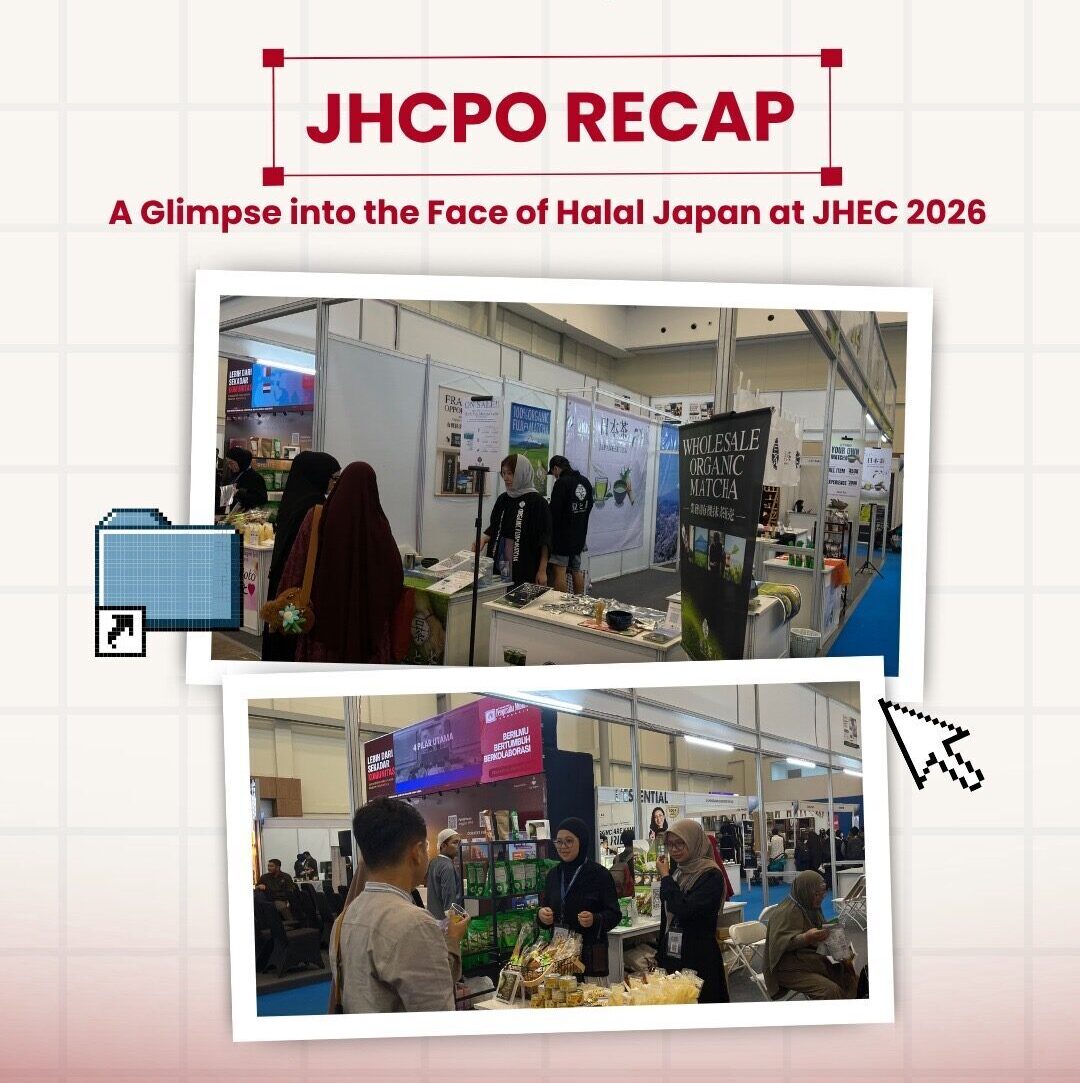
JHCPO Recap: A Glimpse into the Face of Halal Japan at JHEC 2026
JAKARTA (17/9/2026)
Japan’s Strong Determination to Unlock the Potential of Indonesia’s Halal Market
From August 28–30, 2026, Jamalindo Research & Consulting (hereafter Jamalindo R&C) took part in the Jakarta Halal Expo Conference 2026 (JHEC 2026). This event is one of the largest halal exhibitions in the region, held over three days at ICE BSD, Tangerang, Indonesia. The event brought together visitors and investors to explore the latest trends in the halal industry, offering practical guidance from the import process through to sales, along with business-matching sessions with supermarket and minimarket chains. For both local and international entrepreneurs, the event presented a valuable opportunity to deepen their understanding of the Indonesian market.
At JHEC 2026, Jamalindo R&C hosted a special pavilion booth showcasing quality products from eight trusted Japanese companies such as spanning food and beverages, cosmetics, and everyday household goods. The pavilion also featured a Japanese Tea Corner, a dedicated space offering visitors the chance to brew and taste matcha and organic teas from various Japanese prefectures.
The Success of Mame-To-Cha and Indonesia’s Growing Matcha Trend
Among the many Japanese products on display at JHEC, the matcha booth “Mame-To-Cha” was one of the biggest draws for both visitors and business players over the three-day exhibition. Mame-To-Cha is a specialty organic matcha shop operating in the Asakusa and Kamakura areas of Japan. Its success at home has already led the brand to expand into the Philippines.
Mame-To-Cha offers two varieties of matcha: pure matcha (with no additional ingredients) and matcha latte (matcha blended with fresh milk). Beyond serving high-quality matcha drinks, the brand also invited visitors at the Japanese Tea Corner to experience preparing matcha by hand themselves. This is an activity that received a strongly positive response throughout the event.
Building on Mame-To-Cha’s success at JHEC, it is clear that matcha continues to dominate Indonesia’s sweet beverage market, with the trend expected to keep growing. This is driven by rising public awareness and knowledge of matcha, as well as the broader health-conscious lifestyle trend in Indonesia, which has fueled growing interest in organic matcha products that align well with the Mame-To-Cha brand.
Commenting on this trend among Indonesian consumers, Mr. Kaneshiro of Mame-To-Cha noted:
“Given the strong awareness of matcha among Indonesian consumers, we want to carefully consider the best path forward for our expansion.”
Jamalindo R&C’s representative, Mr. Arif Ariansyah, also affirmed the growing popularity of Japanese matcha in Indonesia:
“Japanese matcha carries a high quality standard that continues to attract strong interest. This is a market that is still growing and will keep growing. Beyond matcha, Japan also offers many other delicious types of tea. This time we served several teas from Kagoshima for tasting. Genmaicha happens to be my personal favorite.”
JHEC 2026 was more than just a platform for introducing matcha to prospective Indonesian consumers. It also marked several important milestones for the development of Japanese F&B business in Indonesia, including:
- Plans to open a new matcha shop branch in the Depok area
- Plans for a collaboration with a coffee shop in the Bekasi area
Jamalindo R&C’s Role in Expanding Japan’s Presence in Indonesia
In supporting the distribution and marketing of products in Indonesia, Jamalindo R&C consistently facilitates and supports a wide range of partnerships with Japanese companies. One such partner is Konyakuya Honpo Co., Ltd., a manufacturer of konjac (a low-calorie, fiber-rich food ingredient derived from the konjac plant, widely used in noodles, jellies, and health foods) based in Saitama Prefecture.
Konyakuya Honpo Co., Ltd. has worked with Jamalindo R&C for the past two years on its Indonesian marketing efforts and has established a local sales entity. The company has already obtained Halal certification from JHCPO and is currently in the process of registering its products with BPOM, Indonesia’s National Agency of Drug and Food Control. The company plans to begin marketing in Indonesia in 2027 and will continue strengthening its expansion into the market.
Mapping the Outlook for Japanese Products in Indonesia
As the country with the world’s largest Muslim population, Indonesia’s demand for halal products continues to grow in tandem with the broader expansion of the halal industry. This makes Indonesia one of the most promising growth markets for Japanese companies heading into the end of 2026.
The enthusiastic response from buyers who flocked to the Japan pavilion bazaar at JHEC 2026 reinforces confidence that the momentum behind the commercialization of Japanese products in Indonesia will continue on a positive trajectory. This view was echoed by Mr. Hamza of JHEC KPMI:
“Enthusiasm toward Indonesia from Japan will keep growing. The global halal market is expanding rapidly, and Japanese companies cannot afford to miss out on it. We hope to see even more Japanese products enter Indonesia.”
The Major Challenge Facing Japanese Businesses Entering the Indonesian Market
While Indonesia’s halal industry presents a promising opportunity, Japanese businesses must also contend with a new market reality. Starting in October 2026, the Indonesian government will begin implementing its latest halal law, which requires all products to carry halal certification and mandates a “Non-Halal” label on any product that does not qualify. This regulation clarifies boundaries that were previously ambiguous, giving consumers clear certainty about which products are halal and which are not.
This shift will have a significant impact on Japanese companies, particularly in terms of the increased need for halal certification in Japan. Halal compliance will now be tested comprehensively, from production through to export, and the barriers to entering the Indonesian market are set to rise accordingly.
Among the key challenges companies must navigate when marketing in Indonesia are:
Product Registration Procedures
When exporting products to Indonesia, Japanese businesses often struggle to navigate local administrative procedures and the extensive documentation requirements involved. In addition, the complex process of registering raw material eligibility with BPOM (Indonesia’s National Agency of Drug and Food Control, which oversees the safety and legality of food, drugs, and cosmetics sold in the country) demands considerable care and precision.
Halal Certification Requirements (BPJPH Certification)
Halal products sold in the Indonesian market must obtain official halal certification from a local or international certification body recognized by BPJPH, Indonesia’s government body responsible for halal certification. This means that halal certification bodies in Japan that are not registered with BPJPH run the risk of having their certified products go unrecognized upon export. As such, it is not enough for Japanese companies to rely solely on “already being halal-certified in Japan”. They must use a BPJPH-registered certification body or undergo re-certification through BPJPH.
Choosing the Right Local Partner
It would not be an overstatement to say that success in the Indonesian market depends heavily on the choice of local partner. Differences in culture and business practices between Japan and Indonesia can often lead to communication challenges. This is sometimes compounded by local partners who become passive after signing a contract, preventing the partnership from reaching its full potential.
What Should Japanese Businesses Do When Entering Indonesia?
Drawing on its experience providing consultation and support, Jamalindo R&C highlights one crucial takeaway for Japanese companies:
“The project lead must go to the field in person.”
This underscores the strong recommendation for Japanese business leaders to visit Indonesia and conduct research on the ground themselves. Doing so allows for a far more comprehensive understanding of local market conditions, the economy, consumers, business customs, partners, and the opportunities within the halal market. Overseas expansion subsidies should also be put to good use for market research, partner selection, sales strategy, field visits, test marketing, and regulatory compliance.
A common pitfall is appointing a project lead who has never visited Indonesia, resulting in an analysis based solely on AI research, literature review, or desk reports. The Indonesian market cannot be understood from behind a desk alone. The atmosphere on the ground, business rhythms, working pace, partner sincerity, and consumer response can only truly be grasped through direct, in-person presence.
Ultimately, the key to success in doing business in Indonesia lies in a strong on-the-ground understanding and the selection of a trustworthy partner. Indonesia holds vast and compelling potential in the halal market — making a thorough and comprehensive understanding of this sector essential for any Japanese company before pursuing business expansion here.
Written by: Alhayya Maritza & Naflah Azizah Wibowo