Breaking Barriers: How One Man’s $3 Trillion Vision is Reshaping Korea’s Halal Future
Visionary Pioneer Transforms Skepticism into Success
Kim Jin-woo discovered his calling in 2006 while experiencing Malaysia’s thriving halal industry firsthand. Recognizing untapped potential in a market where South Korea’s Muslim population represents less than 0.2 percent, he embarked on a nearly two-decade journey to establish K-halal as a significant economic force.
The entrepreneur understood halal’s scope extends far beyond dietary restrictions, encompassing a comprehensive lifestyle affecting 1.9 billion people worldwide with an economy valued at approximately $3 trillion. His Malaysian experience revealed how Korea could meaningfully participate in this massive global market.
Opening Doors Despite Initial Resistance
Returning to Korea in 2015, Kim encountered substantial skepticism about his halal mission. Eight out of ten people questioned his focus on halal, with some concerns escalating to police inquiries. Despite this resistance, he remained convinced that Korea’s booming food, beauty, cultural exports could not afford to ignore the substantial Muslim consumer market.
Kim’s strategy involved connecting Korean employers with the growing Muslim migrant community while gradually building awareness about halal principles. His persistence eventually opened doors to partnerships with government agencies, including the Ministry of Oceans plus Fisheries for halal expo hosting.
Educational Foundation Building Through Awareness Campaigns
The primary challenge Kim identified was widespread ignorance about halal concepts among Koreans, with 96 percent lacking basic understanding of halal meaning. His approach focused on education rather than enforcement, working with organizations like the Seoul Business Agency to provide comprehensive halal industry training for thousands of workers.
Kim emphasizes that halal represents inclusion rather than exclusion, positioning it as a natural lifestyle choice that Koreans should experience organically. This educational philosophy underlies all his awareness-raising initiatives.
K-Halal Food Festa Showcases Market Potential
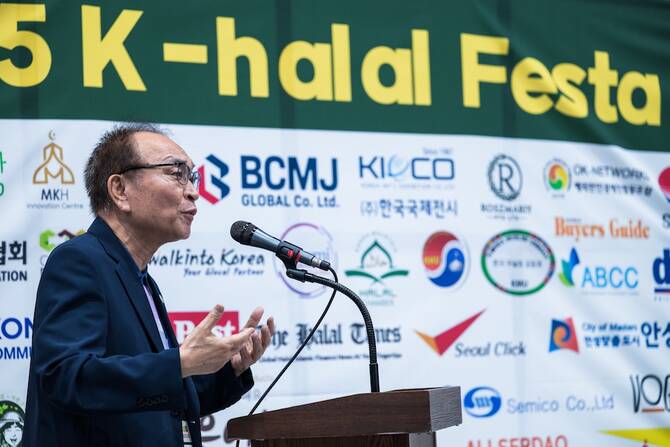
As CEO of Halal Korea plus chair of the Overseas Korean Entrepreneurs’ Cooperative, Kim spearheaded the K-Halal Food Festa at Seoul’s Coex Magok Exhibition Hall. The event featured over 100 booths from Korean companies with international participants, attracting diverse audiences including industry buyers, curious students, families seeking new experiences.
Visitors departed with bags containing halal-certified ramen, sauces, iconic K-beauty products, demonstrating the broad appeal of Korean halal offerings beyond traditional Muslim consumers.
Quantifiable Growth Across Multiple Sectors
South Korea’s halal footprint shows measurable expansion across various industries. In the food sector specifically, halal products represented 11.1 percent of total agri-food exports in 2023, marking a significant increase from 9.4 percent in 2022 according to Korea Food Research Institute data.
Seoul’s government responded to growing demand by expanding halal certification institutions from four to six in January, supporting companies seeking entry into Muslim-majority markets. Kim forecasts continued growth of 10 percent year-on-year for South Korea’s halal exports.
Strategic Challenges Require Creative Solutions
The halal industry’s expansion faces notable obstacles, including resistance to proposed halal food factory clusters. Plans for an Iksan facility, located 170 kilometers south of Seoul, encountered protests despite its potential to supply both export markets with domestic demand, remaining unrealized years after initial proposals.
Kim acknowledges these challenges while proposing alternative approaches focusing on international collaboration rather than domestic manufacturing expansion.
International Partnerships Drive Future Growth
Kim envisions Korea-Saudi Arabia halal clusters or Korea-UAE halal partnerships where Korean corporations establish production facilities while local partners manage marketing with halal certifications. This collaborative model addresses both cultural sensitivities plus market access challenges.
His strategy draws inspiration from Japan’s success in attracting 6-7 million Muslim tourists annually, compared to Korea’s approximately half that number.
Tourism-Driven Market Expansion Strategy
Kim’s ultimate vision involves creating comprehensive halal ecosystems encompassing food, cosmetics, fashion to transform Korea from solely a K-pop destination for teenagers into a welcoming environment for Muslim families with substantial purchasing power.
Increased Muslim tourism would naturally generate demand for halal beauty products, fashion items, other lifestyle goods, creating a self-sustaining cycle of market growth. This approach positions halal not as a niche specialty but as an integral component of Korea’s broader cultural export strategy.
Original Article:
Lee, S.-K. (2025, September 22). Once overlooked, K-halal gains traction in Korea’s mainstream. Arab News. https://www.arabnews.com/node/2616286/world