Food Tray MBG Controversy: Allegations of Pork Oil Content and Demands for Local Products
JAKARTA – Indonesia’s Free Nutritious Meals (Makan Bergizi Gratis/MBG) program has come under public scrutiny following allegations that food trays or ompreng imported from China contain hazardous materials, including pork oil. This issue has prompted responses from various parties, ranging from government agencies to civil society organizations demanding the use of local and halal products.
Understanding Indonesia’s Free Nutritious Meals (MBG) Program
The Free Nutritious Meals (MBG) program is an Indonesian government initiative aimed at providing free nutritious food to school students, pregnant women, and toddlers. The program was launched as an effort to address stunting and improve the nutritional quality of Indonesian society, particularly vulnerable groups.
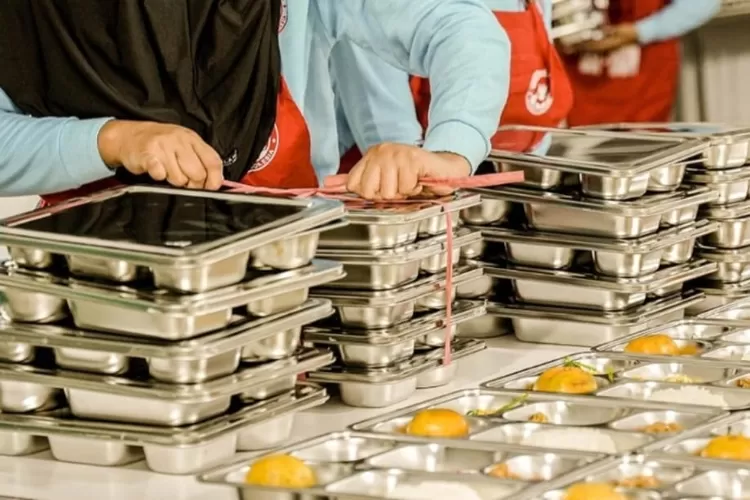
MBG is one of the priority programs of President Prabowo Subianto’s administration, targeting 82.9 million beneficiaries by the end of 2025. The program not only provides nutritious food but also uses food trays or ompreng (sectioned food containers) to facilitate food distribution to beneficiaries in schools and health facilities.
Allegations of Pork Oil Content in Imported Food Trays
The controversy began with an investigative report by Indonesia Business Post in the Chaoshan region, eastern Guangdong Province, China, which is allegedly an importer of ompreng for Indonesia’s MBG Program. The report found 30-40 factories producing food ompreng for the global market, including those allegedly for the MBG Program.
The report claimed the discovery of practices involving falsification of “Made in Indonesia” labels and SNI logos on ompreng that were actually produced in China. More concerning, there were indications of the use of pork oil or lard in the production process of these ompreng, as well as the use of type 201 ompreng allegedly containing high manganese content unsuitable for acidic foods.
Responding to these allegations, Head of the National Nutrition Agency (BGN) Dadan Hindayana stated that his agency is conducting a “check and recheck” or thorough examination regarding these allegations. However, Dadan also stated that BGN has never procured ompreng for the MBG Program.
UGM Expert Explains Methods for Testing Pork Oil Content
Prof. Dr. Abdul Rohman, S.F., M.Si., Apt., a UGM expert in halal product analysis, explained the possibility that pork oil content in these ompreng could be used as a lubricant component. “It’s possible that this pork fat is used as a lubricant component as a mixture for other oils, such as mineral oil,” he stated on Thursday (August 28).
To detect pork oil content in food containers, Abdul Rohman explained that the required stages begin with extraction. “First, extraction is performed so that pork fat can be extracted and subsequently analyzed using specific methods,” he explained.
The commonly used method is gas chromatography equipped with mass spectrometer detector (GC-MS) to identify fatty acids present. Gas Chromatography Mass Spectrometry (GC-MS) is a gas chromatography technique used in conjunction with mass spectrometry. This technique is generally used to search for compounds that are easily volatile under high vacuum conditions with low pressure when heated. GC-MS can separate and identify complex chemical components with high accuracy levels.
“The fatty acids obtained are compared with fatty acids identified in pork fat,” said this Faculty of Pharmacy UGM lecturer.
Besides the GC-MS method, the LC-HRMS method can also be used through identification of pork fat markers. “This method is generally more widely used by experts,” he said.
Role of Schools in Ensuring Halal Compliance and Cleanliness
In addition to the central government, schools also have important responsibilities in ensuring the halal compliance and cleanliness of eating utensils used in the MBG program. Schools need to pay attention not only to the quality of food served but also be careful about the eating equipment used.
School principals and MBG management teams at the school level need to verify halal certificates and SNI on food trays to be used. They must also ensure the physical condition of food containers is clean and suitable for use before distribution to students.
These preventive measures are crucial considering that the majority of students in Indonesia are Muslim, making halal aspects a primary consideration. Schools also need to maintain good communication with food and food tray suppliers to ensure all components of the MBG program meet established health and halal standards.
IPNU Urges Use of Local and Halal Products
Responding to this controversy, the Nahdlatul Ulama Student Association (IPNU) took concrete steps by encouraging the use of local and halal products for MBG program food trays. IPNU General Chairman Muhammad Agil Nuruz Zaman said his organization had provided a recommendation letter to Trade Minister Budi Santoso so that MBG food tray procurement would favor local entrepreneurs.
“We recommend regarding the MBG program, specifically food tray products, to better support local entrepreneurs. We also recommend that these food trays guarantee health and safety in terms of product halal aspects,” said Agil after submitting the recommendation letter at the Ministry of Trade.
IPNU, along with other student organizations such as the Indonesian Islamic Student Executive Board (PB PII) and Muhammadiyah Student Association (IPM), emphasized the importance of food safety assurance with food trays that meet health standards, are tested through SNI certification, and ensure product halal compliance given that the majority of Indonesia’s population is Muslim.
Laboratory Testing and Local Product Comparison
Regional Leadership Council (PC) IPNU Ahmad Muzakki Wafa revealed that his organization is conducting laboratory tests on imported food trays at PT Sucofindo’s laboratory with two samples from China. This testing is conducted to ensure material content does not conflict with health standards or halal principles.
Muzakki suspects there are indications of using animal-based lubricants prohibited for Muslims in the imported food tray printing process. As a comparison, local food tray production uses plant-based lubricants such as vegetable oil, which is considered safer while supporting halal food sustainability for Indonesian society.
“Laboratory test results will come out in 1-2 days so these results can be a strong foundation for the government to strengthen support for local products,” said Muzakki (CNN Indonesia, 2025a).
Indonesian National Standards for Food Trays
The National Standardization Agency (BSN) previously established Indonesian National Standard (SNI) 9369:2025 concerning sectioned containers (food trays) made of stainless steel for food to support the MBG Program. This standard was established on June 18, 2025, through BSN Head Decision Number 182/KEP/BSN/6/2025.
“With this standard, we want to ensure that food trays used in the MBG Program are safe to use, not easily damaged, and do not contain hazardous substances. This also encourages domestic industry to produce quality eating equipment,” said BSN Standard Development Deputy Hendro Kusumo.
Economic Impact and National Independence
IPNU also emphasized the economic aspects of using local products. According to Agil, food tray products should be entirely produced domestically, from raw materials to printing, thereby promoting national industry while expanding employment opportunities for Indonesian people.
This organization reminded that domestic producer associations are very ready to meet MBG food tray quota needs, so there is no reason for the government to remain dependent on imported products from abroad. Thus, the state budget can be optimally absorbed and job opportunities for the people can be expanded.
Government Response
Until now, the government through BGN is still conducting thorough examinations regarding these allegations. BPOM is also reportedly preparing laboratory tests to ensure MBG ompreng safety. Meanwhile, the Ministry of Trade has not yet provided an official response regarding recommendations submitted by student organizations.
This controversy has become an important momentum to evaluate MBG food tray import policies and prioritize local products that guarantee quality, safety, and halal compliance for Indonesian society.
Key Takeaways and Public Awareness
Essentially, the government must guarantee the quality and halal status of all products used in public programs like MBG. This responsibility extends beyond food items to include containers, packaging, and all related materials that come into contact with food consumed by the public, particularly given Indonesia’s predominantly Muslim population.
Furthermore, all layers of society must also be vigilant in selecting products, containers, or packaging. Citizens, educational institutions, and local administrators should develop the capacity to verify certifications, understand labeling requirements, and make informed choices about the products they use or procure.
This controversy also serves as a catalyst for increasing public awareness about the importance of supporting domestic products. The debate has highlighted the vulnerabilities that come with heavy reliance on imported goods, particularly when it comes to ensuring compliance with local religious and safety standards. Such awareness can drive consumer behavior toward prioritizing locally-manufactured products that are not only economically beneficial but also more easily monitored for quality and halal compliance.
The increased public scrutiny of imported products may ultimately strengthen Indonesia’s domestic manufacturing sector while ensuring that public welfare programs maintain the highest standards of safety and religious appropriateness.
References
ANTARA. (2025, August 26). BGN cek dugaan impor ompreng MBG mengandung minyak babi. ANTARA News. Retrieved from https://www.antaranews.com/berita/4234567/bgn-cek-dugaan-impor-ompreng-mbg-mengandung-minyak-babi
CNN Indonesia. (2025, August 26). IPNU dorong penggunaan produk lokal dan halal untuk food tray MBG. Retrieved from https://www.cnnindonesia.com/nasional/20250826121050-20-1266524/ipnu-dorong-penggunaan-produk-lokal-dan-halal-untuk-food-tray-mbg
Universitas Gadjah Mada. (2025, August 26). Ramai Ompreng MBG Diduga Tak Halal, Pakar UGM Jelaskan Cara Mengujinya. Retrieved from https://ugm.ac.id/id/berita/ramai-ompreng-mbg-diduga-tak-halal-pakar-ugm-jelaskan-cara-mengujinya/
Suyanto, A., Nurrahman, N., Hersoelistyorini, W., Sya’di, Y. K., Dewi, T. A., Sabriana, D., … & Wardoyo, F. A. (2025). PEMBINAAN KANTIN SEKOLAH UNTUK PANGAN SEHAT DAN HALAL. Jurnal Pengabdian Masyarakat Teknologi Pertanian, 4(1).
Putra, C., Ariantika, L., Reina, C., Sulistiani, S., Yunita, R., & Nabila, R. (2024). Analisis Komponen Senyawa Minyak Atsiri dalam Tumbuhan dengan Menggunakan Metode GC-MS. Jurnal Ilmiah Wahana Pendidikan, 10(13), 475-492.