Certification Crisis Holds Back Bangladesh’s Halal Cosmetics Ambitions
Massive Market Growth Creates Strategic Opportunity
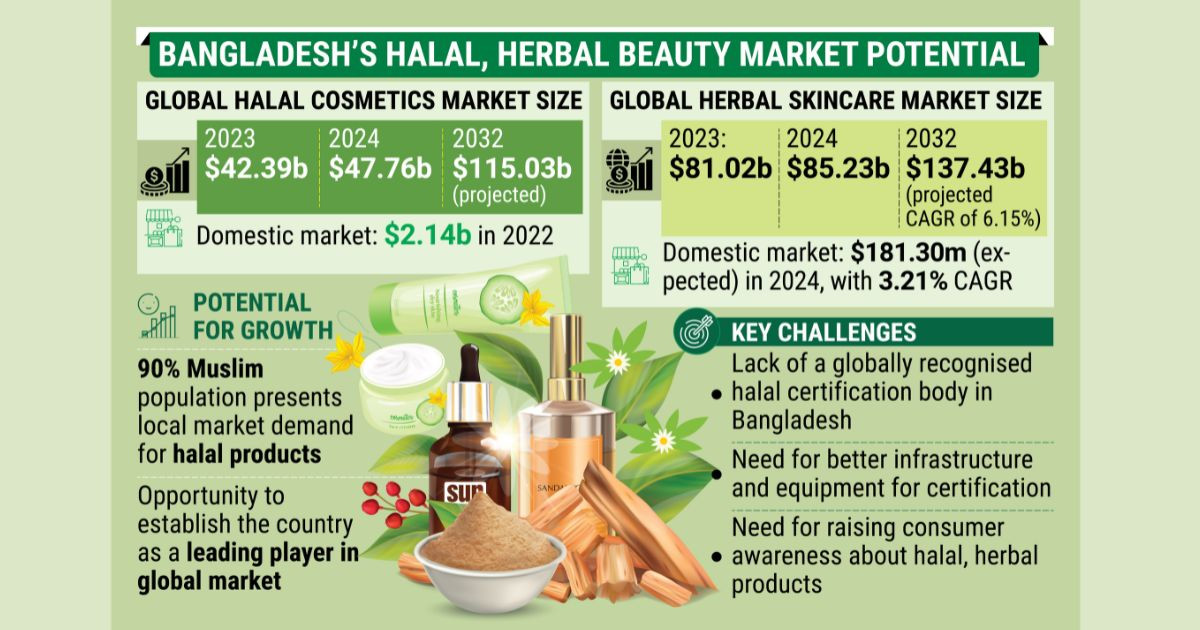
The global halal cosmetics market reached $42.39 billion valuation in 2023, projected to reach $47.76 billion in 2024 with $115.03 billion by 2032. The Asia-Pacific region dominated the halal cosmetics market with 64.87% share in 2023 according to Fortune Business Insights, positioning regional players like Bangladesh advantageously for market participation.
In 2022, the Asia-Pacific region’s total halal cosmetics revenue reached $18.43 billion, with Indonesia generating $5.67 billion (highest regional revenue), followed by Malaysia ($3.64 billion), India ($2.8 billion), Bangladesh ($2.14 billion), China ($1.97 billion).
Academic Experts Identify Bangladesh’s Market Leadership Potential
Prof Syed Ahsanul Alam, chairman of National Bureau of Economic Research Bangladesh (NBER) plus Department of Marketing professor at University of Chittagong, highlights increasing global demand for halal cosmetics among both Muslim with non-Muslim consumers valuing ethical, hygienic products.
Bangladesh could position itself as a leading player in halal cosmetics markets, both locally with globally. In a country where Muslims comprise approximately 90% of the population, demand for halal-certified personal care products like shampoos, nail polish, lipsticks, lotions rises steadily.
Infrastructure Deficiencies Hinder Market Development
Despite market potential, challenges including lack of standardized certification, limited infrastructure hinder Bangladesh’s full potential realization. Prof Ahsanul Alam emphasizes that improving certification processes, investing in infrastructure, educating consumers with manufacturers, strengthening supply chains, implementing robust monitoring systems, expanding market awareness, investing in research plus development (R&D), enhancing international collaboration represent main challenges. Halal herbal hair colors using safe, natural ingredients instead of carcinogenic chemicals also gain popularity among health-conscious consumers.
Consumer Awareness Drives Demand Despite Quality Concerns
Wahida Parvin Ishita, a Jagannath University student, seeks halal personal beauty items, particularly perfumes, as they remain free from harmful or haram materials prohibited by Islamic law. Although many people remain unaware of halal cosmetics, some consumers specifically seek halal perfumes while prioritizing quality cosmetics as counterfeit skincare with beauty products flood markets.
Ishita expresses concern over counterfeit, substandard products, noting friends suffered skin issues after using such items. Many cosmetics sell online, particularly through social media with various shops, without BSTI certification, emphasizing product quality assurance remains essential for consumer safety.
Industry Leaders See Economic Transformation Potential
Mohammad Ishaqul Hossain Sweet, former Federation of Bangladesh Chambers of Commerce plus Industry (FBCCI) director, believes the halal cosmetics sector possesses huge potential though inadequate development stems from insufficient government support.
Bangladesh can now manufacture quality cosmetics, requiring policy support with improved ease of doing business. Halal cosmetics command approximately 44% worldwide demand, potentially playing significant economic roles comparable to Bangladesh’s readymade garments (RMG) sector.
Certification Infrastructure Gaps Limit Export Capabilities
MS Siddiqui, Vice President of International Business Forum of Bangladesh (IBFB), notes that globally, halal food with cosmetics appeal to both Muslims plus non-Muslims. Halal cosmetics avoiding animal fat or alcohol attract consumers from various religions, though Bangladesh has not fully leveraged this emerging sector.
Currently, no regulatory organization possesses equipment with qualified manpower to issue globally acceptable certificates, creating fundamental barriers to international market access requiring urgent governmental attention.
BSTI Establishes State-of-the-Art Certification Laboratory
SM Abu Sayed, deputy director (Halal Certification) at BSTI, confirms BSTI readiness to provide internationally recognized certification, enabling exporters to reach global markets while increasing export volumes. BSTI has established a national halal laboratory in a new building costing Tk500 crore, providing halal certification for various industries including food with cosmetics.
Equipment imported from EU, Germany, other countries supports significant halal product potential, particularly in Muslim-majority markets worldwide. However, only Remark HB Limited has applied for certification since October, indicating low industry awareness of compliance requirements.
Herbal Products Sector Demonstrates Parallel Growth
The global herbal skincare products market reached $81.02 billion valuation in 2023, expected to grow from $85.23 billion in 2024 to $137.43 billion by 2032, with 6.15% compound annual growth rate (CAGR) during this period according to Market Research Future.
Bangladesh witnesses surging demand for eco-friendly, locally sourced natural cosmetics, with the natural cosmetics market expected to generate $181.30 million revenue in 2024, maintaining 3.21% annual growth rate through 2029 according to Statista.
Established Manufacturers Lead Market Transformation
Abdus Sattar, chief operating officer (COO) of Mumtaj Herbal Products, reports the company has supplied herbal beauty products for 30 years, producing 100% herbal items plus some non-harmful chemical products, all BSTI-approved. The company obtained halal certification from Islamic Foundation while planning BSTI certification soon.
Sattar urges government action against smuggling with counterfeit products to protect local industry, emphasizing positive shifts among Bangladeshi consumers now opting for high-quality, halal, herbal products. The company plans direct export operations due to growing international demand, currently managed through third-party agents.
Original Article:
Islam, R. (2024, November 2). Pure and profitable: Halal, herbal cosmetics eye the global pie. Daily Sun. https://www.daily-sun.com/post/775202