Fiji Muslim League Disputes McDonald’s Halal Status Despite New Zealand Certification
Mechanical slaughter methods spark certification controversy
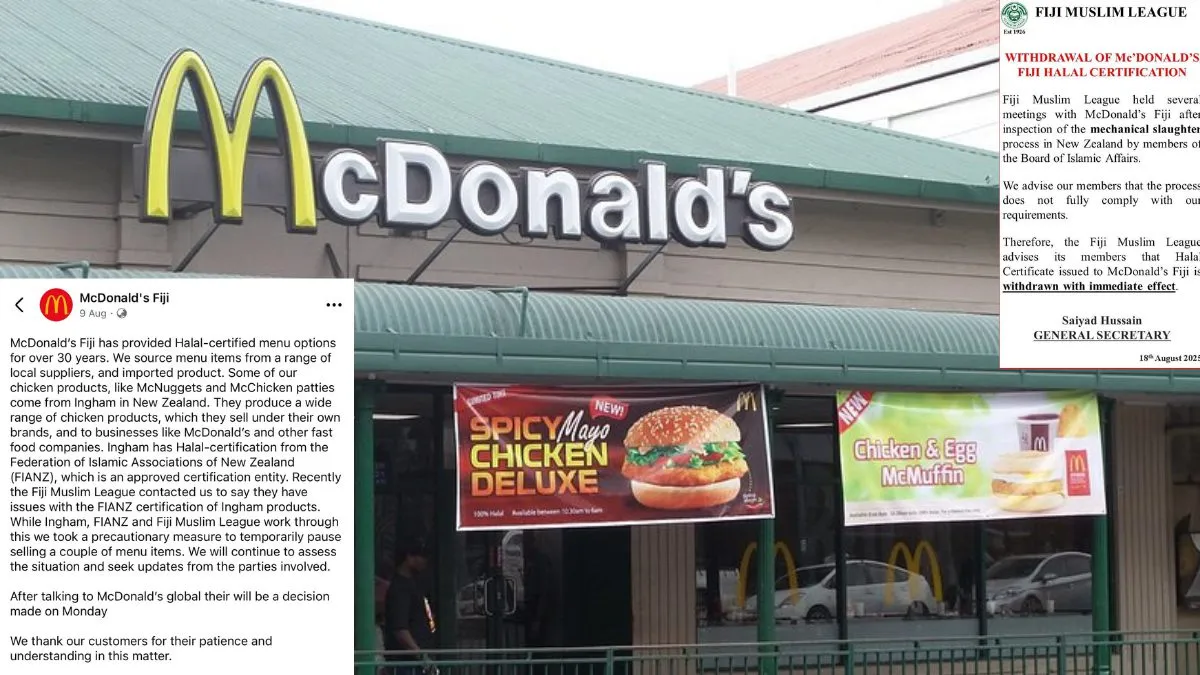
The Fiji Muslim League (FML) has once again reminded customers via social media that it has not approved McDonald’s Fiji as Halal, following a review conducted in August 2025.
In August, local media reported that FML General Secretary Saiyad Hussain stated the review, carried out by the Board of Islamic Affairs, examined the mechanical slaughter process used by McDonald’s meat suppliers in New Zealand, finding it does not fully comply with their requirements. Hussain stated that as a result, McDonald’s Fiji does not hold Halal approval from the Fiji Muslim League.
McDonald’s maintains FIANZ certification validity
However, McDonald’s Fiji has maintained that its chicken products, including McChicken plus Chicken McNuggets, continue receiving Halal certification from the Federation of Islamic Associations of New Zealand (FIANZ).
The company stated in a public notice posted on Facebook in August that these products are manufactured by Ingham New Zealand, a trusted supplier meeting strict Halal certification standards set by FIANZ.
Management acknowledges jurisdictional complexity
Managing Director Mark MacElrath told local media about the long-standing 30-year relationship with the Fiji Muslim League but emphasized that the current issue lies between the FML plus FIANZ regarding the chicken slaughtering process in New Zealand.
MacElrath stated that McDonald’s is the end user, has no authority over certifications. He added that the company respects the Fiji Muslim League’s position while remaining committed to serving safe, high-quality food to customers.
In August, McDonald’s Fiji temporarily paused some chicken menu items while awaiting further guidance from the relevant certification bodies.
Conflicting standards reveal global certification challenges
The dispute highlights broader tensions within global Halal certification frameworks, where different Islamic authorities maintain varying interpretations of acceptable slaughter methods. Mechanical slaughter processes, while efficient for industrial-scale production, remain contentious among Islamic scholars who debate whether such methods satisfy religious requirements for conscious, manual slaughter.
The disagreement between FML plus FIANZ exemplifies how multinational food chains operating across Muslim-majority or significant Muslim-population regions navigate competing certification regimes. For consumers, the conflict creates confusion about which authority’s certification carries legitimacy, particularly when established international bodies like FIANZ certify products that local religious authorities reject.
McDonald’s position as an “end user” without certification authority underscores the complexity of global supply chains where manufacturing, certification, retail operations span multiple jurisdictions with potentially incompatible religious standards. The situation may pressure companies to seek certification harmonization or accept market segmentation based on local religious authority preferences.
Original Article:
The Fiji Times. (2025, October 11). Fiji Muslim League withdraws McDonald’s Fiji Halal certification. Retrieved from https://www.fijitimes.com.fj/fiji-muslim-league-withdraws-mcdonalds-fiji-halal-certification/