The Use of Restraining Boxes in Halal Slaughter: Does It Constitute Animal Cruelty?
The debate surrounding halal slaughter has once again attracted public attention following the circulation of a post on X showing cattle being restrained using a mechanical device before slaughter.
 Source: x.com/72crusader72
In the video, the animal is placed inside an automated restraining system that positions the body prior to the cutting process. The post framed halal slaughter as a practice in which animals are “letting it bleed to death,” sparking broader discussions about animal ethics, religious slaughter, and the use of modern technology in halal meat production.
The machine shown in the video is known in the meat processing industry as a restraining box or, in some systems, a rotary restrainer. In large-scale slaughterhouses, this equipment is used to hold and position animals so that the slaughtering process can be carried out more safely, quickly, and efficiently. However, visuals of animals being mechanically restrained often trigger emotional reactions and are frequently perceived as a form of animal cruelty. Therefore, it is important to understand the function of this technology more objectively through both Islamic teachings and animal welfare studies.
Animal Slaughter in Islamic Teachings
In Islam, animal slaughter is not merely a technical process for obtaining meat, but part of an ethical framework that emphasizes ihsan (compassion and excellence) toward all living beings. Islam places significant importance on minimizing animal suffering throughout the slaughter process.
Prophet Muhammad said:
“Indeed, Allah has prescribed excellence in all things. So when you kill, kill well; and when you slaughter, slaughter well. Let one of you sharpen his blade and spare suffering to the animal he slaughters.”
(Sahih Muslim No. 1955a)
This hadith demonstrates that slaughter in Islam is closely connected to ethical treatment and animal welfare. Animals must not be abused, intentionally frightened, or subjected to unnecessary stress before slaughter.
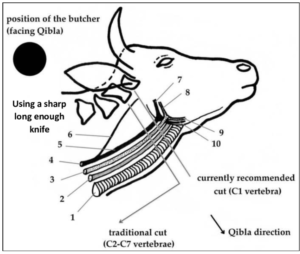 Halal slaughter method in cattle (Abdullah et al., 2019). 1: trachea; 2: oesophagus; 3: vena jugularis externa dextra; 4: arteria carotis communis; 5: arteria carotis externa dextra; 6: arteria carotis interna dextra; 7: arteria maxillaris; 8: vena maxillaris; 9: vena linguofacialis; and 10: truncus linguofacialis.
Islamic teachings also require the use of a sharp blade to ensure a swift cut, as illustrated in the halal slaughter method above, thus minimizing pain and distress. In addition, animals should not witness the slaughter of other animals, as this may increase fear and psychological stress.
Thus, the concept of halal slaughter contains a strong ethical dimension that aligns with modern discussions on animal welfare and humane slaughter practices.
The Function of Restraining Boxes in Modern Slaughterhouses
In modern slaughterhouses, particularly in cattle processing facilities, restraining systems are commonly used to control animal movement during slaughter. These systems include upright restraining boxes, rotary restrainers, and conveyor restrainers for poultry processing. The equipment shown in the viral video appears to be a rotary restraining box, a system designed to rotate and stabilize the animal’s body before slaughter takes place.
The primary purpose of these systems is to reduce the risk of injury to both the animal and slaughterhouse workers. Large animals such as cattle may react aggressively when frightened or stressed, making restraining systems necessary to maintain stability and precision during slaughter. Proper restraint also allows the cutting process to be performed more quickly and efficiently.
Nevertheless, videos showing animals being mechanically restrained often generate negative public perceptions. Without proper explanation regarding slaughterhouse procedures and animal welfare standards, such visuals can easily be interpreted as inhumane treatment. As a result, discussions surrounding halal slaughter frequently focus more on emotional reactions to graphic visuals than on the actual welfare protocols implemented in slaughterhouses.
Do Restraining Boxes Cause Animal Suffering?
From an animal welfare perspective, the use of restraining boxes cannot automatically be categorized as animal abuse. Stress levels in animals prior to slaughter are more strongly influenced by handling methods, surrounding noise, physical pressure, and operator behavior than by the existence of the machine itself.
Well-designed restraining systems may actually help reduce panic and uncontrolled movement in animals, thereby minimizing the risk of injury and excessive stress. However, poorly designed equipment, excessive force, overcrowded conditions, or untrained operators may increase fear and distress in animals.
Therefore, the main issue does not lie in the existence of the restraining box itself, but in how the equipment is used and supervised in practice. Research on halal slaughter also suggests that animal welfare is influenced by the entire pre-slaughter handling system, including transportation conditions, restraint methods, equipment quality, and operator skills.
This demonstrates that animal suffering in slaughterhouses cannot be fully understood solely through short video clips circulating on social media without broader context.
How Does Islam View the Use of Restraining Boxes?
In Islam, the use of modern technology in slaughterhouses is generally permissible as long as it does not contradict halal slaughter principles and humane treatment of animals. The use of restraining boxes is not considered prohibited if the equipment helps facilitate slaughter while minimizing unnecessary harm and suffering.
Several international halal certification bodies also permit the use of restraining systems under specific conditions. These conditions generally require that the animal remains alive prior to slaughter, that the cutting process is performed correctly, and that the equipment does not inflict excessive suffering on the animal. Human supervision is also necessary to ensure compliance with halal standards and animal welfare procedures.
Therefore, the permissibility of restraining technology in Islam is determined not by the existence of the machinery itself, but by whether the process upholds the principle of ihsan and minimizes unnecessary suffering during slaughter.
Qurban and the Perception of Animal Cruelty
Growing public sensitivity toward animal welfare issues has led some people to view qurban slaughter as a form of violence against animals. This perception is partly influenced by the increasing distance between modern society and food production processes. Many people consume meat without directly witnessing livestock farming or slaughter practices.
In Islam, however, qurban is not intended as an act of cruelty or violence toward animals. Rather, it is a form of worship associated with sacrifice, social solidarity, and food distribution within the community. The slaughter process is conducted for consumption and religious purposes while maintaining ethical responsibility toward living creatures.
For this reason, discussions surrounding halal slaughter should not rely solely on emotional reactions to social media visuals, but should also consider ethical frameworks, animal welfare standards, and slaughter practices implemented in modern food production systems.
Conclusion
The use of restraining boxes in halal slaughter cannot automatically be classified as animal cruelty. In modern slaughterhouses, restraining systems are used to improve safety, stability, and precision during the slaughter process. From both Islamic and animal welfare perspectives, the primary ethical concern lies not in the existence of the technology itself, but in how animals are treated throughout the process.
Islam emphasizes the principles of ihsan, humane treatment, and minimizing unnecessary suffering during slaughter. Similarly, modern animal welfare research highlights the importance of proper handling, appropriate equipment design, and operator training to reduce stress in animals.
Therefore, discussions surrounding halal slaughter should move beyond emotional reactions to viral social media videos and instead focus on scientific evidence, animal welfare standards, and ethical slaughter practices in modern food production systems.
– Written by Naflah –
References
Abd El-Rahim, I. H. A., et al. (2023). Effect of halal and stunning slaughter methods on meat quality: A review. International Food Research Journal, 30(2), 290–302.
Farouk, M. M., Al-Mazeedi, H. M., Sabow, A. B., Bekhit, A. E. D., Adeyemi, K. D., Sazili, A. Q., & Ghani, A. (2014). Halal and kosher slaughter methods and meat quality: A review. Meat Science, 98(3), 505–519.
Sahih Muslim, Hadith No. 1955 tentang ihsan dalam penyembelihan. https://sunnah.com/muslim:1955a
Majelis Ulama Indonesia. (2023). Stunning diizinkan dengan syarat tertentu. https://halalmui.org/stunning-diizinkan-dengan-syarat-tertentu/