Halal Market Emerges as Key Growth Engine for Vietnamese Exporters
| By English vov
As global trade faces mounting pressure from geopolitical instability, inflation, and protectionist policies, Vietnam is accelerating efforts to diversify its export destinations. Within this shifting landscape, the halal market, particularly in the Middle East—has moved to the forefront as a strategic pillar for long-term export sustainability.
Middle East Demand Strengthens Vietnam’s Export Outlook
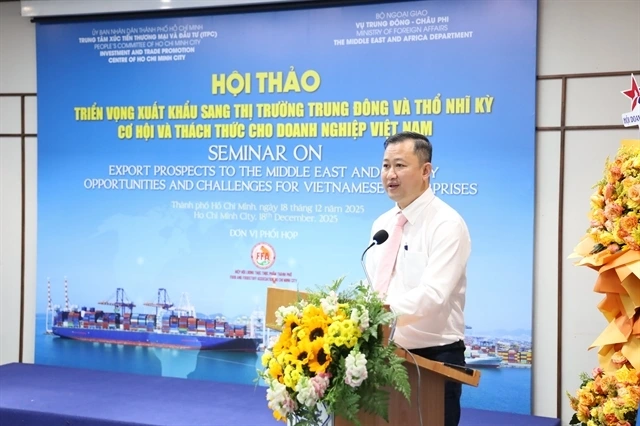
Speaking at the conference “Export Prospects to the Middle East and Türkiye: Opportunities and Challenges for Vietnamese Enterprises” in Ho Chi Minh City on December 18, Tran Phu Lu, director of the Investment and Trade Promotion Centre of HCM City (ITPC), emphasized that the Middle East is no longer an alternative market but a vital growth driver. The region records annual imports exceeding US$1.2 trillion and maintains GDP growth of 5–6%, making it one of the world’s most dynamic import hubs.
Vietnam’s export performance reflects this momentum. During the first 11 months of 2025, shipments reached US$5.4 billion to the UAE, US$1.9 billion to Saudi Arabia, and US$1.6 billion to Türkiye. Major retail chains such as Lulu Hypermarket, Al Othaim Markets, Choithrams, and Citi Hypermarkets have also shown increasing interest in sourcing Vietnamese products, signaling rising confidence in Vietnam’s manufacturing and food processing capabilities.
Türkiye Positions Itself as a Strategic Halal Gateway
Türkiye is gaining attention as a crucial logistics and market gateway, enabling Vietnamese products to access not only Middle Eastern economies but also a global Muslim consumer base exceeding two billion people. Nguyen Viet Hang, Vietnam’s Commercial Counsellor in Türkiye, highlighted that bilateral trade cooperation continued to progress positively in 2025 despite global volatility.
Vietnamese enterprises made a notable impression at the Global Halal Summit and Halal Expo 2025 in Istanbul, showcasing products ranging from food and agricultural goods to cosmetics and herbal medicines. With a Muslim population of nearly 90 million and strong influence within the Organisation of Islamic Cooperation (OIC), Türkiye offers an advantageous entry point into global halal supply chains.
Global Halal Economy Expands at Rapid Pace
Nguyen Phuong Tra, director-general of the Middle East and Africa Department at Vietnam’s Ministry of Foreign Affairs, underscored the scale of opportunity within the halal economy. Muslims account for roughly 25% of the global population, while the halal economy is projected to reach US$10 trillion before 2028.
The halal food sector alone is expected to grow from US$2.7 trillion in 2024 to US$5.9 trillion by 2033, with annual growth approaching 9%. The Middle East, home to around 500 million people and GDP totaling US$3.6 trillion, continues to rely heavily on food imports, with GCC countries sourcing up to 85% of their food from overseas markets.
Certification Complexity Remains a Major Barrier
Despite strong demand, Vietnamese exporters still face significant challenges, particularly in navigating diverse halal certification systems. These include GCC standard GSO 993:2015, Indonesia’s HAS 23103:2012, Malaysia’s MS 1500:2019, and OIC/SMIIC 1:2019, which is recognized across 56 OIC member states.
High certification costs, limited validity periods, and intense competition from established exporters increase entry barriers. Trade fraud risks also persist, prompting authorities to urge businesses to strengthen partner verification and adopt secure payment mechanisms.
Halal Standards Align with Global ESG Principles
Ramlan Osman, director of the Vietnam Halal Certification Authority (HALCERT), noted that halal principles closely align with international standards such as the UN Global Compact and Environmental, Social, and Governance (ESG) frameworks. As a result, adopting halal practices enhances product credibility for both Muslim and non-Muslim consumers while complementing existing industrial certifications.
He also outlined a nine-step halal food certification process designed to help enterprises better prepare for compliance and market entry.
Managing Trade Risks and Expanding Market Share
From a logistics and finance perspective, Thi Hong Uytun, founder of HM Dragon Logistics and Consulting Company, highlighted Türkiye’s dual role as both a consumer market and a transit hub to the Middle East and the European Union. Vietnam is currently Türkiye’s third-largest trading partner within ASEAN, with exports reaching US$1.93 billion in 2024, although Vietnamese goods still represent only 0.5% of Türkiye’s total imports.
To mitigate risks related to currency volatility and payment practices, exporters are advised to prioritize irrevocable letters of credit confirmed by reputable banks and strengthen financial due diligence prior to contract execution.
Strengthening Vietnam’s Position in the Halal Trade Ecosystem
The conference, jointly organized by ITPC, the Ministry of Foreign Affairs’ Middle East and Africa Department, and the HCM City Food and Foodstuff Association, formed part of the Business Matching and HCM City Products Week 2025 – Food and Beverages. The event reinforced Vietnam’s ambition to integrate more deeply into the global halal economy by enhancing compliance capacity, market intelligence, and strategic partnerships.
As diversification becomes a necessity rather than a choice, the halal market stands out as a resilient pathway for Vietnamese exporters seeking sustainable growth in an increasingly uncertain global economy.
Original Article:
VietnamPlus. (2025). Halal market offers significant growth opportunities for Vietnamese exporters. https://english.vov.vn/en/economy/halal-market-offers-significant-growth-opportunities-for-vietnamese-exporters-post1255044.vov