JHCPO Recap: Discovering Indonesia’s Economic Potential Through Trade Expo Indonesia 2026
(JAKARTA 2026/10/20)
Last Thursday and Friday were an unforgettable moment for JHCPO. JHCPO had the opportunity to attend Trade Expo Indonesia (TEI 2026), the largest expo and economic conference organized by the Ministry of Trade of the Republic of Indonesia. TEI 2026 has now reached its 41st year, showing the event’s lasting presence and importance for [incomplete in original].
Held over five days at ICE BSD, the expo hosted around 1,873 business exhibitors. Transaction figures were also impressive. According to CNN, total transactions at TEI 2026 were estimated at US22.94billion,orroughlyRp414trillion.Ofthis,US510.79 million came from MSMEs, reflecting the growth potential of Indonesia’s market this year.
JHCPO’s Participation in the MoU Signing Session
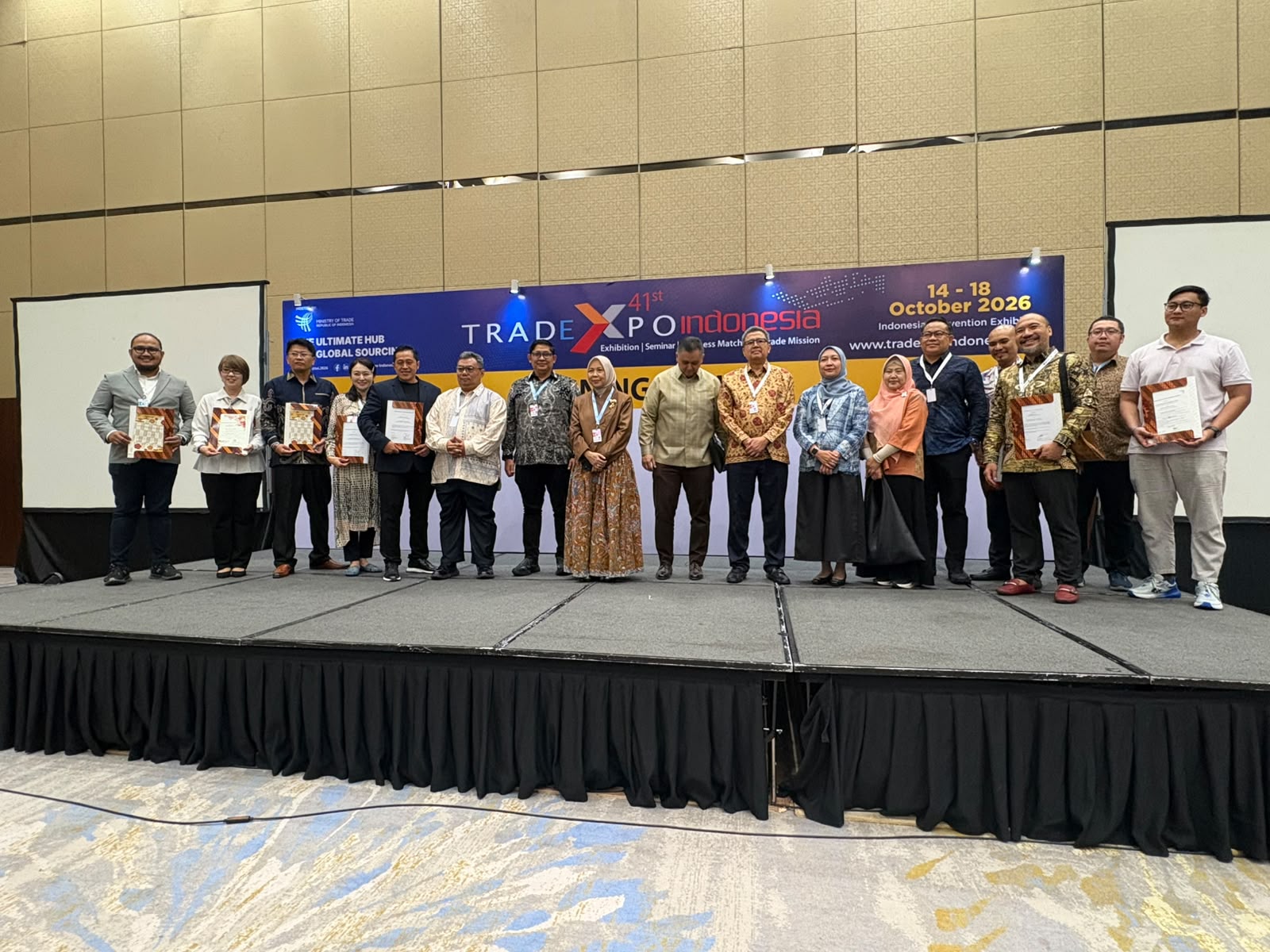
On Thursday, October 15, 2026, JHCPO began its participation in TEI 2026 with a Memorandum of Understanding (MoU) signing held at [venue missing in original]. The session formalizes cooperation between foreign companies, the Ministry of Trade, and domestic business stakeholders who will conduct commercial activities in Indonesia. It is also tangible proof of businesses’ commitment to strengthening ties with Indonesian institutions. The agenda was also attended by [incomplete in original].
During the session, JHCPO signed and formalized four of its Indonesian subsidiaries. The signing demonstrates the legality and strategic direction of JHCPO’s entry into the Indonesian market, and is expected to bring the company a step closer to understanding and entering it. The companies are:
- Jamalindo Research & Consulting: consultation and IT company
- Sinergi Jamalindo Solution: BPOM registration
- PT Mayorasa: vegan mayonnaise
- PT Rin Biotek: honey and soap factory
The event took place at Nusantara Hall, ICE BSD, from 13:00 to 15:00 WIB. It opened with the MoU signing with 426 foreign companies from 22 countries, including Malaysia, Singapore, China, Bangladesh, India, the Netherlands, Oman, Italy, Hungary, and Japan. After all documents were signed, the event continued with group photos organized by country.
Visiting Indonesia’s Largest Trade Exhibition
After the MoU session, the JHCPO team visited the bazaar expo, the heart of TEI 2026. Spanning Halls 1 to 10 of ICE BSD, it showcased more than 1,873 exhibitors with diverse products, from food and beverage, manufacturing, culinary, and beauty and cosmetics to logistics and more. Over two days of visiting booths, the team met and connected with more than 50 local Indonesian businesses. Several of their products are explored further below.
Tempeh: The Best-Selling Indonesian Item in Japan
Tempeh is the most sought-after Indonesian commodity in the Japanese market. At TEI this year, the team took a closer look at the booth of PT Azaki Food, a producer and distributor of tempeh products established in Bogor in 2005. With its main factory in Sukabumi, West Java, Azaki Food has marketed its products across Indonesia, including Palangkaraya, Banjarmasin, Pekanbaru, Abepura, and 80 other cities.
Its success extends beyond the domestic market. Its tempeh is also sold overseas, including the USA, Australia, Saudi Arabia, and India, with Japan as its main export market. Japanese consumers’ health awareness, and tempeh’s ease of preparation, have made it increasingly popular in Japan. Besides high-quality tempeh, Azaki Food’s products hold a BPJPH halal certificate, HACCP certification, and FSSC 22000.
More product info: https://tempeazaki.com/
Black Garlic: A Unique Product Good for Health
Besides products in demand in Japan and globally, the team also looked for unique products in terms of packaging, flavor, and benefits. One that caught their attention was black garlic by Alamme Nutrifood, a company founded in [location missing in original] that focuses on health products. Black garlic is ordinary garlic heated at a low temperature for a long time, which caramelizes it naturally without chemicals. It offers benefits such as heart health, cancer prevention, blood pressure stabilization, and skin health.
Alamme Nutrifood sells two variants, peeled and unpeeled. The team tasted the peeled variant: the crunchy texture usually found in garlic turns chewy, like a gummy. Notably, the peeled black garlic comes in a strawberry flavor that masks the garlic’s smell and taste.
The product is already exported to many countries, with South Korea as the main one. The team believes its uniqueness and benefits could be a promising market opportunity in Japan.
More product info: https://alamme.com/products/black-garlic-powder
Sago: A Unique Staple Alternative to Rice
One unique booth was Sagolicious, which sells noodles and pasta made from sago. Sago is a staple food made from the starch of the trunk of the sago palm (mainly Metroxylon sagu), aged around 7 to 12 years. In Indonesia, it grows abundantly in the swamps and forests of eastern Indonesia, such as Papua and Maluku, where it is a traditional staple. [Production process: to be added.]
Sago is usually eaten as a rice substitute, and some is made into cakes. Compared to rice, it offers benefits such as higher carbohydrate content, being gluten-free, a lower glycemic index, and being more environmentally friendly. At the Sagolicious booth, sago is made into various noodles and pasta. They also sell instant noodles colored naturally with spirulina, turmeric, moringa leaf, and dragon fruit.
More product info: https://sagolicious.id/
Indonesia’s Potential and Challenges in the Global Market
After two days of touring TEI 2026 booths, it is clear that many unique products could boost Indonesia’s economy in the global market. Indonesia has abundant and diverse raw materials, and investors at home and abroad have long imported them. However, this alone does not maximize Indonesia’s market potential. Creative products by local producers, made with domestically sourced ingredients, open more opportunities for foreign investors to build business partnerships and help local producers adapt to the global market.
Even so, Indonesian local brands have yet to fully establish themselves globally. Limited knowledge of, and access to, export procedures keeps many products stuck in the local market. Many business owners are also unsure which countries suit their products, so they never find the market that can maximize them. To address this, the Indonesian government is expected to provide education and guidance for industries, especially small and medium-sized ones, in reaching overseas markets. Producers can also meet export requirements such as HACCP [other hygiene standards to be added] for product hygiene. For halal markets, products should ideally already hold BPJPH halal certification, since BPJPH is the benchmark halal institution for halal standards in many countries.
Written by: Alhayya Maritza
Editor: Naflah Azizah Wibowo
References:
CNN Indonesia. (2026). Transaksi Trade Expo Indonesia 2026 Tembus Rp414 T Lampaui Target. Retrieved 19 October 2026: https://www.cnnindonesia.com/ekonomi/20261018182903-92-1416794/transaksi-trade-expo-indonesia-2026-tembus-rp414-t-lampaui-target
Foto Bisnis. (2026). Bisnis Indonesia Raih Silver Media Award TEI 2026. Retrieved 19 October 2026: https://foto.bisnis.com/view/20261018/2013619/bisnis-indonesia-raih-silver-media-award-tei-2026
IPB Digitani. (2026). PROSES PEMBUATAN SAGU: DARI POHON HINGGA JADI TEPUNG. Retrieved 19 October 2026: https://digitani.ipb.ac.id/proses-pembuatan-sagu-dari-pohon-hingga-jadi-tepung/
Tempe Azaki Website. (n.d). Retrieved 19 October 2026: https://tempeazaki.com/