Thailand Leverages AI Technology to Transform Halal Industry Amid Global Economic Uncertainty
Source: Mina News Net
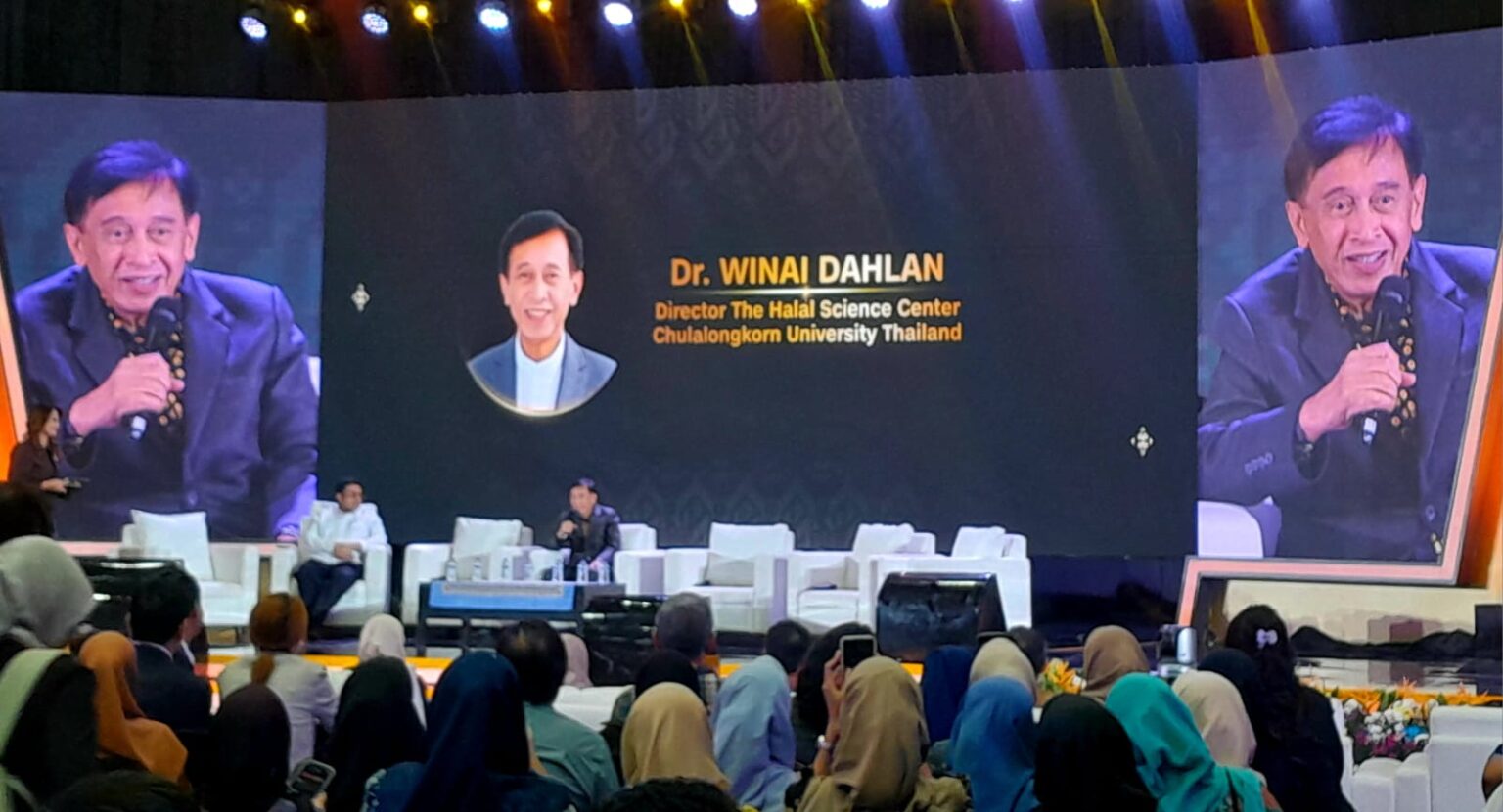
JAKARTA – In response to rising global geo-economic fragmentation and international trade tensions, Thailand has unveiled an innovative artificial intelligence-driven approach to strengthen trust and security in its halal product offerings. This groundbreaking strategy was presented by Prof. Dr. Winai Dahlan, founder of the Halal Science Center at Chulalongkorn University, during the Indonesia International Halal Festival (IIHF) 2025 in Jakarta, marking a new chapter in digital halal diplomacy across ASEAN and the Islamic world.
The 2AI Revolutionary Approach
Speaking at the Jakarta International Convention Center (JICC) in Senayan, Thailand showcased its national strategy centered on integrating technology with Islamic principles through what they term the “2AI approach” – combining Actual Implementation with Artificial Intelligence. This methodology represents a sophisticated response to the increasingly complex challenges of haram contamination in modern food manufacturing.
Prof. Winai Dahlan emphasized that traditional labeling methods are no longer sufficient for today’s Muslim consumers, who demand more scientific, transparent, and traceable halal assurance. “We can no longer rely solely on conventional labeling. Muslims now demand more scientific, transparent, and traceable guarantees of product halal status,” he stated before the international delegation.
Scientific Leadership from an Unexpected Source
Remarkably, Thailand, with its Muslim minority population, has positioned itself as a trailblazer in halal science. Since 2003, the government has supported the Halal Science Center (HSC) at Chulalongkorn University, establishing it as the world’s first halal science institution. The center’s latest development, the HAL-Q system (Halal Assurance, Liability and Quality), integrates comprehensive training, document and raw material inspection, and forensic halal laboratory testing.
The HAL-Q system has been implemented across more than 1,000 food manufacturing facilities, involving 159,000 workers and producing 197,744 laboratory test samples. These tests encompass DNA detection, alcohol content, fatty acids, and gelatin analysis, with all results certified under ISO/IEC 17025:2017 standards.
Digital Ecosystem and Blockchain Integration
Thailand’s government has developed the Halal Route App, a comprehensive digital platform that consolidates data on restaurants, mosques, tourist attractions, and halal products. The platform incorporates blockchain technology to ensure supply chain transparency, representing a significant advancement in halal certification technology.
According to HSC data, over 100,000 users have registered for the Halal Route application, which is further enhanced by NFT systems and smart contracts to strengthen blockchain-based digital halal certification. This technological integration addresses growing concerns about product authenticity and traceability in the global halal market.
Strategic Response to Global Trade Challenges
The timing of Thailand’s halal innovation push coincides with threats from Geo-Economic Fragmentation (GEF) resulting from global tariff conflicts. Thailand is strategically positioning its halal products as essential commodities in Muslim-majority markets, including ASEAN countries, OIC members, and GCC nations.
Before the current era of geo-economic fragmentation, the global halal economy was valued at $2.29 trillion with annual growth rates of 8-15%. However, with increasing protectionist tensions, countries like Thailand view the halal market as a promising and relatively stable alternative trade avenue.
International Cooperation and Soft Power Diplomacy
At IIHF 2025, Thailand announced the signing of a cooperation agreement with the Islamic Chamber of Commerce and Development (ICCD) under the OIC, previously concluded in Makkah, Saudi Arabia. This agreement facilitates technology transfer and the development of science-based halal quality systems to OIC member countries.
The HSC has actively established partnerships with halal certification bodies including Saudi FDA and Emirates International Accreditation Centre (EIAC), while playing a crucial role in the OIC’s SMIIC (Standard and Metrology Institute for Islamic Countries) network as Thailand’s official representative.
Halal Science as Geopolitical Tool
Thailand’s comprehensive approach demonstrates that halal science innovation extends beyond mere certification processes. Through the 2AI approach and digital halal diplomacy, Thailand is showcasing halal science as a form of soft power capable of building national image, opening market access, and strengthening geopolitical positioning in an increasingly fragile global trade environment.
This strategic initiative positions Thailand uniquely in the global halal ecosystem, proving that innovation and technological advancement can transcend traditional religious and cultural boundaries to create meaningful economic and diplomatic opportunities in the modern Islamic economy.
Original article:
minanews.net. (n.d.). Thailand Dorong Inovasi Halal Berbasis AI di Tengah Ketidakpastian Ekonomi Global. Retrieved July 14, 2025, from https://minanews.net/thailand-dorong-inovasi-halal-berbasis-ai-di-tengah-ketidakpastian-ekonomi-global/