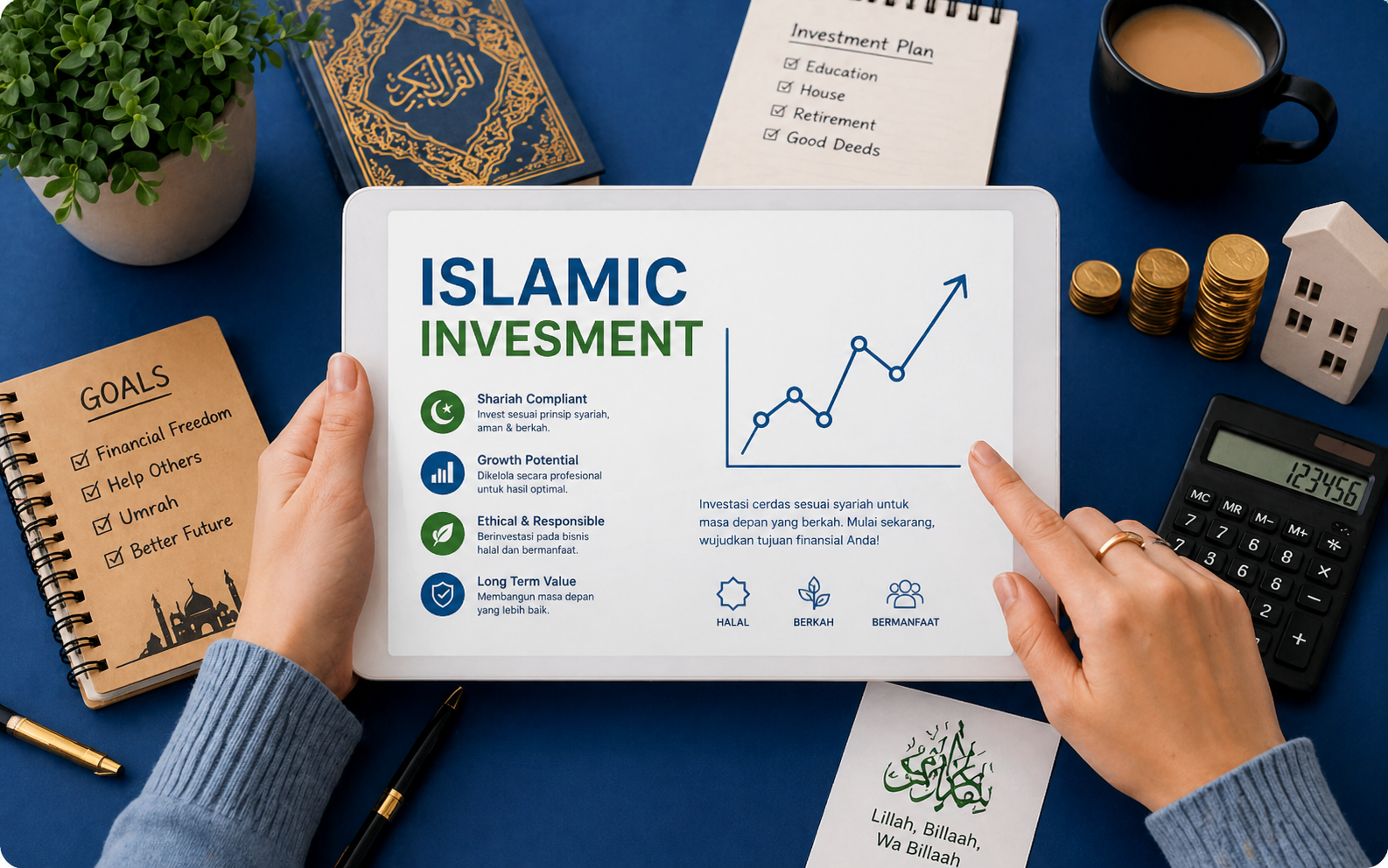
Investment in the Perspective of Islamic Economics
Investment in the Perspective of Islamic Economics
Introduction
Investment is an economic activity that plays an important role in improving people’s welfare. In general, investment is defined as the activity of placing capital or funds into an asset or business for a certain period of time with the expectation of gaining profits in the future.
Along with the development of the global economy, people are becoming more aware of the importance of managing and growing their assets to meet future needs. However, in practice, many people still do not fully understand the concept of investment, making them vulnerable to unclear investments or even fraud. Therefore, a proper understanding of investment, especially from an Islamic perspective, is very important.
In Islam, investment is not only an economic activity but also part of muamalah (social and economic transactions), which must follow Islamic principles to bring benefits and blessings.
Definition of Investment in Islam
In general, investment is the activity of placing funds into assets or business projects for a certain period with the aim of earning profits in the future. Investment is usually done by putting capital into various business sectors that have profit potential.
From an Islamic perspective, investment is also understood as an effort to develop wealth so that it can provide greater benefits. The term investment comes from the word invest, which means to plant, while in Arabic it is known as istitsmar, meaning to make something grow and increase.
Thus, investment in Islam is not only focused on material profit but also aims to create social welfare and gain blessings from Allah SWT.
Legal Basis of Investment in Islam
Investment in Islam is highly encouraged because it helps people prepare for the future and improve their standard of living. This is reflected in several verses of the Qur’an that encourage people to prepare for the future, such as
Al-Hasyr verse 18,
يٰٓاَيُّهَا الَّذِيْنَ اٰمَنُوا اتَّقُوا اللّٰهَ وَلْتَنْظُرْ نَفْسٌ مَّا قَدَّمَتْ لِغَدٍۚ وَاتَّقُوا اللّٰهَۗ اِنَّ اللّٰهَ خَبِيْرٌ ۢ بِمَا تَعْمَلُوْنَ ١٨
O believers! Be mindful of Allah and let every soul look to what ˹deeds˺ it has sent forth for tomorrow.1 And fear Allah, ˹for˺ certainly Allah is All-Aware of what you do.
This verse emphasizes the importance of planning for the future. In an economic context, investment is one form of effort to prepare for future needs in a wise and responsible way.
Al-Baqarah verse 261,
مَثَلُ الَّذِيْنَ يُنْفِقُوْنَ اَمْوَالَهُمْ فِيْ سَبِيْلِ اللّٰهِ كَمَثَلِ حَبَّةٍ اَنْۢبَتَتْ سَبْعَ سَنَابِلَ فِيْ كُلِّ سُنْۢبُلَةٍ مِّائَةُ حَبَّةٍۗ وَاللّٰهُ يُضٰعِفُ لِمَنْ يَّشَاۤءُۗ وَاللّٰهُ وَاسِعٌ عَلِيْمٌ ٢٦١
The example of those who spend their wealth in the cause of Allah is that of a grain that sprouts into seven ears, each bearing one hundred grains. And Allah multiplies ˹the reward even more˺ to whoever He wills. For Allah is All-Bountiful, All-Knowing.
This verse shows that wealth which is managed and used properly will grow and multiply. In Islamic investment, this reflects the concept of lawful and blessed wealth growth, especially when accompanied by good intentions.
and QS. An-Nisa verse 9,
وَلْيَخْشَ الَّذِيْنَ لَوْ تَرَكُوْا مِنْ خَلْفِهِمْ ذُرِّيَّةً ضِعٰفًا خَافُوْا عَلَيْهِمْۖ فَلْيَتَّقُوا اللّٰهَ وَلْيَقُوْلُوْا قَوْلًا سَدِيْدًا ٩
Let the guardians be as concerned ˹for the orphans˺ as they would if they were to ˹die and˺ leave ˹their own˺ helpless children behind. So let them be mindful of Allah and speak equitably.
This verse encourages Muslims to ensure the well-being of their families and future generations. Investment is one way to maintain economic stability so that one does not leave behind a weak generation in the future.
In addition, investment activities fall under muamalah, which are generally permissible unless there is evidence that prohibits them. Therefore, investment must follow Islamic principles derived from the Qur’an and Hadith.
Principles of Investment in Islam
When making investments, Muslims must pay attention to several important principles so that their activities do not contradict Islamic teachings:
- Halal business
The object of investment must come from lawful (halal) activities and must not violate Islamic law. Businesses related to gambling, alcohol, interest (riba), or harmful activities are not allowed. - Free from riba
Riba refers to unjust or excessive gain in financial transactions. Islam prohibits all forms of riba because they create injustice. - Free from gharar and maysir
Gharar means uncertainty, while maysir refers to gambling or excessive speculation. Investments must be clear, transparent, and not overly speculative. - Avoid harmful practices
Investment transactions must not involve fraud, manipulation, bribery, or fake trading that can harm others.
Types and Practices of Sharia Investment
In modern economic development, Islamic investment can be carried out through various financial instruments such as sharia stocks, sharia mutual funds, and investments in the real sector. In Islamic finance, profits are usually obtained through a profit-sharing system.
For example, in Islamic banking, customers entrust their funds to the bank to be managed in halal business activities, and the profits are shared based on an agreed ratio (nisbah).
In addition, the Islamic capital market applies a screening process to ensure that companies chosen for investment comply with sharia principles.
Risks in Investment
Like other economic activities, investment also involves risks. Investors may gain profits or experience losses depending on business conditions. Therefore, investors must understand the type of investment they choose and ensure it complies with Islamic principles.
A good understanding of investment can also help people avoid fraudulent investment schemes that promise high returns in a short time.
Conclusion
Investment is an important economic activity that can improve individual and social welfare. From an Islamic perspective, investment is encouraged because it helps people manage and grow their wealth productively.
However, investment must follow sharia principles, such as avoiding riba, gharar, and maysir, and ensuring that the investment is in halal businesses. By applying these principles, investment not only provides financial benefits but also brings blessings to human life.
Source
Hidayati, A. N. (2017). Investasi: Analisis dan Relevansinya dengan Ekonomi Islam. Malia: Jurnal Ekonomi Islam, 8(2).
Sakinah. (2014). INVESTASI DALAM ISLAM. Iqtishadia, 1(2). https://ejournal.iainmadura.ac.id/iqtishadia/article/view/483
Pardiansyah, E. (2017). Investasi dalam Perspektif Ekonomi Islam: Pendekatan Teoritis dan Empiris. Economica: Jurnal Ekonomi Islam, 8(2), 337–373. https://journal.walisongo.ac.id/index.php/economica/article/view/1920