Chinese Muslim Entrepreneurs Look to Malaysia as a Launchpad for Global Halal Markets
| By SCMP
Malaysia is increasingly positioning itself as a strategic gateway for Muslim-owned businesses from China seeking wider access to the global halal economy, as reflected in the growing scale of a Chinese Muslim food festival held in Kuala Lumpur.
A Festival That Signals Bigger Ambitions
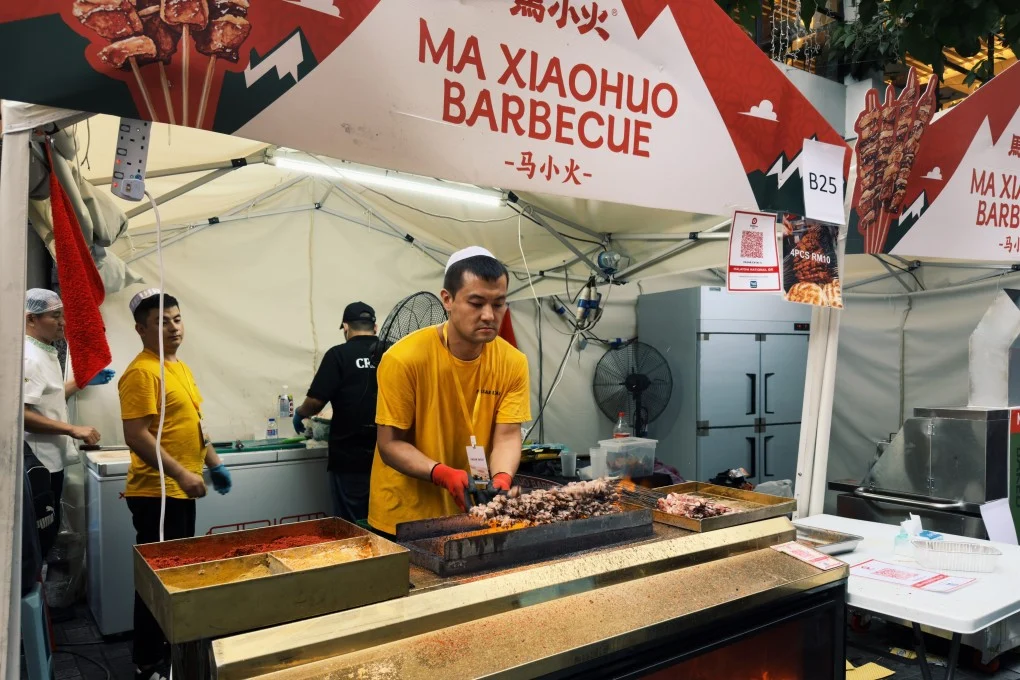
At the outdoor grounds of 1 Utama Shopping Mall, the aroma of cumin, chilli, and charcoal-grilled lamb fills the air as vendors prepare traditional dishes such as Lanzhou beef noodles, Xinjiang-style lamb skewers, and hand-pulled noodles. Now in its third year, the Chinese Muslim Food Festival has become a focal point for culinary exchange — and a business springboard.
The 11-day event, running until January 4, features around 60 vendors offering food, art, and handicrafts, most of them from China’s Muslim-majority regions. Organizers say the festival’s rising popularity reflects growing confidence among Chinese Muslim entrepreneurs in Malaysia’s halal ecosystem.
Trust as the Missing Link in Global Expansion
According to festival organizer Shoaib Ma, a Lanzhou-born restaurateur and food influencer, China’s halal industry has significant production capacity but faces credibility challenges abroad.
“China can produce at scale, but trust is the issue. Many people outside China are unaware that there are Muslim communities and halal-certified factories operating there,” he said.
China is home to an estimated 30 million Muslims, spread across regions such as Xinjiang, Ningxia, Gansu, and Qinghai, as well as major cities like Xi’an. Despite this, Chinese halal products often encounter skepticism in overseas Muslim markets due to limited familiarity with China’s halal certification systems.
Malaysia’s Halal Credentials as a Global Benchmark
In contrast, Malaysia is widely recognized as a gold standard in halal assurance. With Muslims comprising around 60 per cent of its 34 million population, the country’s halal certification framework — overseen by Jabatan Kemajuan Islam Malaysia (JAKIM) — enjoys broad international recognition.
Malaysia’s halal food and beverage exports are projected to reach US$12.9 billion in 2025, while the global halal food market is expected to be worth nearly US$2 trillion this year, according to industry estimates. The country has topped the halal food category in the Global Islamic Economy Index for 11 consecutive years.
From Festival Booths to Permanent Footprints
Several businesses that participated in earlier editions of the festival have since established restaurants, factories, or distribution operations in Malaysia. This reflects a broader strategy encouraged under Malaysia’s Halal Industry Master Plan 2030, which actively invites foreign producers to manufacture locally and export to Muslim markets in the Middle East, South Asia, and Europe.
“Our plan is to make Malaysia our international halal hub. We set up operations here, obtain JAKIM certification, and export from Malaysia to Muslim markets worldwide,” Ma explained.
Growing Interest from Beyond Southeast Asia
Among the exhibitors is Moustache Wang Catering, a family-run business from Xinjiang that operates dozens of restaurants and multiple factories in China. While the company does not yet have a Malaysian entity, its packaged halal products are attracting attention from overseas buyers.
“There has been interest from Australia, Eastern Europe, and Southeast Asia,” said Ismail, the company’s 29-year-old owner, pointing to a takeaway bowl of lamb soup noodles priced at 15 ringgit (US$3.20).
Expanding the Halal Marketplace
The festival highlights cuisines associated with the Hui Muslim community and Xinjiang, influenced by Central Asian culinary traditions. Visitors have arrived not only from Malaysia but also from Singapore and other countries, organizers noted.
William Ng, president of the Small and Medium Enterprises Association Malaysia, described the initiative as an expansion rather than competition.
“This broadens the halal market. There are very few Malaysian businesses offering Lanzhou noodles or Xinjiang-style halal products,” he said.
Trade Ties Strengthen the Halal Corridor
Food and agriculture have become among the fastest-growing segments in Malaysia–China trade, alongside Malaysia’s exports of halal-certified products, palm oil, and premium agricultural goods to China. Chinese firms, in turn, increasingly see Malaysia as a strategic base for reaching Muslim consumers globally.
Prime Minister Anwar Ibrahim has described China as Malaysia’s most important trading partner, citing long-term cooperation and shared economic interests.
Looking ahead, Ma said similar festivals are planned in Indonesia, Central Asia — starting with Uzbekistan — followed by the Middle East, Europe, and North America.
“Muslim populations are growing rapidly in many regions, but Malaysia is where we begin,” he said.
Source:
South China Morning Post. (2025). Muslim businesses in China target Malaysia as global halal gateway. https://amp.scmp.com/week-asia/economics/article/3338263/muslim-businesses-china-target-malaysia-global-halal-gateway