Australia’s Halal Red Meat Export Industry: A Model of Compliance and Integrity
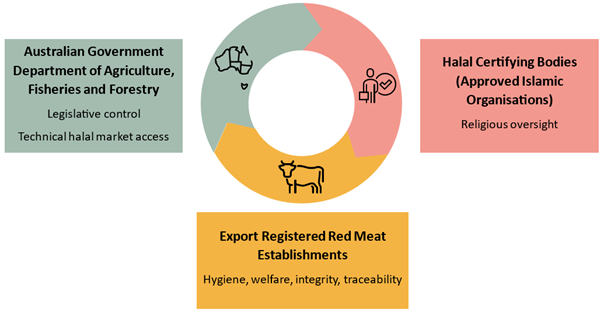
Source: Australian Goverment Departement of Foreign Affairs and Trade Website
Kawaguchiko, Japan – The term “halal,” derived from Arabic, signifies what is permissible or lawful under Islamic law. For meat and meat products to be classified as halal, they must be processed in strict adherence to these religious guidelines, which encompass not only the method of slaughter but also the treatment of the animals and the handling of the meat. Australia has emerged as a significant player in the global halal red meat market, exporting over 1 million tonnes of meat and offal annually to more than 160 countries, including 17 Muslim-majority nations. This article delves into the robust framework that underpins Australia’s halal red meat export industry, ensuring compliance, integrity, and traceability at every stage of production.
Australia’s Commitment to Halal Standards
Australia stands out as one of the few non-Muslim countries with comprehensive legislation governing the production and certification of halal red meat and meat products. This commitment is reflected in the Australian Government Authorised Halal Program (AGAHP), which serves as a cornerstone of the industry, ensuring that all halal products meet both domestic and international standards. The program is designed to instill confidence among consumers and importing countries regarding the halal status of Australian meat products.
The Australian Government Authorised Halal Program (AGAHP)
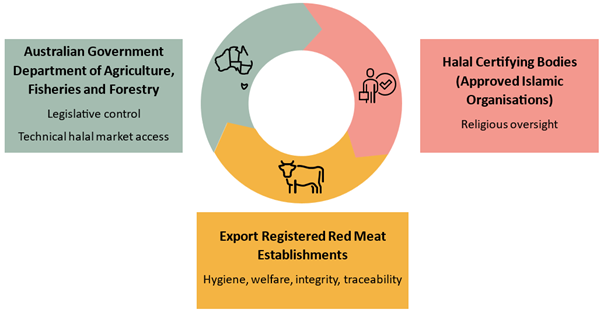
Established in 1997, AGAHP is a collaborative initiative involving three key stakeholders, each playing a vital role in the halal certification process:
- 1. The Australian Government: This body is responsible for legislative oversight and technical market access, ensuring that all halal meat exports comply with both Australian laws and the specific requirements of importing countries. The government’s involvement guarantees a high level of scrutiny and accountability in the halal certification process.
- Approved Islamic Organisations (AIOs): These organisations provide essential religious certification and oversight, ensuring that the production of halal meat aligns with Islamic principles. AIOs are tasked with training and supervising Muslim slaughtermen, conducting regular audits of export registered establishments, and co-signing halal certificates to confirm compliance with agreed halal procedures.
- Export Registered Red Meat Establishments: These facilities are the backbone of the halal meat supply chain, responsible for ensuring hygiene, integrity, traceability, and animal welfare throughout the production process. They must adhere to strict protocols that govern every aspect of meat processing, from slaughter to packaging.
Under AGAHP, all halal red meat products intended for export must comply with specific requirements, including adherence to the importing country’s regulations. Only products that meet these criteria are eligible for an official Australian halal certificate, which serves as a guarantee of their halal status.
Role of Approved Islamic Organisations (AIOs)
AIOs are integral to the halal certification process, acting as the bridge between religious compliance and regulatory standards. Their responsibilities include:
– Training and Supervising Muslim Slaughtermen: AIOs ensure that slaughtermen are well-versed in halal practices, which include invoking the name of Allah at the time of slaughter and ensuring the animal is treated humanely throughout its life.
– Conducting Audits and Monitoring Compliance: AIOs perform regular audits of export registered establishments to ensure ongoing adherence to halal standards. They are vigilant in identifying any non-compliance issues and are required to inform the Department of Agriculture, Fisheries, and Forestry of any discrepancies.
– Co-signing Halal Certificates: When AIOs are satisfied that products meet the agreed halal procedures, they endorse and co-sign halal certificates, which are crucial for international trade.
– Maintaining Comprehensive Records: AIOs are responsible for keeping detailed records of compliance and certification, which are essential for traceability and accountability.
To operate under AGAHP, AIOs must establish an Approved Arrangement with the Australian Government, detailing the importing countries they are certified to serve and the specific halal practices they oversee.
Export Registered Establishments: Ensuring Quality and Compliance
All establishments producing halal meat for export must hold a current Approved Arrangement with the Australian Government. This arrangement outlines critical conditions, including:
– Compliance with AGAHP Standards: Establishments must adhere to the rigorous standards set forth by AGAHP, which cover every aspect of halal production.
– Adherence to Importing Country Requirements: Each exporting establishment must be aware of and comply with the specific halal requirements of the countries they are exporting to, ensuring that their products meet international expectations.
– Identification of AIOs Certifying Products: Establishments must clearly identify the AIOs responsible for certifying their products, fostering transparency in the certification process.
These establishments are required to implement rigorous procedures for the identification, segregation, and integrity of halal products throughout all stages of production, storage, and transport. This includes maintaining separate processing lines for halal and non-halal products to prevent cross-contamination. Regular audits by the Department of Agriculture, Fisheries, and Forestry ensure ongoing compliance with these standards, reinforcing the integrity of the halal certification process.
Conclusion
Australia’s halal red meat export industry exemplifies a commitment to quality, compliance, and integrity. With a well-structured framework in place, the country not only meets the demands of its diverse international markets but also fosters trust among consumers seeking halal products. As the global demand for halal meat continues to grow, Australia’s adherence to stringent halal standards positions it as a leader in the industry, ensuring that its products are both lawful and ethically produced.
Original Articles:
Australian Goverment Departement of Foreign Affairs and Trade (n.d.). Exporting halal red meat and red meat products from Australia. Retrieved April 1, 2025, from https://www.agriculture.gov.au/biosecurity-trade/export/controlled-goods/meat/exporting-halal-red-meat-and-products